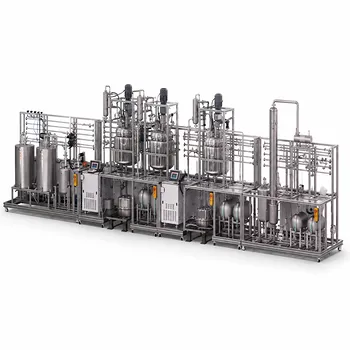
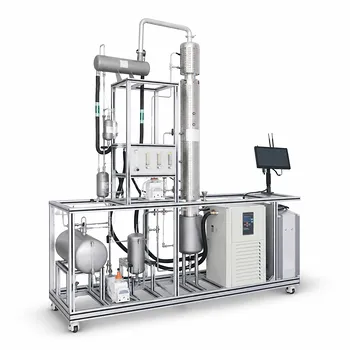
Source reduction isn’t just an environmental goal—it’s a design philosophy that chemical engineering unit operations pilot plants make tangible. In these scaled-down, safe environments, researchers can deliberately modify feedstock, adjust operating instructions, and reconfigure equipment to observe exactly how waste is generated—and how it can be prevented. By testing alternative raw materials, altering flow rates, temperatures, and pressures, or trialing new reactor designs, they gather the empirical evidence needed to eliminate waste before it ever leaves the process.
The true power of a pilot plant lies in its ability to isolate and manipulate individual unit operations, providing undeniable proof of how changes in chemistry, equipment configuration, or energy management can eliminate waste at the source. It turns waste minimization from an abstract target into a measurable, replicable engineering result.
1. Optimizing Process Chemistry and Conditions
Pilot plants let you test the chemical heart of a process without risking full-scale production. By varying reactants, catalysts, and operating windows, you can directly measure how waste footprints shrink.
Fine-Tuning Reaction Parameters
Temperature, pressure, and solvent choice are the most immediate levers. A pilot reaction calorimeter or continuous stirred-tank reactor can run reactions at room temperature and atmospheric pressure, avoiding the energy and material waste associated with heating and pressurization. Altering these parameters side by side reveals which combination minimizes byproduct formation.
Catalyst and Reagent Selection
Testing a new transition metal catalyst in a pilot-scale fixed-bed reactor shows whether it can lower activation energy enough to achieve high conversion under milder conditions. This directly cuts waste from unreacted feed and side reactions. Researchers can also trial reagent-light pathways—reducing the use of protective groups and intermediates (derivatives)—to shrink the number of synthetic steps and the waste they generate.
2. Redesigning Feedstock and Material Inputs
What you put into a process determines what must be removed later. Pilot plants make it practical to experiment with input quality and composition.
Purifying Feed Streams
Integrating a small feed purification unit—an adsorption column or filter—upstream of a catalyst bed reduces impurities that cause side reactions or solvent degradation. Lower impurity concentrations mean less hazardous byproduct formation and longer-lived catalysts, directly cutting solid waste from deactivated material.
Substituting Raw Materials
Pilot-scale blending and feeding systems allow you to introduce alternative feedstocks (bio-based, recycled, or lower-toxicity raw materials). By measuring yield and byproduct profiles under identical downstream conditions, you can identify substitutions that inherently generate less waste without sacrificing product quality.
3. Reconfiguring Equipment and Separation Sequences
Equipment layout and separation choices are often the biggest source of hidden waste. A unit operations pilot plant lets you physically rearrange modules and measure the outcome.
Reactor Design and Debottlenecking
Testing a different reactor type (e.g., microreactor vs. stirred tank) on the pilot scale shows how residence time distribution, mixing, and heat transfer affect byproduct generation. Gathering performance data under varied loads also supports debottlenecking studies that prevent wasteful overdesign and energy-intensive oversizing at full scale.
Integrating Separation for Solvent Recovery
Pilot-scale distillation columns or liquid-liquid extraction units can be placed directly in the process flow to recover and recycle solvents. Researchers quantify the energy-to-purity trade-off and determine how minimizing the diversity of solvents used simplifies the recovery loop—substantially reducing hazardous liquid waste.
Implementing Recycle Loops
By adding a reactant recycle stream with a small separation step (like a membrane or condenser), a pilot plant can demonstrate how unreacted materials are continuously returned to the reactor. Maximizing separation efficiency in this loop, while keeping energy use in check, shows exactly how much virgin feed and downstream waste can be avoided.
4. Enhancing Energy Efficiency as a Source Reduction Strategy
Waste isn’t just material—excess energy consumption is a form of unnecessary environmental burden. Pilot plants equipped with heat exchangers, evaporators, and distillation columns make energy waste measurable and avoidable.
Heat Integration and Pinch Analysis
By instrumenting pilot-scale heat exchangers and monitoring temperature profiles, researchers calculate thermal efficiency and implement heat integration. For example, waste heat from a distillation column reboiler can preheat a feed stream in another unit—a tangible pinch-analysis demonstration that reduces both fuel use and cooling water demand.
Optimizing Energy-Intensive Unit Operations
In an evaporation or distillation pilot rig, adjusting flow rate and reflux ratio directly reveals their impact on steam consumption. Students and engineers learn that tighter process control can maintain separation while slashing energy input—eliminating the “waste” of unnecessary kilojoules.
Understanding the Trade-offs and Limitations
Pilot-scale research is powerful, but it is not a perfect mirror of full-scale operations.
- Scale-up uncertainty: Fluid dynamics, mixing, and heat transfer do not scale linearly; a waste-minimizing condition found at pilot scale can fail when translated to a 10,000-litre reactor. Additional engineering steps are always required.
- Cost and time: Running a pilot plant for statistically significant source-reduction experiments demands staff hours, consumables, and maintenance—resources that may compete with other research priorities.
- Purity vs. energy: The push to recover more solvent or recycle more reactant often demands more distillation stages or higher reflux ratios, creating an energy-to-purity trade-off that must be optimized, not simply maximized.
- Single-objective focus: A change that reduces solid waste (e.g., a new catalyst) might increase liquid effluent or energy use. Pilot plants help uncover these hidden cross-impacts, but they require deliberately designed, holistic experiments.
Making the Right Choice for Your Goal
The way you use a unit operations pilot plant should mirror the specific waste problem you intend to solve.
- If your primary focus is reducing hazardous byproducts: Prioritize feed purification studies, catalyst screening, and alternative feedstock trials. Use the pilot plant to measure how each modification lowers the toxicity and volume of side-product streams.
- If your primary focus is cutting raw material costs and waste: Concentrate on reactant recycle loops, solvent recovery distillation/liquid-liquid extraction, and minimizing solvent diversity. Let the pilot plant quantify the fresh feed savings and the purity-recycling trade-off.
- If your primary focus is lowering energy consumption: Run heat integration experiments with instrumented heat exchangers and evaporators. Manipulate reflux ratios and flow rates to build empirical curves linking operating discipline to energy demand.
- If your primary focus is scaling up a new green process safely: Use the pilot plant as a physical simulation platform to test all proposed source-reduction changes together. Validate that the combined modifications (chemistry, equipment, and control strategy) perform coherently before committing to industrial scale.
With a thoughtfully operated pilot plant, source reduction moves from a theoretical principle to a concrete set of design decisions—decisions you can trust because you’ve already seen them work.
Summary Table:
| Source Reduction Strategy | Pilot Plant Action | Key Waste Minimization Benefit |
|---|---|---|
| Process Chemistry | Fine-tune parameters & test catalysts | Lowers activation energy & byproduct formation |
| Feedstock Redesign | Purify feed streams & substitute materials | Reduces hazardous byproducts & solid waste |
| Equipment Layout | Reconfigure reactors & integrate recycle loops | Minimizes raw material waste & solvent loss |
| Energy Efficiency | Implement heat integration & pinch analysis | Slashes steam, fuel, & cooling water demand |
Advance Your Green Engineering Research with LABPARK
Ready to optimize your processes and achieve measurable waste minimization? LABPARK designs and manufactures premium Educational and Vocational Unit Operations Pilot Plants tailored for chemical engineering, bioprocess & biotech, and environmental & water treatment.
Whether you are a university training the next generation of engineers, a research institute testing green chemistry, or an enterprise scaling up sustainable processes, our pilot plants provide the empirical data and reliability you need.
Contact LABPARK today to discuss your pilot plant requirements and accelerate your source reduction research!
Related Products
- Carbon Dioxide Hydrogen Methanol Synthesis Educational Unit Operations Pilot Plant
- Multi-Reactor Educational Pilot Plant for Reaction Engineering Unit Operations
- Ethyl Acetate Synthesis Unit Operations Pilot Plant for Practical Training
- Multi Pump Fluid Transport Process Piping Unit Operations Training Pilot Plant
- Multi-Modal Distillation Unit Operations Training Pilot Plant
People Also Ask
- How do temp & pressure affect methanol synthesis pilot plants? Optimize equilibrium and catalyst performance.
- Why is a purge system necessary when operating a gas recirculation loop in a methanol synthesis pilot plant? (Guide)
- Why do modern methanol pilot plants operate at lower pressures? Catalyst & Feed Requirements Explained
- What are the operational requirements for catalyst activation? Safe Methanol Pilot Plant Operation
- Why is the chemical plant startup schedule crucial? De-risk scale-up with pilot plants.