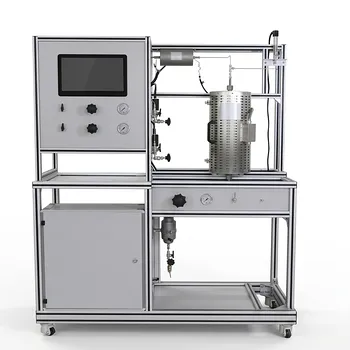
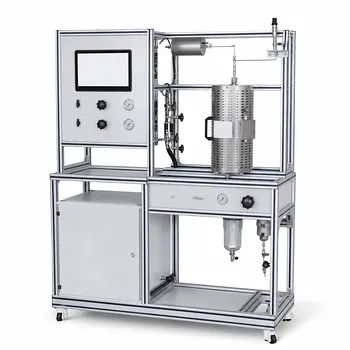
Pressure boosts equilibrium conversion, while temperature creates a critical trade-off. In a methanol synthesis pilot plant, you shift the thermodynamic balance by increasing pressure, which drives the exothermic, volume-reducing reaction toward more product. Temperature, meanwhile, increases the reaction rate but pushes equilibrium against you. And for the copper-based catalyst, staying inside the narrow 230°C to 270°C window is non‑negotiable—too cool and it falls asleep, too hot and it sinters permanently.
The core challenge in any methanol synthesis unit operations pilot plant is balancing the thermodynamic advantage of high pressure with the kinetic advantage of elevated temperature—all while protecting the active copper sites from irreversible thermal damage. Every process decision traces back to this tension.
The Two Levers of Control: Pressure and Temperature
Pilot‑scale methanol synthesis is a masterclass in reaction engineering because the same two control handles push performance in opposite directions. Understanding how they interact is what transforms a textbook concept into a safe, productive experiment.
The Effect of Pressure: A Straightforward Thermodynamic Push
The synthesis reaction (CO + 2 H₂ ⇌ CH₃OH) reduces the total number of gas molecules. According to Le Chatelier’s principle, the system opposes a pressure increase by shifting toward the side with fewer moles—the methanol product.
- Operating in the typical 5‑15 MPa range dramatically raises the equilibrium concentration of methanol at the reactor outlet.
- This pressure-driven shift is purely thermodynamic; it moves the achievable endpoint, not the path to get there.
- In a pilot plant, watching a small step change in back‑pressure regulator setting translate into a measurable jump in outlet methanol concentration is a vivid, real‑time verification of the principle.
The Effect of Temperature: A Kinetic Gain with a Thermodynamic Penalty
The van ’t Hoff equation governs the temperature‑dependence of the equilibrium constant (K_p). Because the methanol reaction is exothermic ((\Delta H_R < 0)), (K_p) decreases as temperature rises. Higher temperature therefore reduces the maximum possible conversion.
However, the Arrhenius equation tells a different story for the rate: the reaction rate constant (k) increases exponentially with temperature. More molecules have sufficient energy to overcome the activation barrier.
- At low temperatures, kinetics are sluggish even though equilibrium is favorable—you wait forever for a tiny amount of product.
- At higher temperatures, kinetics accelerate but equilibrium conversion falls, so you quickly reach a lower “ceiling.”
The pilot plant operator is constantly navigating this rate‑versus‑yield trade‑off.
The Catalyst: A Fragile Engine Inside the Reactor
A copper‑based catalyst (typically Cu/ZnO/Al₂O₃) sits at the heart of the loop. Its performance is inseparable from the temperature profile in the bed.
The Optimal Kinetic Window
The catalyst will only deliver meaningful activity inside a well‑defined thermal envelope.
- Below approximately 230°C, the active metallic copper sites lack sufficient energy to turn over reactants efficiently. Activity is so low that the reactor behaves almost like an empty bed.
- Above 270°C, small copper crystallites begin to sinter—they agglomerate, shrinking the total active surface area. This damage is largely irreversible and permanently degrades catalyst performance.
This is not a soft recommendation; it is a hard boundary for any run aiming to generate replicable data.
The Activation Pre‑Step (Reduction)
Fresh catalyst is loaded in its oxidic form (CuO) and must be carefully reduced to active Cu⁰ before synthesis begins.
- A dilute hydrogen‑in‑nitrogen mixture is passed over the bed while the temperature is slowly ramped.
- The reduction is highly exothermic. Without strict control of the hydrogen concentration and gas flow, a thermal runaway (“flying temperature”) can occur.
- Even a brief temperature spike above the safe limit can sinter the crystallites before the plant ever produces a drop of methanol. This demonstration is often one of the most important safety and procedure lessons in a unit operations pilot plant.
Understanding the Trade-offs and Operational Envelope
The pilot plant is where these competing effects stop being abstract and start generating a real‑time response. The operating map is defined by three intersecting constraints.
1. Equilibrium‑Limited vs. Rate‑Limited Regime
At low temperatures, you are rate‑limited. The equilibrium conversion is high, but the catalyst simply cannot get there in a reasonable residence time. At high temperatures, you become equilibrium‑limited: the reaction races forward but quickly hits a low ceiling. The sweet spot is where the reaction is fast enough to observe in a standard lab period but still achieves a conversion that yields analyzable results.
2. Avoiding Catalyst Deactivation
Temperature excursions above 270°C are not just an equilibrium problem—they are a catalyst life safety problem. A well‑designed pilot‑plant protocol installs multiple temperature probes along the bed depth to catch the sharp hot‑spot that forms at the reactor inlet, where the rate is highest and the exotherm is most aggressive.
3. The Role of Space Velocity
While not the primary question, adjusting gas hourly space velocity is the third tuning knob that depends on temperature and pressure. Higher space velocity reduces per‑pass conversion but increases productivity per unit catalyst mass. Trainees learn to integrate all three variables by documenting how the shape of the thermal profile changes when space velocity is doubled at constant pressure.
Making the Right Choice for Your Goal
How you adjust temperature and pressure depends entirely on what you need the pilot plant to demonstrate. Concrete recommendations follow.
- If your primary focus is maximum single‑pass conversion: Run at the highest pressure your system is mechanically rated for (often 8–10 MPa) and control the reactor inlet temperature near 230°C. Accept a slower reaction rate and longer stabilization time.
- If your primary focus is catalyst longevity and data reproducibility: Maintain the catalyst bed peak temperature strictly below 270°C, even if that means sacrificing some equilibrium conversion. Use a steep temperature gradient at the inlet rather than a high uniform bed temperature.
- If your primary focus is exploring kinetic vs. thermodynamic control: Design a sequence of runs where you hold pressure constant and step through temperatures from 210°C to 270°C, then hold temperature constant and step through 5, 8, and 12 MPa. The crossover point where rate gain levels off and equilibrium loss accelerates will become visually obvious.
- If your primary focus is pilot plant safety training: Emphasize the H₂ reduction protocol. Show how a 5°C overshoot during activation can permanently halve catalyst activity before synthesis even starts—cementing the lesson that pilot plant operation is as much about protecting the catalyst as it is about running the reaction.
Mastering these two parameters transforms the methanol synthesis pilot plant from a simple demonstration rig into a genuine process engineering laboratory, where every choice is a deliberate balance between speed, yield, and long‑term catalyst health.
Summary Table:
| Parameter | Thermodynamic Effect | Kinetic / Physical Effect | Operational Target |
|---|---|---|---|
| Pressure | Shifts equilibrium to methanol (increases yield) | Increases collision frequency & rate | 5–15 MPa (system limit) |
| Temperature | Reduces equilibrium yield (exothermic) | Accelerates rate (Arrhenius) | 230°C–270°C (prevent sintering) |
Bring Hands-on Process Engineering to Life with LABPARK
Are you looking to teach complex thermodynamic and kinetic concepts, like methanol synthesis, with real-world equipment?
LABPARK provides state-of-the-art Educational and Vocational Unit Operations Pilot Plants in chemical engineering, bioprocess & biotech, and environmental & water treatment. Designed specifically for universities, research institutes, and enterprises, our systems offer students and researchers safe, high-fidelity environments to master real-world reactor control, catalyst activation, and system optimization.
Contact LABPARK experts today to find the ideal pilot plant solution for your lab!
Related Products
- Carbon Dioxide Hydrogen Methanol Synthesis Educational Unit Operations Pilot Plant
- Methanol Synthesis and Catalyst Performance Evaluation Educational Unit Operations Pilot Plant
- Carbon Dioxide Hydrogenation Methanol Synthesis Educational Unit Operations Pilot Plant
- Methane Cracking Educational Unit Operations Pilot Plant
- Ethyl Acetate Synthesis Unit Operations Pilot Plant for Practical Training
People Also Ask
- Why is a purge system necessary when operating a gas recirculation loop in a methanol synthesis pilot plant? (Guide)
- Why do modern methanol pilot plants operate at lower pressures? Catalyst & Feed Requirements Explained
- What are the operational requirements for catalyst activation? Safe Methanol Pilot Plant Operation
- Why is the chemical plant startup schedule crucial? De-risk scale-up with pilot plants.
- When to transition from PID to adaptive control in pilot plants? Key process indicators.