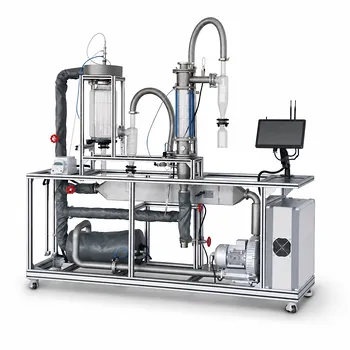
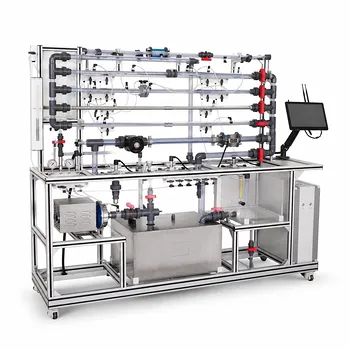
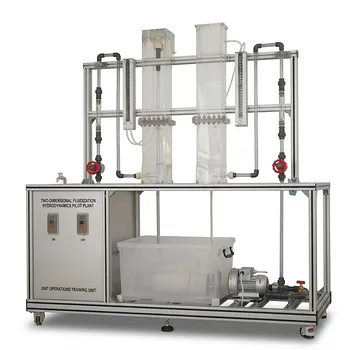
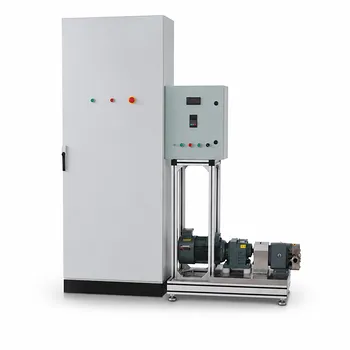
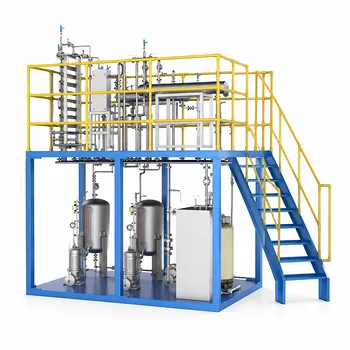
The first time a student turns a valve on a pilot-scale extraction unit, theory becomes tangible. Educational unit operations pilot plants transform abstract critical process parameters (CPPs) like temperature, agitation speed, and membrane pore size into observable, measurable outcomes. By physically manipulating these variables during extraction and filtration, students directly witness how yield, purity, and throughput shift—turning the conceptual frameworks of Quality by Design (QbD) and risk assessment into an intuitive, hands-on understanding that no simulation alone can provide.
The true power lies not just in seeing a final result, but in learning to map how specific changes in a process parameter ripple through a unit operation to impact product quality. Pilot plants make this cause-and-effect relationship visible and teach students to design experiments that establish the robust operating region where a process can reliably produce safe, high-quality output.
From Abstract Variables to Tangible Control
Chemical engineering textbooks describe extraction as a mass-transfer equilibrium and filtration as a pressure-driven separation. But a student who has never felt the vibration of an agitator or seen a filter cake crack under vacuum won't truly grasp how sensitive these steps are to small operational shifts. Educational pilot plants bridge this gap.
Turning a Parameter List into a Physical Investigation
When a student first encounters a process, they see a long list of potential influences: temperature, agitation speed, vessel orientation, filter media, flow rate, pressure, time. A pilot plant lets them categorize these variables physically using methodologies like Cause-and-Effect (C&E) risk assessment.
They learn to distinguish controllable parameters (C) from noise factors (N) and experimental variables (X). Through guided exercises, they might hold extraction temperature constant while systematically varying agitation speed, measuring how quickly the target compound diffuses into the solvent. This tangible classification of variables is foundational for industrial process design.
Building a Direct Connection to Quality Attributes
Every chemical process aims to deliver a product with specific Critical Quality Attributes (CQAs)—the measurable properties that define success. In a pilot plant, students can directly connect CPPs to CQAs.
For extraction, a change in temperature doesn't just alter a number on a screen; it changes the color, viscosity, and subsequent purity of the collected solution. In filtration, swapping a membrane type can be felt in the pressure drop and seen in the filtrate clarity. This immediacy embeds QbD principles far more deeply than any case study. Students learn to ask: "If I adjust this parameter, which quality attribute will shift, and by how much?"
Deep Dive: Making Extraction and Filtration Steps Transparent
Extraction and filtration are not black boxes when performed on a pilot scale. Each step becomes a series of observable, adjustable events, and the impact of your choices becomes visible.
Unpacking the Extraction Process
During extraction, the goal is to pull a target compound from a mixture. Pilot plants let students isolate the key knobs.
- Temperature control: A student can set a jacketed vessel to precisely 45°C and compare the extraction yield to a room-temperature run. They see how a higher temperature reduces solvent viscosity, improves mass transfer, and can also degrade a heat-labile product—a trade-off no equation fully captures.
- Agitation speed: By adjusting the impeller RPM, they observe how poor mixing leads to a stagnant layer and low yield, while excessive speed might entrain gas or cause stable emulsions that complicate downstream separation.
- Vessel orientation and fill volume: Students can physically see how a tilted vessel or incorrect fill level creates a dead zone where solvent isn’t contacting the solid, dramatically reducing efficiency. This spatial intuition is critical for scale-up.
Visualizing Filtration as a Dynamic Process
Filtration is often taught as a steady-state model, but reality is dynamic. A pilot-scale Nutsche filter or membrane rig reveals the real-world constraints.
- Membrane and media selection: A student can start with a coarse membrane and witness turbid filtrate, then switch to a finer one and see the pressure immediately spike as the cake compresses. They learn that the "right" membrane is always a compromise between clarity and throughput.
- Pressure and flow control: By adjusting a pump or a valve, they feel the system react. They learn to identify the point where a cake becomes incompressible or where a sudden pressure excursion signals blinding—forces that define the true design space.
- Cake formation and washing: A pilot plant shows that a filter cake is a living entity. Students can experiment with wash solvent volume and observe how channelling or uneven distribution leaves residual impurities trapped, directly linking operating parameters to final purity.
Building a Quality-by-Design Mindset Through Experimentation
The core value of a pilot plant isn’t just demonstration; it’s an experimental platform where students learn the methodology of industrial process development.
From Sensitivity Analysis to a Design Space
Students begin by mapping method factors to specific unit operations and performing a sensitivity analysis. They might vary extraction temperature across a range and plot yield, purity, and impurity profiles.
This teaches them that a "safe" operating point isn't a single magic number but a multidimensional design space. They learn to identify the region where product quality remains acceptable despite normal variations in temperature, pressure, or raw material quality. This is the essence of QbD, and it only becomes instinctive through hands-on iteration.
Designing Experiments with Purpose
A pilot plant is the perfect sandbox for learning Design of Experiments (DoE). Instead of changing one variable at a time in a tedious, often misleading way, students can plan factorial experiments to uncover interaction effects.
For example, they might discover that a higher extraction temperature is only beneficial when combined with a specific agitation speed. This teaches that process robustness isn't about finding the highest yield point on a univariate chart, but about understanding the process signature—the multivariate trajectory that consistently delivers quality, even during scale-up or site transfer.
Integrating Instrumentation and Process Signatures
Modern pilot plants are equipped with sensors and data historians. Students learn to gather historical data on mass and energy balances, pressure profiles, and flow rates, then use latent variable models to diagnose deviations.
When they move from a lab-scale extraction to a pilot-scale unit, they can no longer rely on simple endpoint testing. They must track the process path. A pilot plant lets them collect the dense time-series data needed to build multivariate statistical models, teaching a critical skill for industrial process monitoring.
Understanding the Trade-offs and Limitations
Pilot plants are an invaluable teaching tool, but they are not a perfect replica of industrial reality. An objective understanding of their limits is essential for a well-rounded education.
The Fidelity Gap
A pilot-scale system introduces its own dynamics that differ from full-scale production. Fluid dynamics, wall effects, heat loss patterns, and residence time distributions can diverge significantly. A student may find that an extraction works perfectly on a 5-liter scale but fails on a 500-liter scale because the mixing regime changes. Pilot plants teach the need to identify such gaps, but they cannot eliminate them.
Managing the Resource Trade-off
Running physical experiments consumes time, raw materials, and energy. A thorough DoE matrix on a pilot plant can take weeks and generate waste. Students must learn to balance the depth of physical exploration with the speed of simulation. This constraint is itself a lesson in industrial resource management, but it can limit the breadth of what can be explored within a semester.
The Danger of Over-Controlled Environments
Many teaching pilot plants have a level of sensor density and pristine cleanliness that real production environments lack. This can create a false sense of security, where students underestimate the impact of noise factors like ambient temperature swings, operator variability, or raw material lot-to-lot variation. The instructor must explicitly introduce these unplanned disruptions to turn a pilot plant exercise into a genuine risk-assessment lesson.
Making the Right Choice for Your Learning Objective
The way you use a pilot plant depends entirely on the specific skill you want to build. Align your experimental design with your goal.
- If your primary focus is embedding Quality by Design principles: Design a structured exercise where students categorize variables (C/N/X), perform a risk assessment, and then execute a small DoE to map a design space for a defined CQA.
- If your primary focus is building troubleshooting intuition: Introduce deliberate process disturbances—a clogged filter, a mis-tuned PID loop, an ambient temperature shift—and ask students to diagnose the root cause by tracing the process path from sensor data.
- If your primary focus is understanding scale-up fundamentals: Have students compare performance data from a bench-scale beaker extraction and a pilot-scale unit, then compute the empirical mass and heat transfer coefficients that explain the differences.
- If your primary focus is mastering equipment interaction and P&IDs: Pair the physical pilot plant with its P&ID and have students manually control loops, trace piping, and observe how a valve stroke changes pressure drop and flow, before relying on automation.
By treating the pilot plant as a vehicle for inquiry, not a static demonstration, you turn extraction and filtration from abstract unit operations into a physical language of cause, effect, and control.
Summary Table:
| Unit Operation | Key Process Parameters (CPPs) | Impact on Quality / Yield (CQAs) |
|---|---|---|
| Extraction | Temperature, Agitation Speed, Fill Volume | Yield, product purity, viscosity, mass transfer rate |
| Filtration | Membrane/Media type, Pressure, Flow control | Filtrate clarity, cake resistance, washing efficiency |
Empower the Next Generation of Chemical Engineers
Bridge the gap between textbook theory and industrial reality. LABPARK designs and delivers state-of-the-art Educational and Vocational Unit Operations Pilot Plants tailored for universities, research institutes, and enterprises.
Our advanced systems cover:
- Chemical Engineering (Extraction, Filtration, Distillation, etc.)
- Bioprocess & Biotechnology
- Environmental & Water Treatment
Equip your students and researchers with the hands-on tools they need to master critical process parameters and Quality by Design (QbD) principles.
Contact LABPARK Today to Customize Your Pilot Plant Solution
Related Products
- Multi-Reactor Educational Pilot Plant for Reaction Engineering Unit Operations
- Polymerization Granulation and Pellet Processing Educational Unit Operations Pilot Plant
- Multi-Functional Drying Educational Unit Operations Pilot Plant
- Comprehensive Fluid Mechanics Educational Unit Operations Pilot Plant
- Electrolytic Hydrogen Production Educational Unit Operations Pilot Plant
People Also Ask
- How do educational unit operations pilot plants address safety and waste management when scaling up?
- How do educational unit operations pilot plants bridge theory and design? Bridge the Engineering Gap
- Why Compare Predicted and Experimental Excess Enthalpy? Key to Accurate Pilot Plant Scale-up
- Why Use PTFE & Hastelloy in Chemical Pilot Plants? Prevent Corrosion & Ensure Safety
- How to study gasification in pilot plants? Compare exit gas composition & efficiency