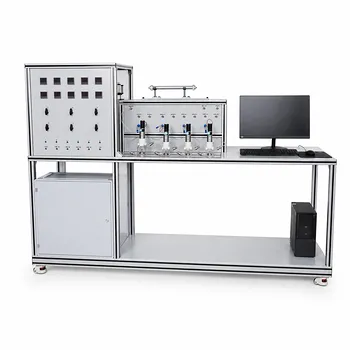
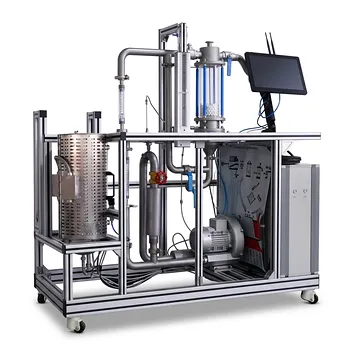
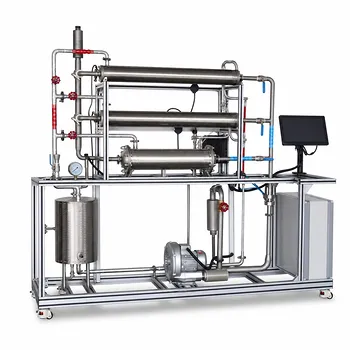
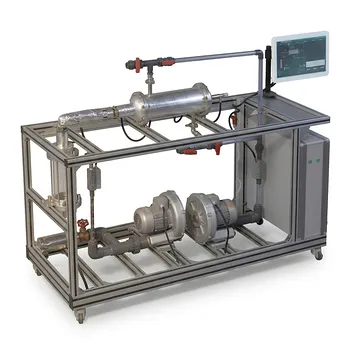
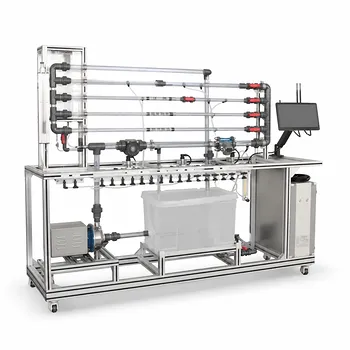
The determination of gas diffusion coefficients in chemical engineering laboratory training is accomplished through a select set of classic, robust experiments. Students primarily study the Stefan tube method, the Taylor dispersion method, and chromatographic techniques (Gas Chromatography) to measure how fast a gas molecule moves through another gas. These hands-on methods turn abstract Fick's law into tangible data, forming the experimental backbone of mass transfer education.
Mastering these three methods teaches you to directly link molecular-level transport to the performance of real-world unit operations like absorption, distillation, and gas-solid reactions. The true skill lies not just in running the experiment, but in choosing the right technique for the system and critically evaluating the physical assumptions behind each measurement.
Why Measuring Diffusion Coefficients is Foundational
In unit operations, the rate at which gases mix, separate, or react is governed by mass transfer, which is inseparable from the molecular diffusion coefficient. Before students design a single absorption tower or catalyst pellet, they must first quantify the intrinsic mobility of the molecules.
Connecting Micro to Macro
A diffusion coefficient (units of m²/s or cm²/s) is the molecular property that drives mass transfer. In the lab, students learn that empirical correlations can estimate this number, but direct measurement removes uncertainty. By measuring a coefficient themselves, they see how temperature, pressure, and composition truly affect mass transport, a lesson no textbook can fully deliver.
The Educational Payoff
These experiments are not just academic exercises. They force a student to reconcile ideal Fick's law with real sensing and measurement errors. When a student later calculates an overall mass transfer coefficient from pilot-plant data, they instantly recognize the role of the diffusivity they once measured in a simple glass tube.
The Three Core Experimental Methods in Laboratory Training
Chemical engineering unit operations labs overwhelmingly focus on three primary methods. Each reveals the same fundamental parameter via a different transport geometry, teaching students to validate results across independent techniques.
Stefan Tube Method: Observing a Stagnant Diffusion Front
This is the most intuitive and widely used educational method. A long, narrow tube is filled with a stagnant gas B, and one end is sealed with a liquid reservoir of volatile liquid A. The liquid evaporates, and vapor A diffuses upward through the stagnant column of B. Students measure the movement of the liquid meniscus or the gas-liquid interface over time. Because only component A is moving (component B is stagnant), Fick’s law simplifies to a steady-state unidirectional diffusion equation, allowing a direct calculation of the gas-phase diffusivity.
The beauty of the Stefan tube is that it visually demonstrates a diffusion-convection hybrid: as vapor A moves upward, the bulk gas must "push" downward to maintain constant pressure, a nuance that solidifies understanding of molar flux equations. Students typically run the experiment at constant temperature and pressure, comparing their result to the Chapman-Enskog prediction.
Taylor Dispersion Method: Analyzing Dispersion in a Laminar Flow
Here, a sharp pulse of solute (or tracer gas) is injected into a carrier gas flowing in a long, straight tube under laminar flow. As the solute band travels, it spreads due to the combined action of radial diffusion and the parabolic velocity profile. By measuring the concentration-time profile at a detector downstream, students can extract the molecular diffusion coefficient from the variance of the peak.
This method is valued for its speed and the fact that it directly mimics the axial dispersion phenomenon in tubular reactors. Students see how flow rate and tube diameter affect the measured dispersion, and they learn to deconvolve the apparatus’s contribution to band spreading from the true molecular diffusion. It also reinforces the powerful idea that a macro-scale signal (peak width) can yield a micro-scale transport property.
Chromatographic Techniques: Migration Rate in a Packed Column
In this method, a Gas Chromatograph (GC) is used not just for analysis, but as a diffusion cell itself. A small sample of the test gas is injected into an inert carrier gas flowing through a packed column. The broadening of the eluting peak and its retention time contain information about the gas-phase diffusion coefficient through the column packing. Students apply the van Deemter equation or related plate theory, relating the measured height equivalent to a theoretical plate (HETP) back to the molecular diffusivity.
This technique uniquely demonstrates how diffusion operates inside porous media. While more mathematically involved, it directly prepares students for the concepts of effective diffusivity and tortuosity in catalyst pellets. It also teaches the critical skill of decoupling instrument effects from the sample’s true diffusivity, a recurring theme in all analytical chemistry.
Bridging the Lab to the Plant: From Molecular to Macro
Once a student has measured a gas diffusion coefficient, the next step is scaling it up. The same coefficient measured in a Stefan tube becomes the $D_{AB}$ term inside the Sherwood number correlations used to size absorption towers. In lab courses, this is often demonstrated with pilot-scale absorption or distillation columns where students calculate mass transfer coefficients and see how their measured diffusivity influences the overall separation performance.
Implications for Porous Catalysts and Gas-Solid Reactions
Beyond bulk fluid systems, the measured molecular diffusivity is the starting point for understanding effective diffusivity in porous solids. When pore sizes become comparable to the molecular mean free path, Knudsen diffusion begins to dominate. In advanced labs, students may combine their gas-phase measurement with pore-structure data to predict the effective diffusivity using resistances in series ( $1/D_e = 1/D_{Ae} + 1/D_{Ake}$ ). This directly informs whether a catalytic reaction is diffusion-limited or reaction-limited, a cornerstone of reactor design.
Understanding the Trade-offs and Common Pitfalls
No single method is universally superior; each has assumptions that students must respect to avoid misleading results. Recognizing these limitations is as important as performing the measurement itself.
Stefan Tube: Simplicity vs. Sensitivity
The Stefan tube requires meticulous control of temperature stability and elimination of external vibrations. Any draft or thermal gradient in the room can distort the diffusion front. Students often find that evaporative cooling at the liquid surface creates a temperature gradient that slightly suppresses the true diffusion rate unless corrected. It is also inherently slow, with a single measurement taking hours.
Taylor Dispersion: Laminar Flow at All Costs
The method’s mathematical model collapses if the flow is even slightly turbulent or if the injection volume is too large. Students must verify the Reynolds number and ensure a truly inert, well-distributed initial pulse. Secondary flows in coiled tubes, a common practical design to save bench space, introduce deviations that must be accounted for with an empirical correction factor.
Chromatographic Methods: Deconvolution of Peaks
The challenge here is separating the diffusion-related band broadening from all other sources—extra-column tubing, injection width, and detector time constant. Students learn that the HETP is a composite function, and extracting $D$ requires measuring the plate height at multiple carrier gas velocities to isolate the C-term in the van Deemter equation. It’s an excellent exercise in error analysis, but it easily frustrates those expecting a simple one-shot measurement.
Making the Right Choice for Your Learning Goal
The method you choose in an educational setting should align with the physical insight you want to cement. Consider these guidance points.
- If your primary focus is grasping stagnant medium diffusion and unidirectional flux: The Stefan tube method is unmatched. It translates directly to the Stewart-Maxwell equations and mass transfer with a stationary component, such as evaporation from a flat plate.
- If your primary focus is process dynamics and rapid measurement in flowing systems: The Taylor dispersion method excels. It will teach you about axial dispersion in real reactors and let you generate a full temperature-dependent dataset in a single lab session.
- If your primary focus is porous media, chromatography, and detector-based analysis: The chromatographic technique is essential. It builds the conceptual bridge to effective diffusivity and is the most flexible method for multi-component mixtures, provided you invest the time in mastering peak deconvolution.
A complete chemical engineering education does not favor one; it exposes you to all three. The data from a Stefan tube validates your Taylor dispersion setup, and the chromatographic runs prepare you for the complexity of real catalyst supports—together, they build an unshakable confidence in your ability to predict mass transfer rates from first principles.
Summary Table:
| Method | Physical Principle | Key Advantage | Main Limitation |
|---|---|---|---|
| Stefan Tube | Evaporation & stagnant gas diffusion | Simple setup, direct Fick's law visualization | Slow measurement, sensitive to temperature drafts |
| Taylor Dispersion | Laminar flow dispersion in a tube | Fast measurement, reflects reactor dispersion | Requires strict laminar flow & precise injection |
| Chromatography | Packed column peak broadening (van Deemter) | Models porous media diffusion | Complex mathematical peak deconvolution |
Bring Advanced Mass Transfer Concepts to Life in Your Lab
Looking to equip your students and researchers with state-of-the-art hands-on training tools? LABPARK provides premium Educational and Vocational Unit Operations Pilot Plants in chemical engineering, bioprocess & biotech, and environmental & water treatment. Designed specifically for universities, research institutes, and enterprises, our systems make complex transport phenomena like gas diffusion tangible and measurable.
Ready to upgrade your laboratory capabilities? Contact us today to request a catalog or discuss your lab requirements with our team!
Related Products
- Educational Unit Operations Pilot Plant for Intraparticle Diffusion Effective Factor Measurement
- Dual-Drive Stirred Gas-Liquid Mass Transfer Coefficient Determination Pilot Plant
- Absorption and Desorption Educational Unit Operations Pilot Plant
- Carbon Dioxide PVT Curve Determination Educational Unit Operations Pilot Plant
- Liquid-Liquid Mass Transfer Coefficient Determination Educational Pilot Plant
People Also Ask
- How do educational unit operations pilot plants bridge theory and design? Bridge the Engineering Gap
- How do educational unit operations pilot plants address safety and waste management when scaling up?
- Why is the chemical plant startup schedule crucial? De-risk scale-up with pilot plants.
- Why Compare Predicted and Experimental Excess Enthalpy? Key to Accurate Pilot Plant Scale-up
- Why Use PTFE & Hastelloy in Chemical Pilot Plants? Prevent Corrosion & Ensure Safety