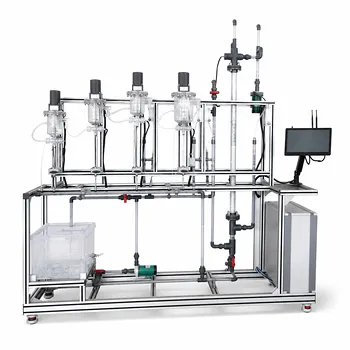
The heart of process optimization lies in a single, often underestimated variable: time. In a gas-phase catalytic reactor like those used for ethylene oxychlorination, precise residence time control is the non-negotiable key to unlocking maximum yield. It directly dictates the delicate balance between driving reactant conversion to near-completion and preventing the target product from degrading into unwanted side products.
Mastering residence time is the linchpin of reactor optimization. For ethylene oxychlorination, an optimal ~10-second contact time pushes HCl conversion toward 100% while preserving the valuable 1,2-dichloroethane (EDC) product. Stray too far—either shorter or longer—and either conversion or selectivity collapses, wasting feedstock and complicating downstream purification.
The Delicate Dance of Residence Time in Catalytic Reactors
The surface-level answer is that residence time directly governs conversion and selectivity. But the deeper, educational insight lies in how it maps the entire kinetic landscape of a reaction network.
The Imperative of Precision: Beyond Just “Enough Time”
Residence time is not simply about providing sufficient duration for reactants to collide with the catalyst. In a reaction like ethylene oxychlorination, where HCl must be fully consumed, too short a contact time leaves unconverted hydrogen chloride in the effluent.
This represents a direct loss of raw material and creates a downstream corrosion and separation burden. Precise control down to fractions of a second allows researchers to experimentally locate the exact flow rate and bed height combination that pushes HCl conversion to near its thermodynamic limit—around 100% at the ~10-second mark identified in pilot studies.
The Peril of Overexposure: When More Time Means Less Product
The far subtler, and often more expensive, problem is excessive residence time. The target product, 1,2-dichloroethane (EDC), is not thermodynamically inert. If it lingers in the hot zone of the reactor, it undergoes thermal cracking, reverting to vinyl chloride monomer (VCM) and HCl.
This transforms a high-selectivity process into a series-reaction nightmare. The desired intermediate (EDC) is consumed, and the cascade of side reactions dilutes the product stream. Without precise flow control—via metering pumps and variable catalyst bed heights—operators cannot define the narrow window where EDC yield peaks before cracking takes over.
The Deep Need: Using Residence Time to Map Kinetic Landscapes
The real power of residence time control in a research or educational pilot plant is its role as a investigative probe. It moves the reactor from a “black box” to a transparent kinetic instrument.
Uncovering the Optimal Window for Maximum Intermediate Yield
The ethylene oxychlorination reaction perfectly illustrates the principle of series reactions ($A \rightarrow R \rightarrow S$). The intermediate $R$ (EDC) reaches a maximum concentration at a specific optimal time ($t_{opt}$).
Without precise residence time tuning, that peak remains hidden. By integrating precision dosing pumps that vary feed flow rate and providing multi-point sampling along the reactor length, a pilot plant allows students and researchers to plot the full concentration-versus-time curves for HCl, EDC, and VCM. They can visually pinpoint the exact spatial or temporal coordinate where the EDC yield is maximized—vindicating their kinetic models with real data.
From Lab to Lesson: Teaching the Fundamentals of Reactor Design
Educational pilot plants thrive on these tangible demonstrations. Adjusting the Weight Hourly Space Velocity (WHSV) while monitoring output composition lets students internalize the inverse relationship between flow rate and conversion.
This transforms an abstract differential equation into a live, calibrated experiment. They learn that a “bigger” reactor—or a slower feed—does not automatically mean a better process. It teaches the core engineering discipline of balancing capital cost against chemical efficiency, all anchored in the concept of a finite, optimal residence time.
Understanding the Trade-offs and Practical Pitfalls
Precise residence time control is incredibly powerful, but its application comes with hidden traps that researchers must actively manage.
The Temperature Coupling Trap
Residence time adjustments never occur in a thermal vacuum. In a strong exotherm or endotherm, changing the flow rate alters the heat transfer dynamics and can shift the bed temperature. Because both kinetics and equilibrium constants are exponentially sensitive to temperature, a poorly controlled experiment can conflate residence time effects with thermal drift. The 10-second optimum for ethylene oxychlorination is valid only at a tightly controlled temperature; lose that control, and the “optimal” residence time appears to shift for the wrong reasons.
The Illusion of “Steady State”
In pilot-scale tubular reactors, altering the feed flow to change residence time also changes the fluid residence time distribution (RTD). A slower flow might edge the reactor closer to laminar flow or introduce dead zones, meaning that not all fluid elements experience the same reaction time. Without careful verification of plug-flow behavior, researchers can misinterpret back-mixing or channeling as a change in intrinsic kinetics, leading to a flawed scale-up.
Making Precise Residence Time Control Actionable
Translating these principles into a repeatable experimental strategy is what separates a good pilot plant from a great research platform.
- If your primary focus is maximizing raw material conversion: Target the flow rate and bed height that deliver the ~10-second residence time known to push HCl conversion toward 100%, then trim incrementally to confirm you are not overshooting into product degradation.
- If your goal is to teach students core reaction engineering concepts: Use variable flow metering pumps and axial sampling ports to let them generate the complete series-reaction profile, visually identifying the peak intermediate concentration and linking it directly to the design equation for a PFR.
- If you are scaling up a catalytic process from bench to pilot: Maintain constant WHSV as your scaling parameter, but systematically interrogate the upper and lower residence time limits to define a safe, flexible operating window that tolerates industrial flow fluctuations without sacrificing selectivity.
Ultimately, precise residence time control transforms a pilot plant from a simple demonstration rig into a powerful discovery tool, enabling you to pinpoint the exact operating conditions that marry profitability with chemical efficiency.
Summary Table:
| Residence Time | HCl Conversion | Product Selectivity (EDC) | Process Consequences |
|---|---|---|---|
| Too Short | Low (< 100%) | High potential, but incomplete | Downstream corrosion, raw material waste |
| Optimal (~10s) | Near 100% | Maximum EDC yield | Peak chemical efficiency, optimized process |
| Too Long | Near 100% | Low (EDC cracks to VCM & HCl) | Product degradation, complex purification |
Optimize Your Chemical Engineering Research & Training with LABPARK
Are you looking to bridge the gap between theoretical reaction kinetics and hands-on discovery? LABPARK provides state-of-the-art Educational and Vocational Unit Operations Pilot Plants in chemical engineering, bioprocess & biotech, and environmental & water treatment.
We empower universities, research institutes, and enterprises to achieve precise process control, map kinetic landscapes, and scale up catalytic reactions safely and efficiently.
Ready to elevate your laboratory capabilities? Contact our experts today to find the perfect pilot plant solution for your institution.
Related Products
- Micro-Scale Gas-Solid Catalytic Reaction Educational Pilot Plant
- Fixed Bed Gas Solid Catalytic Reaction Educational Pilot Plant
- Fluidized Bed Gas Solid Catalytic Reaction Educational Pilot Plant
- Gas Phase Mixing and Residence Time Distribution Determination Educational Unit Operations Pilot Plant
- Fixed-Bed Chemical Reaction and Gas Dust Tar Removal Unit Operations Pilot Plant
People Also Ask
- Why is a multibed configuration necessary for exothermic reactions? Optimize your pilot plant trajectory.
- Fluidized vs. Fixed Bed Reactors: Comparing Heat & Complexity in Pilot Plants
- Why is thermal management a major challenge in methane oxidative coupling? Reactor Solutions for Pilot Plants
- How does the Mears criterion evaluate transport resistance? Key Guide to Intrinsic Kinetics
- How do reactor pilot plants safely study gas-solid reactions? Master kinetics with thermal & flow control.