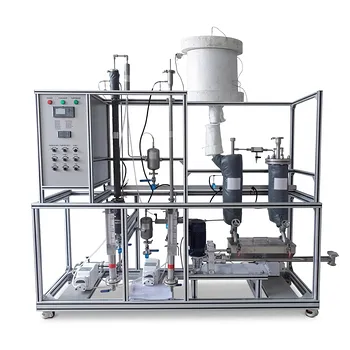
For any educational or research pilot plant focused on the Water Gas Shift reaction, precious metal catalysts in microchannel reactors decisively outperform traditional granulate systems by eliminating pyrophoric hazards, collapsing the required catalyst volume, and enabling safe operation under the frequent thermal cycles that define lab environments.
Traditional WGS units are bulky, two-stage systems loaded with iron-chrome and copper-zinc catalysts that are pyrophoric, temperature-sensitive, and intolerant of moisture. A microchannel reactor housing a precious metal catalyst solves all of these problems at once, giving students and researchers a compact, flexible, and inherently safer platform that vividly demonstrates modern process intensification.
Traditional WGS pilot plants force a trade-off between safety, size, and thermal stability. Precious metal catalysts in microchannel reactors eliminate that trade-off: they are non-pyrophoric, operate across a wide temperature window, and shrink the catalyst bed by orders of magnitude—all while letting you study the fundamental kinetics and transport limits that define the unit operation.
The Limitations of Traditional WGS Catalyst Systems
A conventional WGS pilot plant is built around a cumbersome two-stage design. This complexity is a direct consequence of the catalyst materials themselves, creating multiple pain points in a teaching or research setting.
The Problem with Iron-Chrome and Copper-Zinc Catalysts
The first stage runs at 370–400°C using iron-chrome catalysts, while the second stage must stay below 250°C with copper-zinc formulations.
Copper-based catalysts are highly sensitive to temperature excursions. Overheating destroys their activity.
They are also pyrophoric—if air leaks into the bed during shutdown or maintenance, the catalyst can ignite, posing a serious safety risk. Moreover, liquid water condensation during cold startups or shutdowns physically degrades the catalyst pellets and causes irreversible damage.
Frequent Cycling Compounds the Problems
Educational and research pilot plants rarely run continuously. They are started up, shut down, and reconfigured constantly.
Every thermal cycle stresses the traditional catalyst bed. The risk of air ingress rises with each opening of the system. And the need to carefully manage cool-down ramps to avoid condensation makes quick changes impossible. This directly conflicts with the iterative, exploratory rhythm of a teaching lab.
How Precious Metal Catalysts in Microchannels Solve These Problems
Shifting to a precious metal catalyst housed in a microchannel reactor addresses the inherent fragility of traditional systems while simultaneously unlocking new capabilities for teaching and research.
Operational Safety with Non-Pyrophoric Catalysts
The most immediate advantage is that precious metal WGS catalysts are non-pyrophoric.
You can expose them to air at room temperature without any risk of fire. This one property transforms the safety profile of a lab-scale unit operation. Students can load and unload reactors, trace leaks, or modify tubing without the constant fear of a catastrophic exotherm. Spent catalyst disposal also becomes significantly simpler and safer.
Wider Temperature Flexibility for Simplified Operation
Precious metals catalyze the WGS reaction over a far broader temperature range than either iron-chrome or copper-zinc.
A single-stage microchannel reactor can often cover what traditionally required two separate beds. This collapses the process complexity. For a pilot plant, that means fewer vessels, fewer thermocouples, and a control scheme that doesn’t need to manage a delicate inter-stage temperature drop.
It also means the reactor is far more forgiving of the thermal swings that happen during start-up or when students adjust parameters. There is no low-temperature copper bed to protect from sintering or condensation.
Compact Footprint through Process Intensification
A precious metal alone isn’t enough—it must be deployed in a structure that exploits its high intrinsic activity. A microchannel reactor does exactly that.
Microchannels offer extremely short diffusion distances and high surface-area-to-volume ratios. This overcomes the mass and heat transfer limitations that plague traditional fixed beds packed with millimetre-scale pellets.
The result is a dramatic improvement in volumetric productivity. The same CO conversion can be achieved at gas hourly space velocities (GHSV) that are 10 to 15 times higher than in a conventional tubular reactor. In practice, this means the catalyst bed volume—and therefore the whole reactor footprint—shrinks drastically, fitting easily onto a benchtop cart instead of occupying a walk-in fume hood.
Educational and Research Benefits
Beyond pure performance, the precious metal–microchannel system becomes a uniquely capable teaching instrument. It directly maps onto core chemical engineering principles.
Demonstrating Process Intensification Principles
Process intensification is a key modern concept, and this setup makes it tangible.
Students can measure CO conversion and see that identical outlet specs are achieved with a reactor that is a fraction of the size of a traditional bed. They can vary space velocity from tens of thousands to hundreds of thousands per hour and map the kinetic regime, directly observing the effect of mass transport limitations being vanquished by microchannel geometry.
Safe Start-Up and Shut-Down for Frequent Lab Cycles
The non-pyrophoric nature and thermal flexibility align perfectly with the stop-and-go reality of an educational lab.
A session can begin quickly without a multi-hour reduction procedure. At the end of the day, you can simply turn off the heat and flow nitrogen, or even air, without a carefully choreographed cool-down. The catalyst is ready for the next experiment immediately. This accelerates learning cycles and increases the total number of experimental runs a class can complete in a semester.
Understanding the Trade-offs
No technology is a universal solution. A responsible technical evaluation must weigh the clear advantages against the inherent compromises.
Higher Material Cost
Precious metals are expensive. The upfront catalyst cost per kilogram is orders of magnitude higher than iron-chrome or copper-zinc alternatives.
However, in a microchannel reactor, the absolute quantity of catalyst is drastically smaller because of the high volumetric productivity. The economic comparison is not cost-per-kilogram but cost-per-experiment-hour. For most lab-budget calculations, the total metal cost is a manageable line item, especially when offset by savings on safety infrastructure and floor space.
Pressure Drop and Catalyst Integration
Packing loose powder directly into microchannels creates an unacceptably high pressure drop and poor heat transfer.
Modern microchannel WGS systems therefore use engineered catalyst structures: metal foams, washcoated inserts, or structured supports coated with a thin layer of precious metal on a high-surface-area washcoat (such as silica or alumina). This keeps the pressure drop low (often well below typical limits) while maintaining full catalyst utilization. For a pilot plant, this means you must integrate a purpose-built, coated insert rather than simply pouring granulate into a tube. It’s a design constraint, not a barrier.
Durability Under Realistic Feed Conditions
While precious metals resist sintering better than copper under temperature swings, they can be sensitive to sulfur or chloride poisons in the feed gas.
In a tightly controlled educational environment fed with bottled gases, this is a non-issue. But researchers intending to use real syngas from a reformer must add a polishing step upstream. This is a standard consideration for any catalyst, but it must be planned for.
Making the Right Choice for Your Educational or Research Pilot Plant
Your specific goal should dictate the balance you strike between upfront cost, safety, and experimental throughput.
- If your primary focus is maximum safety and operational simplicity for undergraduate teaching: Choose a pre-engineered microchannel WGS unit with a non-pyrophoric precious metal catalyst. The elimination of ignition risk and condensation damage is worth the premium.
- If your primary focus is studying classical two-stage WGS kinetics and aging phenomena in traditional catalysts: A traditional dual-bed setup may still be appropriate, but it must be paired with rigorous safety interlocks and operating protocols. Acknowledge the higher risk and logistical burden.
- If your primary focus is demonstrating process intensification and modern reactor engineering to graduate students: A microchannel reactor with an engineered precious metal catalyst support is the definitive platform. It lets you directly measure and contrast space velocities, pressure drops, and temperature profiles against textbook fixed-bed equations.
- If your primary focus is budget-constrained proof of concept: Start with a single-stage microchannel reactor using a minimal loading of precious metal. The total catalyst purchase cost will be surprisingly low, and you will avoid the substantial ancillary costs of large furnaces, heavy gas cabinets, and multi-point safety monitors.
In every case where frequent cycling, student interaction, or space is a constraint, the precious metal microchannel WGS system transforms a historically hazardous and bulky unit operation into a safe, compact, and educationally transparent experience.
Summary Table:
| Feature | Traditional WGS Systems (Fe-Cr / Cu-Zn) | Precious Metal Microchannel Reactors |
|---|---|---|
| Safety / Pyrophoric Risk | High (risk of ignition & water damage) | Safe (non-pyrophoric, air-tolerant) |
| Reactor Size & Footprint | Bulky, two-stage system | Compact, single-stage benchtop |
| Thermal Cycling | Poor tolerance, slow startup/cool-down | High tolerance, rapid start/stop |
| Volumetric Productivity | Low (standard space velocity) | 10x–15x higher GHSV |
Upgrade Your Lab with LABPARK's Advanced Pilot Plants
Bring cutting-edge process intensification to your students and researchers safely. LABPARK provides premium Educational and Vocational Unit Operations Pilot Plants in chemical engineering, bioprocess & biotech, and environmental & water treatment. Designed specifically for universities, research institutes, and enterprises, our systems replace hazardous, bulky setups with safe, compact, and high-performance microchannel reactor solutions.
Ready to transform your chemical engineering laboratory? Contact LABPARK today to get a custom quote and detailed specifications!
Related Products
- Ion Exchange Water Purification Educational Pilot Plant for Engineering Unit Operations
- Dual-Mode Gas Absorption and Desorption Unit Operations Training Pilot Plant
- Fixed-Bed Chemical Reaction and Gas Dust Tar Removal Unit Operations Pilot Plant
- Two Phase Flow Pattern Velocity Resistance Measurement Educational Pilot Plant
- Electrolytic Hydrogen Production Educational Unit Operations Pilot Plant
People Also Ask
- How to Prevent Ion Exchange Channeling? Expert Solutions for Pilot Plants
- How does ion exchange work in water treatment pilot plants? Cost & process guide.
- What operational precautions should lab operators take for resin volume changes and air pockets? Key Guide
- How to use ion exchange pilot plants to verify alkalinity? A hands-on guide for engineering students.
- How can students use ion exchange pilot plants for column sizing? Master Wastewater Design