Modified BWR equations are a workhorse for light hydrocarbon simulations—but their power comes with razor-sharp edges. In a pilot plant setting, these models are exquisitely sensitive to adjustable binary interaction parameters (such as ( M_{ij} )). A 10% shift in a single parameter can trigger large errors in bubble pressure and K-factors. Beyond that, the predictions degrade near the critical region, can fail at low temperatures, and fall apart when water or polar compounds enter the mixture. Those are the non-negotiable practical limits.
The deepest layer of the problem is not the equation’s algebraic form—it’s that the parameters are never truly universal. To make a modified BWR model reliable in your pilot plant, you must feed it with multicomponent experimental data and temperature-aware adjustments, then continually validate the results against physical measurements. Without that discipline, simulations can confidently deliver answers that violate the laws of thermodynamics.
The Foundation of Sensitivity: Adjustable Binary Parameters
The heart of a modified BWR calculation lies in mixing rules that stitch pure-component parameters together. Those rules rely on an empirical binary parameter, often denoted ( M_{ij} ).
The Razor-Thin Margin of an Adjustable Constant
Small changes in ( M_{ij} ) cascade into large shifts in predicted phase equilibrium. A 10% variation can throw bubble-pressure predictions far outside acceptable engineering tolerance.
This sensitivity means that parameter tuning is not a one-time task—it is an ongoing negotiation with real data. If your pilot plant conditions wander outside the fitted range, the model’s trustworthiness evaporates quickly.
Why Temperature Makes the Problem Harder
Even when you lock down a good ( M_{ij} ) value at one temperature, it often does not hold at another. The parameter itself is frequently temperature-dependent, turning a single fitting exercise into a multi-dimensional regression problem.
Ignoring this drift can lead to K-factors that are accurate at the design temperature but dangerously wrong during start-up, shutdown, or any thermal swing. In a pilot plant that deliberately explores off-design operation, this blind spot can produce misleading conclusions about separation efficiency.
Where Physics Stops Playing Nicely
The Critical-Region Blind Spot
All classical analytical equations of state, including modified BWR forms, suffer near the critical region. Density and equilibrium predictions lose their sharpness exactly where the distinction between vapor and liquid blurs.
In a pilot distillation column trying to operate close to the critical pressure, this inaccuracy can make the simulation predict separations that the hardware simply cannot deliver. The result is a gap between simulation and measurement that no amount of parameter tweaking can fully close.
The Low-Temperature Enthalpy Trap
Original 8-constant BWR formulations can stumble badly at cryogenic conditions. In the worst cases, the calculated enthalpy defect becomes so severe that the model predicts a physically impossible negative specific heat—a cold stream exiting a heat exchanger at a lower temperature than it entered.
For pilot plants working with cold hydrocarbons, this is more than a curiosity; it corrupts heat balance calculations that underpin energy integration and separator design. The only fix is to adopt extended versions, such as the Starling 11-constant form or temperature-dependent modifications, that restore thermodynamic consistency in the low-temperature range.
The Hidden Cost of Numerical Ambition
Computational Expense and Data Hunger
The BWRS equation is prized for its accuracy—roughly ±1% for liquid and gas densities of light hydrocarbons, alongside reliable enthalpy and K-value predictions. But that precision comes at a price: its numerical complexity makes equilibrium calculations significantly slower.
In a pilot plant environment where rapid scenario testing is invaluable, the equation’s sluggishness can become a practical bottleneck. The rich set of coefficients also demands an enormous amount of experimental PVT, vapor pressure, and enthalpy data before the model can be trusted for a new substance.
The Phantom of Non-Unique Parameters
A subtle but critical weakness is that fitting only pure-component and binary mixture data does not yield a unique set of parameters. Different optimizer runs can produce different coefficient sets that all fit the calibration data equally well—yet diverge wildly when extrapolated to heavier hydrocarbons or wider temperature ranges.
The remedy is to embed multicomponent K-value data into the regression procedure, alongside density and enthalpy measurements. This anchors the model in the type of mixture behavior your pilot plant actually sees and extends the reliable temperature range downward. Without it, simulations become speculative.
The Polar Compound Wall
Modified BWR equations are fundamentally built for non-polar substances. When water or other polar molecules enter the feedstock, the predictive power collapses. Water behavior often requires separate, dedicated correlations rather than a single unified equation of state.
In pilot plants that handle hydrocarbon-water separation, liquid-liquid extraction, or steam stripping, relying solely on a standard BWRS model can produce dangerously inaccurate three-phase equilibrium and azeotrope predictions. Physical pilot plant runs then become the primary source of truth, not just a checkpoint.
Understanding the Trade-offs
Every thermodynamic choice embeds a trade-off. Modified BWR equations give you unrivaled accuracy within their envelope—but they demand more from the user than simpler alternatives.
Precision vs. Practicality
The BWRS family can beat cubic equations of state like Peng-Robinson for non-polar light hydrocarbons, delivering superior density and enthalpy values that make energy balances crisp. However, this precision requires you to carry a heavier computational load and invest significant effort in data collection every time you move to a new chemical system. In a pilot plant where speed of insight matters, that cost can shift the decision toward simpler models with pre-regressed parameters.
Extrapolation Risk
Once you move outside the temperature, pressure, or composition range of the data used to fit the parameters, you are flying blind. Even a well-tuned BWRS model is not physics; it is a sophisticated interpolation engine. Extrapolating to heavier cuts like C10+ or to conditions near the dew point can yield numbers that look plausible but hide dangerous errors. The pilot plant is the only place you can safely discover where that boundary lies.
Making the Right Choice for Your Pilot Plant
Your ideal thermodynamic strategy depends entirely on what you are trying to achieve—and what you are willing to sacrifice.
- If your primary focus is high-fidelity simulation of light, non-polar hydrocarbons: Leverage a modified BWR equation like BWRS, but commit to fitting its binary parameters with multicomponent experimental data from your pilot plant, and never extrapolate beyond your calibration envelope without a validation run.
- If your process involves water, polar compounds, or three-phase equilibria: Do not bet on a standalone BWR-type model. Use dedicated water correlations for the aqueous phase and treat binary interaction parameters as mandatory tuning knobs that must be refreshed at each temperature of interest using pilot plant measurements.
- If computational speed and rapid iteration are paramount: Consider a well-tuned cubic equation of state for coarse scoping, but keep a modified BWR on standby for critical energy balance and final design checks—and always verify those checks against at least one pilot-scale data point.
- If you are scaling up toward production and need to predict behavior for heavy hydrocarbon fractions: Never rely solely on pure-component and binary fits. Run a multicomponent regression that includes pilot-scale K-value data, and accept that the model’s accuracy will still degrade gracefully only within the range you experimentally covered.
A modified BWR equation is not a magic mirror—it is a calibrated instrument. Treat it with the same empirical discipline you apply to your pilot plant hardware, and it will serve you well.
Summary Table:
| Limitation / Sensitivity | Impact on Pilot Plant Operations | Mitigation Strategy |
|---|---|---|
| Binary Parameter (M_ij) | High sensitivity; 10% shift causes major bubble pressure/K-factor errors. | Calibrate using multicomponent experimental data; adjust for temperature swings. |
| Critical Region | Inaccurate density and phase equilibrium predictions near critical pressure. | Validate simulation predictions against physical pilot-scale measurements. |
| Cryogenic Temperatures | Thermodynamic inconsistency; potential negative specific heat predictions. | Adopt extended BWR forms (e.g., Starling 11-constant) or temp-dependent models. |
| Polar Compounds (Water) | Predictive power collapses; poor three-phase equilibrium predictions. | Apply dedicated water correlations for the aqueous phase. |
| Computational Speed | Sluggish simulation iteration compared to simpler cubic equations (e.g., Peng-Robinson). | Use cubic equations for rapid scoping; save BWR/BWRS for final checks. |
Bridge the Gap Between Simulation and Real-World Operations
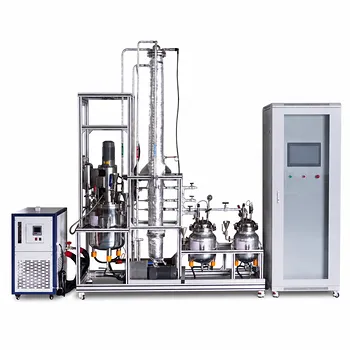
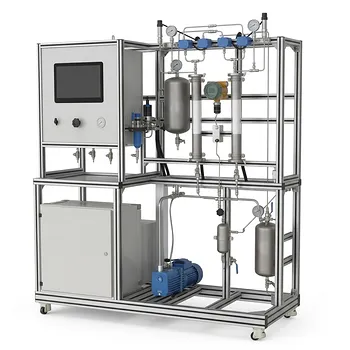
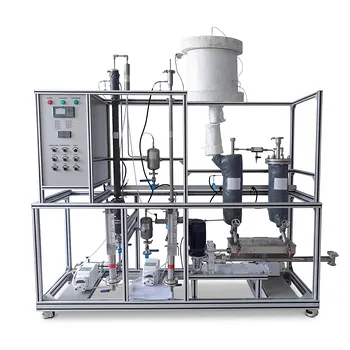
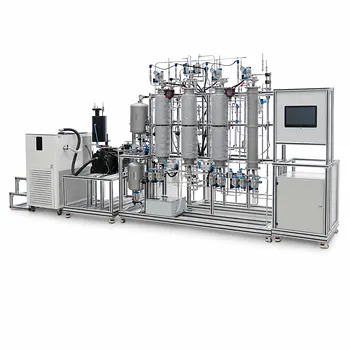
Don't let thermodynamic simulation errors derail your research or process scale-up. LABPARK designs and delivers state-of-the-art Educational and Vocational Unit Operations Pilot Plants across chemical engineering, bioprocess & biotech, and environmental & water treatment.
Specially engineered for universities, research institutes, and enterprises, our physical pilot plants provide the precise empirical data you need to validate your equations of state and optimize hydrocarbon separation processes.
Ready to elevate your laboratory capability? Contact LABPARK today to discuss your pilot plant requirements!
Related Products
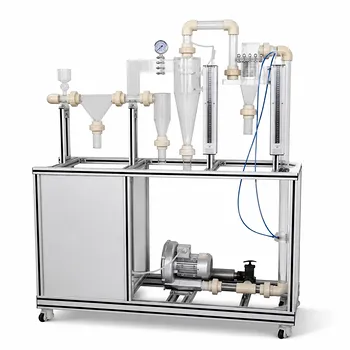
- Gas-Solid Heterogeneous Separation Demonstration Educational Unit Operations Pilot Plant
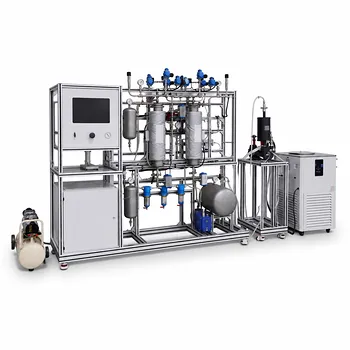
- Bench Scale Dual Column Gas Separation and Capture Educational Pilot Plant
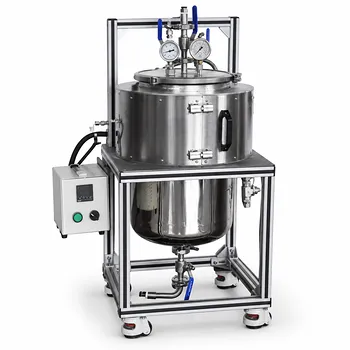
- Hot Filtration Educational Unit Operations Pilot Plant Laboratory System
- Carbon Dioxide Hydrogenation Methanol Synthesis Educational Unit Operations Pilot Plant
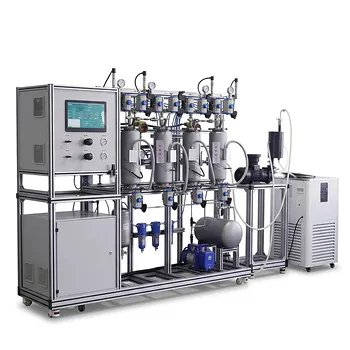
- Multi-Component Gas Pressure Swing Adsorption Pilot Plant for Unit Operations Education
People Also Ask
- Why is pressure drop characterization critical in separation pilot plants? Key operational insights.
- What are the key thermodynamic considerations for gas mixture modeling? Expert Guide
- What are the primary operational objectives and physical requirements when running heterogeneous separation pilot plants?
- What are the material limitations of gas separation pilot plants? Key factors to consider.
- What are the trade-offs in olefin-paraffin separation? Optimize Pilot Plant Performance