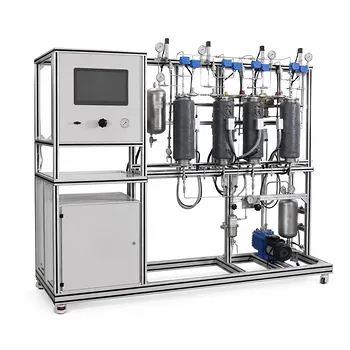
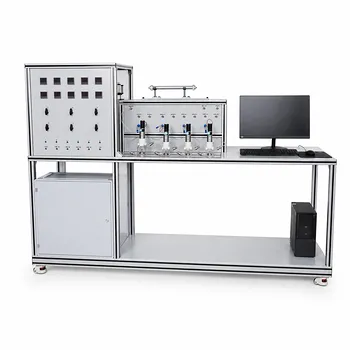
The core trade-off in olefin-paraffin pilot plant separation is the direct coupling between the distillation column’s operating pressure and the effectiveness of the refrigeration system. Raising the pressure improves condenser performance but simultaneously lowers the relative volatility between the olefin and paraffin—forcing you to add more separation stages and a higher reflux ratio to reach the same purity.
Light olefin recovery (ethylene from ethane) in a cryogenic distillation pilot plant is a balancing act: higher pressure helps the refrigeration cycle but hurts the separation thermodynamics. The practical limits are set by the column’s mechanical design, the available refrigeration capacity, and the reboiler duty—each of which constrains how far you can push the operating envelope to minimize energy and equipment cost.
Why the Pressure – Volatility Trade-off Defines Everything
The Two Sides of the Same Coin
In a cryogenic demethanizer or deethanizer, the overhead condenser must reject heat at a temperature low enough to liquefy the overhead vapor. Increasing the column pressure raises the condensation temperature, which makes the refrigeration system more efficient and reduces the required compressor work per unit of cooling.
However, the price you pay is a reduction in relative volatility (α). Relative volatility quantifies how easily the olefin can be separated from the paraffin. When α drops, you need significantly more theoretical stages and a higher reflux ratio to maintain product purity. This directly increases the column’s capital cost and the reboiler steam demand.
What Happens at Pilot Scale
In a pilot plant, these competing effects are magnified because the equipment is smaller, and heat losses become proportionally larger. A small column operating at a high reflux ratio can become dominated by parasitic heat gain, making it difficult to obtain clean material balances. Researchers must therefore map out the pressure – reflux sweet spot where the refrigeration system can operate reliably without driving the separation to an impractical number of stages.
The Practical Constraints That Shape Your Operating Window
Column Mechanical Limits
A pilot-scale high‑pressure column has a fixed maximum allowable working pressure (MAWP) dictated by its shell thickness and flange ratings. You cannot freely increase pressure; you hit a hard wall. This ceiling often forces the design to a lower pressure, which then places a greater burden on the refrigeration system to reach condensing temperatures.
Refrigeration Capacity and Reboiler Duty
The refrigeration loop’s capacity is a finite utility. If the condenser duty exceeds what the chiller can deliver (especially during turndown or startup), the column profile collapses and separation is lost. Similarly, the reboiler heat input is limited by the available steam or hot oil, and excessive reboiler duty at high reflux ratios can flood the column or trigger hydraulic limitations.
Heat Ingress and Instrumentation
On a pilot scale, the surface‑to‑volume ratio is high, meaning ambient heat leaks are disproportionately large. Cryogenic operations demand superior insulation and cold‑box design. Even small heat leaks can erode the reflux, making it hard to distinguish between an intrinsic separation problem and an operational artifact. Temperature and pressure instrumentation must be placed correctly to capture pinch points—otherwise the process remains a black box.
Understanding the Trade-offs Beyond the Pressure Setting
Purity vs. Recovery vs. Energy
You rarely optimize all three simultaneously. A pilot campaign that targets maximum olefin purity typically accepts a lower recovery and a higher energy bill. Conversely, maximizing recovery often recycles a sloppy cut back to the feed, which raises the reflux and reboiler duty. The art of piloting is to find the operating point that generates the data needed to validate a scalable model, not necessarily to produce the absolute best separation in the pilot itself.
Stage Count and Reflux Ratio
You can compensate for a low relative volatility with more trays or packing. In a pilot tower, however, adding stages is not trivial—the column is already built. Therefore, the only remaining lever is the reflux ratio, which exponentially increases energy consumption for marginal purity gains. This exposes a critical pilot‑plant constraint: you must match the equipment’s available stages with the expected α at the chosen pressure, or you will never meet the separation target regardless of how much heat you put in.
Emerging Alternatives and Their Own Constraints
While cryogenic distillation remains the industrial workhorse, membrane‑based olefin‑paraffin separation is an active area of research. Membrane pilot plants trade pressure ratio for selectivity and must guard against plasticization and physical aging of the polymer. Although not yet a commercial replacement, these alternative unit operations highlight that every separation technology carries its own pressure – selectivity – stability triangle, which must be understood in a pilot setting to produce credible scale‑up data.
Common Pitfalls to Avoid
- Operating at the wrong pressure regime: Choosing a pressure too close to the column’s MAWP leaves zero flexibility for thermal expansion or process upsets; choosing one too low can overwhelm the chiller.
- Neglecting heat loss characterization: Pilot columns can lose so much heat that the observed reflux ratio is meaningless for scale‑up unless the duty is accurately measured and accounted for.
- Ignoring feed composition changes: A pilot plant often tests multiple feedstocks. Each change shifts the bubble‑point curve and rebalances the pressure – volatility trade‑off, requiring a new set of operating conditions.
- Over‑reliance on a single utility loop: If the refrigeration system trips during a cryogenic run, the quick depressurization can thermal‑shock the column internals and destroy packing or trays.
Making the Right Choice for Your Pilot Campaign
Your operating strategy must align with the data you need to collect. Below are guiding choices based on common research goals:
- If your primary focus is generating a rigorous VLE data set: Operate at a moderate pressure that gives a relative volatility large enough to clearly resolve the column profile, even if this requires greater refrigeration effort. Purity and energy are secondary.
- If your primary focus is energy optimization and scale‑up: Map the full pressure‑reflux envelope. Start at a low pressure with a cold condenser, then incrementally raise pressure while measuring the drop in tray efficiency and the gain in chiller COP to find the economic optimum.
- If your primary focus is validating a new process model or hybrid scheme: Impose realistic but not extreme constraints—such as deliberately limiting the reboiler duty—to see how the separation degrades. These off‑design points are often the most valuable for model tuning.
- If your primary focus is testing mechanical reliability under cryogenic duty: Run extended campaigns at the highest allowable pressure (within design limits) to stress the gaskets, welds, and insulation, while monitoring the stability of the refrigeration loop.
Every decision in an olefin‑paraffin pilot plant orbits around the pressure‑volatility trade‑off. Treat the column pressure as your master control knob, and you’ll surface the constraints that matter before they become failures—giving you data that scales with confidence.
Summary Table:
| Parameter / Factor | High Operating Pressure | Low Operating Pressure | Key Pilot Plant Constraint |
|---|---|---|---|
| Relative Volatility (α) | Decreases (harder separation) | Increases (easier separation) | Requires more stages or higher reflux ratio |
| Condenser Refrigeration | Higher temp (more efficient chilling) | Cryogenic temp (demanding chilling) | Finite chiller cooling capacity |
| Reboiler Duty | Increases (higher reflux required) | Decreases (lower reflux required) | Reboiler heat input & hydraulic flooding |
| Parasitic Heat Loss | Lower relative impact | High impact due to cryogenic temps | High surface-to-volume ratio in small columns |
Optimize Your Separation Workflows with LABPARK
Are you looking to scale up your separation processes, validate thermodynamic models, or train the next generation of engineers?
LABPARK provides premium Educational and Vocational Unit Operations Pilot Plants in chemical engineering, bioprocess & biotech, and environmental & water treatment. Specifically engineered for universities, research institutes, and enterprises, our pilot plants feature precise instrumentation, superior insulation, and flexible control systems to help you master complex process trade-offs like olefin-paraffin separation.
Contact our engineering experts today to find the ideal pilot plant solution tailored to your research and training needs!
Related Products
- Gas-Solid Heterogeneous Separation Demonstration Educational Unit Operations Pilot Plant
- Multi-Component Gas Pressure Swing Adsorption Pilot Plant for Unit Operations Education
- Bench Scale Dual Column Gas Separation and Capture Educational Pilot Plant
- Educational Pressure Swing Adsorption Ethylene Capture Unit Operations Pilot Plant
- Pressure Swing Adsorption Educational Unit Operations Pilot Plant
People Also Ask
- Why is pressure drop characterization critical in separation pilot plants? Key operational insights.
- What are the key thermodynamic considerations for gas mixture modeling? Expert Guide
- What are the primary operational objectives and physical requirements when running heterogeneous separation pilot plants?
- What are the material limitations of gas separation pilot plants? Key factors to consider.
- What factors to consider when selecting gas separation membrane materials? A Pilot Plant Guide