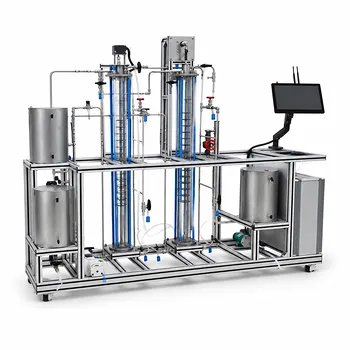
Pilot-scale heterogeneous separation isn’t just about bigger equipment—it’s about achieving three core objectives under precise physical conditions. The primary operational goals are dispersed phase collection (recovering valuable solids or liquids), dispersed medium purification (cleaning feed streams), and environmental protection/safety (treating effluents and preventing hazards). All three depend on fulfilling two physical requirements: a difference in a physical property between the phases (most commonly density) and an external force field—gravity, centrifugal, pressure, or electric—to drive the relative motion that makes separation possible.
The success of any heterogeneous separation pilot plant rests on clearly defining which objective drives your campaign and then engineering the physical conditions to match. Collecting product, purifying a stream, or meeting safety limits each demand different operational emphases, yet they all require the same foundational physics—a property contrast and a controllable driving force.
Understanding the Three Operational Objectives
Heterogeneous separations—like sedimentation, filtration, and cyclone separation—are never run in a pilot plant without a clear purpose. The primary reference breaks this purpose into three distinct operational buckets that should guide every decision from equipment selection to data logging.
Dispersed Phase Collection: Recovering What’s Valuable
In many process development campaigns, the solid, liquid, or even gas phase you’re separating out is the product.
Typical scenarios include recovering crystals from a crystallizer, capturing catalyst particles for regeneration, or isolating precipitated proteins.
When collection is the objective, pilot operations focus on maximizing recovery yield and maintaining particle integrity.
You’ll need to monitor capture efficiency and ensure the separation device doesn’t crush, dissolve, or otherwise degrade the target phase.
Dispersed Medium Purification: Protecting Downstream Equipment
Sometimes the goal is to clean the continuous phase—the liquid or gas that surrounds the dispersed particles.
This is critical when raw feeds contain fine solids that could poison catalysts, erode pumps, or foul heat exchangers.
Pilot runs here emphasize effluent clarity and the long-term stability of downstream unit operations.
You’ll often push the separator to its limits, testing how small a particle you can remove before the pressure drop or energy cost becomes unacceptable.
Environmental Protection and Safety: Meeting Emission and Hazard Limits
A pilot plant isn’t just a research tool; it often must demonstrate compliance with site safety and environmental standards.
Heterogeneous separators are employed to treat exhaust gas, remove combustible metal or carbon dusts, and ensure wastewater meets discharge limits.
Here, the objective shifts to fail-safe reliability and consistent performance.
You’ll prioritize real-time monitoring of outlet concentrations and interlocks that shut down if separation efficiency drops, preventing an unsafe release.
The Two Non-negotiable Physical Requirements
The primary reference makes clear that mechanical separation cannot happen unless two conditions exist simultaneously. Pilot plant design and operation revolve around deliberately creating and controlling these conditions.
A Measurable Difference in Physical Properties
The two phases must exhibit a contrast in some physical property.
In the vast majority of heterogeneous separations—sedimentation, centrifugation, hydrocyclones—that difference is density.
For filtration, the key contrast is particle size relative to the filter medium’s pore size.
Electric precipitators exploit differences in electrical conductivity or charge.
In a pilot plant, you must verify this property difference under actual process conditions (temperature, concentration, and pressure) because a lab measurement at ambient conditions can be misleading.
An Applied External Force Field
A property difference alone isn’t enough; you need a force to drive relative motion.
Gravity provides the weakest but simplest field, used in settling tanks and decanters.
Centrifugal force multiplies gravity’s effect by orders of magnitude in cyclones and centrifuges, making them compact and fast.
Pressure difference is the driving force in filtration, pushing fluid through a medium while retaining solids.
Electric fields drive charged particles toward collection electrodes in electrostatic precipitators.
Pilot plant operators must treat this force field as a critical control parameter—varying it to understand separation efficiency curves and identify the point of diminishing returns.
Bridging Objectives and Physics: What You Actually Control
The deep need behind asking about objectives and requirements is knowing how to translate these theoretical needs into daily pilot plant operations. The supplementary references and field experience highlight practical levers.
Parameter Manipulation as the Link
To connect an objective (e.g., 99% catalyst recovery) to the physical requirements (density difference + centrifugal force), you manipulate flow rate, temperature, pressure drop, and rotational speed.
A pilot plant must be instrumented to measure these variables accurately, allowing you to map how separation efficiency responds to changes.
Scalability hinges on this data: because heterogeneous processes are often governed by dimensionless numbers like Stokes’ number or Reynolds number, pilot-scale physical conditions can be designed to mirror full-scale behavior.
Monitoring Fouling and Degradation
Even though the fundamental physics seem simple, auxiliary phenomena can derail a pilot campaign.
Fouling—the accumulation of material on separator internals or filter media—gradually reduces performance and alters the effective force field (e.g., increased pressure drop in a filter).
Pilot plants must include protocols for monitoring pressure trends and permeability decline over time, exactly as noted for membrane systems, because all heterogeneous separators face surface blinding or cake formation.
Material compatibility is equally crucial: the chosen construction materials must withstand the continuous phase’s chemistry (pH, solvents) to avoid corrosion that changes separator geometry and, hence, the flow field.
Understanding the Trade-offs and Common Pitfalls
No single heterogeneous separation method is ideal for all objectives. Recognizing the inherent trade-offs prevents a pilot campaign from chasing unattainable performance.
- Intensity of force vs. energy consumption: Centrifugal or electric fields achieve high efficiency but consume more energy and can shear fragile particles. A gravity settler is cheap to run but slow and large.
- Purity vs. recovery: Pushing for ultra-clear continuous phase often lowers the recovery of valuable dispersed phase because some fine product is inevitably lost. You must decide which metric drives the economics.
- Scalability vs. experimental flexibility: Pilot plants designed for wide parameter exploration (e.g., varying filter media types) often sacrifice direct geometric similarity to the industrial unit, requiring careful scale-up interpretation.
- Chemical aggressiveness vs. equipment lifespan: Aggressive feeds that achieve fast separation may shorten component lifetimes, adding maintenance cycles that interrupt your data collection.
Making the Right Choice for Your Pilot Campaign
Your specific goals will dictate how you balance these objectives and physical requirements. Use the following guide to focus your operational design.
- If your primary focus is recovering a high-value dispersed product: Emphasize gentle force fields (low shear) and rapid product removal to preserve particle size and purity. Prioritize recovery yield over complete continuous-phase clarity.
- If your primary focus is purifying a feed to protect downstream equipment: Push for high separation efficiency on fine particles, even if that means accepting higher pressure drops and energy use. Validate filter or cyclone performance at worst-case inlet loadings.
- If your primary focus is meeting environmental or safety limits: Design for absolute reliability. Instrument the pilot plant with real-time outlet monitors, build in fail-safe shutdowns, and demonstrate consistent performance across a broad range of feed variations.
- If your primary focus is generating scalable data for a commercial plant: Ensure the pilot unit allows precise measurement of the force field (e.g., G-force, pressure differential) and particle property differences under representative conditions. Document fouling rates to size industrial cleaning systems correctly.
A heterogeneous separation pilot plant is only as valuable as your clarity about the objective it serves and your command of the physical forces it exploits. When you align those two dimensions, the data you gather will reliably inform the industrial design—not just demonstrate that separation is possible.
Summary Table:
| Category | Key Element | Operational Focus & Key Parameters |
|---|---|---|
| Operational Objectives | Dispersed Phase Collection | Maximizing recovery yield and maintaining particle integrity |
| Dispersed Medium Purification | Ensuring effluent clarity and protecting downstream equipment | |
| Environmental & Safety | Achieving fail-safe reliability and consistent emission control | |
| Physical Requirements | Property Difference | Density contrast, particle size, or electrical conductivity |
| External Force Field | Gravity, centrifugal force, pressure drop, or electric fields |
Optimize Your Separation Processes with LABPARK
Are you looking to design, scale up, or teach advanced separation processes? LABPARK provides state-of-the-art Educational and Vocational Unit Operations Pilot Plants tailored for chemical engineering, bioprocess & biotech, and environmental & water treatment applications.
We help universities, research institutes, and enterprises bridge the gap between theoretical physics and industrial-scale operations with highly instrumented, reliable pilot systems.
Contact LABPARK today to discover how our pilot plants can enhance your research and training capabilities!
Related Products
- Gas-Solid Heterogeneous Separation Demonstration Educational Unit Operations Pilot Plant
- Multifunctional Membrane Separation Educational Pilot Plant with Ultrafiltration, Nanofiltration, Reverse Osmosis
- Multi-Functional Membrane Separation Educational Pilot Plant for Unit Operations Lab
- Carbon Material Thermal Pretreatment Multiphase Separation Educational Pilot Plant
- Bench Scale Dual Column Gas Separation and Capture Educational Pilot Plant
People Also Ask
- Why is pressure drop characterization critical in separation pilot plants? Key operational insights.
- What are the key thermodynamic considerations for gas mixture modeling? Expert Guide
- What are the material limitations of gas separation pilot plants? Key factors to consider.
- What are the trade-offs in olefin-paraffin separation? Optimize Pilot Plant Performance
- What factors to consider when selecting gas separation membrane materials? A Pilot Plant Guide