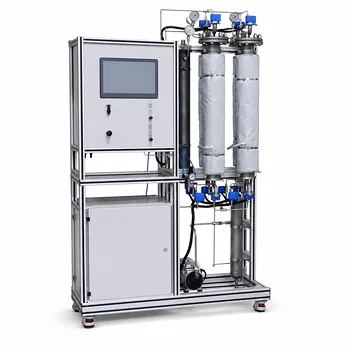
Knowledge Chemical Engineering Education How is NOx absorption simulated in an alkaline pilot plant? Master Mass Transfer & Gas Scrubbing
Author avatar

Tech Team · LABPARK

Updated 2 months ago

How is NOx absorption simulated in an alkaline pilot plant? Master Mass Transfer & Gas Scrubbing


The absorption of NOx in an alkaline pilot plant is simulated by contacting a precisely mixed synthetic flue gas with a circulating sodium hydroxide solution inside a packed or trayed column. Students control the molar ratio of NO to NO₂ (aiming for a 1:1 ratio) and observe how the synergistic chemical reaction transforms poorly soluble nitrogen oxides into dissolved nitrite and nitrate salts. The removal efficiency is quantified by measuring gas-phase NOx concentrations at the column inlet and outlet, turning an environmental challenge into a tangible mass transfer experiment.

The core insight is that pure NO is nearly insoluble in alkaline solutions, but when paired with NO₂ in the right proportion, a rapid disproportionation reaction occurs. This reaction-enhanced absorption is what the pilot plant is designed to demonstrate—showing students that chemical kinetics and diffusion, not just physical solubility, can dominate gas scrubbing performance.

The Chemistry That Makes It Work

Alkaline scrubbing of NOx hinges on a synergistic reaction between NO and NO₂.

Why a 1:1 Ratio Matters

When an equimolar mixture of nitric oxide (NO) and nitrogen dioxide (NO₂) contacts sodium hydroxide (NaOH), they react to form sodium nitrite (NaNO₂) and water. This prevents the gases from escaping back into the vapor phase. If the ratio deviates significantly, one of the gases remains largely unreacted and slips through the column, slashing efficiency.

The Role of the Liquid Phase

The liquid serves two masters: it must dissolve the reactive gases and provide hydroxide ions for rapid neutralization. The reaction cascade ultimately produces a mix of nitrite and nitrate ions, locking the NOx in solution and allowing students to track absorption through liquid-phase analysis if desired.

Simulating the Process in a Pilot Plant

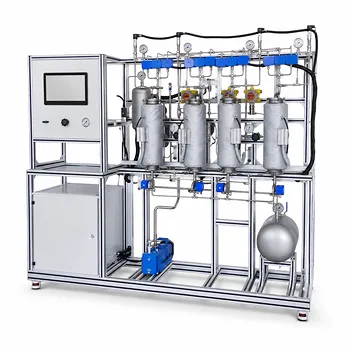
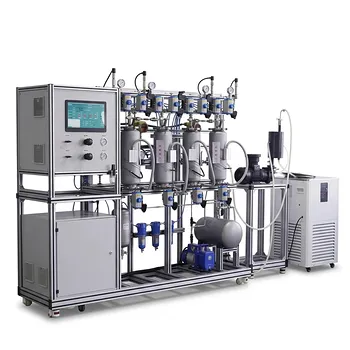
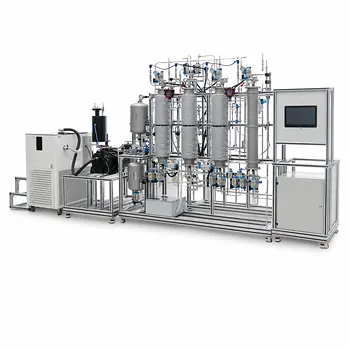
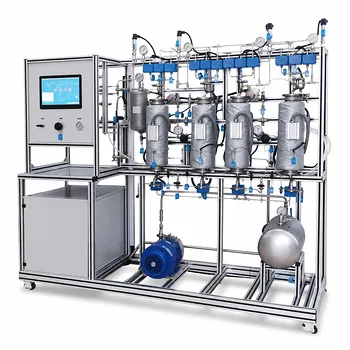
A well-designed absorption unit operations pilot plant brings this chemistry to life.

Modular Column Design and Gas Delivery

Pilot plants often use modular columns that can be arranged in series or switched between different bed heights and tray configurations. Students can first run a short packing section, then extend it, directly witnessing how additional contact stages improve removal. Synthetic flue gas is created by blending NO, NO₂, and a carrier gas (nitrogen or air) under precise flow control to set the desired inlet concentration and molar ratio.

Instrumentation and Data Collection

Key points are instrumented with gas analyzers (chemiluminescence or electrochemical sensors) at the inlet and outlet, along with flow meters, pressure transducers, and temperature probes. This enables real-time monitoring of removal efficiency and calculation of the overall mass transfer coefficient. Some setups also measure the liquid-phase accumulation of nitrite/nitrate to perform a material balance.

Tracking Reaction Enhancement

By comparing a run with NaOH to a baseline using pure water, students see that the chemical reaction dramatically increases the amount of NOx absorbed per liter of solvent. They can also explore the condition under which reaction kinetics can be decoupled from pure physical diffusion: if the pseudo-first-order reaction rate constant times the liquid residence time is much less than one ($k_i^* \tau \ll 1$), the system behaves like physical absorption. In the alkaline NOx case, the reaction is so fast that mass transfer is entirely enhanced, a key learning point.

Understanding the Trade-offs and Practical Limits

No simulation is perfect, and students must recognize where theory meets reality.

Sensitivity to NO/NO₂ Ratio

The 1:1 molar ratio is the thermodynamic sweet spot, but real exhaust streams rarely oblige. An excess of NO leads to breakthrough of unreacted nitric oxide; an excess of NO₂ may produce more nitrate but still leaves unconverted gas. The pilot plant teaches that pre-oxidation or ratio adjustment is often needed upstream in industrial practice.

Competing Reactions and Waste Handling

Oxygen in the carrier gas can oxidize NO to NO₂, shifting the ratio inadvertently. CO₂ in real flue gas would also consume caustic, raising solvent costs. Additionally, the spent scrubbing liquor contains nitrite/nitrate salts that require proper disposal, a logistical factor students can quantify by measuring liquid composition over time.

Safety and Operational Constraints

NOx gases are toxic, and NaOH is corrosive. Pilot plants must operate under ventilation and with appropriate gas monitoring. The temperature rise from the exothermic reaction can be small at this scale, but large industrial absorbers often need intercooling to keep the reaction favorable. Students learn that lab-scale simplifications sometimes hide critical heat effects.

How to Apply This to Your Studies

Align your pilot-plant experiments with your learning goal to extract maximum value.

  • If your primary focus is mastering gas-liquid mass transfer: Start with single-stage physical absorption (water + CO₂) as a baseline, then switch to NOx + NaOH to quantify the enhancement factor directly from measured outlet concentrations.
  • If your primary focus is environmental engineering and emission control: Manipulate the inlet molar ratio and observe the breakthrough curve for unreacted NO. Relate this to the concept of stoichiometric limitation and scrubber design for compliance.
  • If your primary focus is process design and scale-up: Use the modular columns to vary bed height and packing type. Plot the number of transfer units (NTU) versus liquid flow rate, and extrapolate the required column height for a target 95% removal—then discuss how kinetics change at industrial scale.
  • If your primary focus is reaction engineering: Measure the temperature profile and compare the observed rate with published kinetic constants. Check if the liquid residence time is long enough to push the system toward equilibrium, verifying the assumption of fast reaction control.

The pilot plant transforms what looks like a simple scrubbing task into a platform for exploring kinetics, mass transfer, thermodynamics, and safety—all in one experiment.

Summary Table:

Key Parameter Process Condition Student Learning Objective
Gas Feed Ratio Equimolar NO to NO₂ (1:1 ratio) Understand synergistic reaction kinetics vs. physical solubility
Scrubbing Medium Circulating sodium hydroxide (NaOH) Study chemical reaction-enhanced mass transfer and neutralization
Column Design Modular packed or trayed configuration Analyze the impact of contact stages and packing height on NTU
Data Collection Inlet/outlet gas concentrations & flow rates Calculate overall mass transfer coefficients and removal efficiency

Bring Unit Operations to Life with LABPARK

Bridge the gap between chemical theory and industrial reality. LABPARK designs and manufactures premium Educational and Vocational Unit Operations Pilot Plants for universities, research institutes, and enterprises.

Whether you are teaching gas absorption, studying bioprocesses, or researching wastewater treatment, our systems provide:

  • Modular flexibility to adapt to various experimental curricula.
  • Industrial-grade instrumentation for precise data collection and mass balance calculations.
  • Robust safety features for handling chemical reactions and toxic gases.

Accelerate hands-on engineering education and advanced research. Contact LABPARK today to find the perfect pilot plant solution for your lab!

Related Products

People Also Ask

Related Products

Dual-Mode Gas Absorption and Desorption Unit Operations Training Pilot Plant

Dual-Mode Gas Absorption and Desorption Unit Operations Training Pilot Plant

Industrial-scale pilot plant for gas absorption and desorption training in chemical engineering. Features dual-mode operation with real and simulated materials, transparent columns for flow visualization, and customizable design. Supports independent or combined loops for hands-on unit operations experiments.

Carbon Dioxide Absorption and Desorption Educational Pilot Plant for Carbon Capture Studies

Carbon Dioxide Absorption and Desorption Educational Pilot Plant for Carbon Capture Studies

Explore carbon dioxide absorption and desorption with this educational pilot plant. Transparent columns visualize mass transfer; electric heating simulates industrial solvent regeneration; touchscreen interface enables data monitoring. Ideal for chemical engineering, bridging theory and practice.

Carbon Dioxide Adsorption and Capture Educational Unit Operations Pilot Plant

Carbon Dioxide Adsorption and Capture Educational Unit Operations Pilot Plant

Advanced laboratory pilot plant for teaching carbon dioxide adsorption and capture unit operations. Features four-tower adsorption system with 400°C heating jackets, high-precision CO2 and O2 sensors, and 15.6-inch touchscreen with wireless data logging. Ideal for chemical engineering education.

Absorption and Desorption Educational Unit Operations Pilot Plant

Absorption and Desorption Educational Unit Operations Pilot Plant

Dual packed column absorption and desorption pilot plant for chemical engineering education, offering real-time mass transfer coefficient measurement, durable mobile frame, industrial touch-screen interface, and customizable design for varied laboratory curricula, enabling hands-on study of gas absorption and stripping.

Packed Bed Absorption Educational Unit Operations Pilot Plant

Packed Bed Absorption Educational Unit Operations Pilot Plant

Study gas-liquid absorption, pressure drop, flooding, and mass transfer coefficients with this pilot plant. Transparent packed column, industrial touchscreen, real-time sensor data, automated analysis. Investigate two-phase flow, loading points, column efficiency. Comprehensive data logging and assessment software included.

Multi-Component Gas Pressure Swing Adsorption Pilot Plant for Unit Operations Education

Multi-Component Gas Pressure Swing Adsorption Pilot Plant for Unit Operations Education

Multi-component gas pressure swing adsorption pilot plant designed for unit operations education. Features four-tower configuration, IoT touchscreen control, dual regeneration, and real-time breakthrough curve analysis for engineering training with safety interlocks and mobile frame simulates industrial PSA processes.

Bench Scale Dual Column Gas Separation and Capture Educational Pilot Plant

Bench Scale Dual Column Gas Separation and Capture Educational Pilot Plant

This dual-column educational pilot plant provides hands-on teaching of gas adsorption, separation, and capture processes. It features stainless steel columns, regeneration up to 400°C, and a 15.6-inch touchscreen PLC for TSA and PSA studies in chemical engineering curricula, process simulation.

Bench Scale Carbon Dioxide Capture Educational Unit Operations Pilot Plant

Bench Scale Carbon Dioxide Capture Educational Unit Operations Pilot Plant

This bench-scale educational pilot plant simulates industrial CO₂ separation using a multi-tower adsorption system for hands-on engineering training. Students achieve ≥90% CO₂ purity while studying pressure swing adsorption, desorption kinetics, and process control in gas purification experiments.

Educational Pressure Swing Adsorption Ethylene Capture Unit Operations Pilot Plant

Educational Pressure Swing Adsorption Ethylene Capture Unit Operations Pilot Plant

Advanced educational pilot plant for pressure swing adsorption ethylene capture provides comprehensive hands-on training in industrial gas separation processes, featuring an eight-column PSA system, real-time data acquisition, and fully customizable design for chemical engineering unit operations laboratories and research.

Pressure Swing Adsorption Educational Unit Operations Pilot Plant

Pressure Swing Adsorption Educational Unit Operations Pilot Plant

Integrated bench-scale pressure swing adsorption pilot plant for hands-on teaching of gas-solid separation, mass transfer, and process optimization using nitrogen-oxygen model, featuring dual-column design, industrial touchscreen control, digital assessment suite, and customizable hardware and software configurations for educational laboratories.

Thermal Desorption Exhaust Gas and Tail Water Treatment Educational Pilot Plant

Thermal Desorption Exhaust Gas and Tail Water Treatment Educational Pilot Plant

Bench-scale educational pilot plant for treating thermal desorption exhaust gas and tail water integrates condensation, Fenton oxidation, precipitation, filtration, and carbon adsorption. Ideal for chemical engineering and environmental labs, teaching unit operations, process control, and real-time data analysis.

Carbon Dioxide Capture and Utilization Educational Pilot Plant for Unit Operations

Carbon Dioxide Capture and Utilization Educational Pilot Plant for Unit Operations

Educational pilot plant for carbon dioxide capture and utilization featuring four-tower adsorption, high-temperature regeneration, precise CO2 analysis, modern touchscreen control, real-time data, and robust construction for hands-on unit operations training in university labs with curriculum alignment and safe operation.

Multimodal Absorption and Desorption Pilot Plant for Unit Operations Training

Multimodal Absorption and Desorption Pilot Plant for Unit Operations Training

Multimodal absorption and desorption pilot plant for higher education labs. Bridges theory and industrial practice with transparent packed columns, three operational modes (real-material, simulated, semi-physical), and SCADA control. Students explore mass transfer, column hydraulics, and process control. Customizable.

Low Concentration Carbon Dioxide Capture Pressure Swing Adsorption Educational Pilot Plant

Low Concentration Carbon Dioxide Capture Pressure Swing Adsorption Educational Pilot Plant

Low-concentration CO2 capture pilot plant using Pressure Swing Adsorption for engineering education. Students gain practical experience in breakthrough curve measurement, adsorption dynamics, and variable analysis in a hands-on lab setting. Ideal for unit operations, mass transfer, and chemical engineering labs.

Fixed-Bed Chemical Reaction and Gas Dust Tar Removal Unit Operations Pilot Plant

Fixed-Bed Chemical Reaction and Gas Dust Tar Removal Unit Operations Pilot Plant

Integrated educational pilot plant for studying catalytic gas-solid reactions and downstream gas purification. Features dual fixed-bed reactor, three-stage heating, and touchscreen control for hands-on engineering training. Ideal for chemical and environmental engineering curricula.

Fluidized Bed Gas Solid Catalytic Reaction Educational Pilot Plant

Fluidized Bed Gas Solid Catalytic Reaction Educational Pilot Plant

Our educational fluidized bed gas-solid catalytic reaction pilot plant is ideal for chemical engineering labs. Students study fluidization dynamics, catalyst evaluation, and process control hands-on. Features include a customizable reactor, touchscreen HMI, and safety interlocks for safe, curriculum-aligned experiments.

Micro-Scale Gas-Solid Catalytic Reaction Educational Pilot Plant

Micro-Scale Gas-Solid Catalytic Reaction Educational Pilot Plant

Explore heterogeneous catalysis with this micro-scale gas-solid catalytic reaction educational pilot plant. Designed for university labs, it enables hands-on study of reaction kinetics and transport phenomena in a benchtop packed bed reactor with high-precision flow control and touchscreen automation.

Educational Unit Operations Pilot Plant for Intraparticle Diffusion Effective Factor Measurement

Educational Unit Operations Pilot Plant for Intraparticle Diffusion Effective Factor Measurement

Designed for chemical engineering university labs, this pilot plant allows hands-on determination of catalyst particle intraparticle diffusion effective factors and gas-solid reaction kinetics using a fixed-bed tubular reactor with industrial touchscreen control, bridging theory and practical reactor design.

Gas Phase Mixing and Residence Time Distribution Determination Educational Unit Operations Pilot Plant

Gas Phase Mixing and Residence Time Distribution Determination Educational Unit Operations Pilot Plant

Integrated lab system for gas-phase mixing and RTD determination. Supports pulse and step tracer methods with dual CSTR and PFR reactors, industrial components, and PC data logging. Provides hands-on study of non-ideal flow and reactor behavior for university students.

Gas-Solid Heterogeneous Separation Demonstration Educational Unit Operations Pilot Plant

Gas-Solid Heterogeneous Separation Demonstration Educational Unit Operations Pilot Plant

Comprehensive visual transparent gas-solid separation pilot plant for chemical engineering labs. Demonstrates gravity settling inertial settling cyclone and bag filter technologies. Enables real-time analysis of fluid-particle mechanics pressure drop and collection efficiency. Ideal for undergraduate unit operations courses.


Leave Your Message