A single flawed thermodynamic assumption can turn a state-of-the-art pilot plant into a costly failure.
When processing synthetic gas that contains water and polar compounds, standard cubic equations of state like Redlich-Kwong are fundamentally mismatched to the chemistry. These models, built for non-polar hydrocarbons, can generate massive prediction errors—such as estimating water solubility in CO₂ at 2.1 mole percent versus a real-world value of 0.25 mole percent, an eightfold mistake. Without rigorous experimental validation of vapor-liquid equilibrium (VLE) data, equipment for gas clean-up, drying, and separation will be sized incorrectly, leading to process bottlenecks, safety hazards, or catastrophic scale-up failures.
Core Takeaway: Water and polar compounds shatter the predictive power of generic thermodynamic models. Validating VLE data in a pilot plant is not an academic exercise—it’s the non-negotiable bridge between a flawed simulation and a safe, efficient, and scalable separation process.
The Hidden Danger of Standard Thermodynamic Models
When Assumptions Fail: Non-Polar Models Meet Polar Reality
Cubic equations of state (EOS) like Redlich-Kwong and Peng-Robinson carry an inherent volume-dependence limitation. They are optimized for non-polar, symmetric molecules typically found in hydrocarbon streams.
Water, alcohols, and other polar compounds interact through strong hydrogen bonds and dipole forces. A standard EOS cannot capture these effects, leading to gross mispredictions in phase splitting. The eightfold error in water/CO₂ solubility is not an outlier—it’s a predictable symptom of applying the wrong physics to a polar mixture.
The Cascade Effect on Pilot Plant Design
VLE data directly determines the number of theoretical stages, column diameter, and energy loads for absorbers, strippers, and distillation columns. An eightfold overprediction of water uptake in a gas stream would make a dehydration column appear far more capable than it is.
In reality, the undersized unit would allow water to break through, potentially freezing in downstream cryogenic equipment or poisoning catalysts. Conversely, believing an erroneously low solubility can lead to dangerous overdesign and wasted capital. Validation is the only way to prevent these cascade failures.
Why Pilot Plants Are the Ultimate Validation Tool
From Theory to Reality: Bridging the Gap
Industry data shows that 70% of engineering data requests focus on phase equilibrium and 25% on enthalpy. While databases like DIPPR and DECHEMA offer reliable pure-component and binary data, they rarely cover the exact multicomponent, polar mixtures and pressure-temperature windows of a novel synthetic gas process.
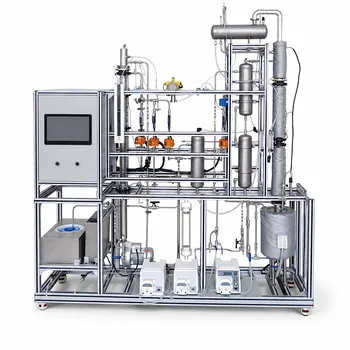
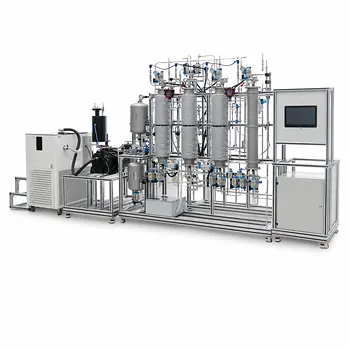
A pilot plant generates the direct experimental VLE data—partial pressures, composition profiles, and mixture enthalpies—that allow engineers to test, tune, and trust their models. This empirical evidence bridges the dangerous gap between a software’s built-in library and a real chemical mixture.
The Role of Binary Interaction Parameters
Process simulators use binary interaction parameters to correct EOS predictions for real mixtures. For a synthetic gas containing water, CO₂, CO, H₂, and trace polar compounds, these parameters are often unknown.
Tools like VLEFIT can take measured P-T-X-Y data from the pilot plant and fit the parameters of an activity coefficient model (Wilson, NRTL) to the actual behavior. Without this step, the simulation is merely guessing, and the eightfold error is the expected result.
Consistency is Not Guaranteed: Gibbs-Duhem Checks
Acquiring raw VLE data is not enough—the data itself must be thermodynamically sound. The Gibbs-Duhem equation constrains how chemical potentials change with composition. Area tests (Herrington) and slope tests (Van Ness-Mrazek) can detect gross or local inconsistencies.
Using inconsistent data to tune a model is just as dangerous as having no data. Validation therefore includes verifying data quality through these diagnostics before accepting the fitted parameters.
Understanding the Trade-offs and Pitfalls
The Expense of Experimentation vs. the Cost of Failure
Running a pilot plant to generate VLE data demands time, skilled personnel, and money. It is tempting to bypass validation and trust a simulation. Yet a single undersized acid gas scrubber that forces a plant shutdown or a frozen heat exchanger from excess moisture can erase years of development budget. The financial calculus always favors validation.
Over-Fitting to a Narrow Window
A validated model is only reliable within the range it was fitted to. If the pilot plant only tests a narrow temperature band, the tuned parameters may fail at the slightly higher conditions required during scale-up. The experimental design must cover the full expected operating envelope.
The Risk of Ignoring Real Gas Complexity
Even perfect VLE data cannot predict unexpected phenomena like gas hydrate formation, electrolytic effects from trace contaminants, or mass-transfer kinetics. Validation must be part of a larger strategy that looks beyond equilibrium to kinetic and safety considerations.
The Specific Threat for Synthetic Gas Streams
Gas Clean-up and Acid Gas Removal
Synthetic gas from coal gasification or biomass fermentation is a complex mixture of CO₂, H₂S, water, and polar organics. Acid gas scrubbing with physical or chemical solvents depends on accurate knowledge of how these components partition between vapor and liquid. The strong molecular interactions in these systems often fall entirely outside the range of standard database values.
Preventing Catastrophic Sizing Failures
The primary reference’s eightfold error in water solubility in CO₂ is a direct design threat for a dehydration or CO₂-capture column. If the water removal system is underdesigned, the wet gas will carry moisture into a downstream methanation reactor or cryogenic separation unit, causing coking, freezing, or mechanical damage. Validating VLE with your specific gas composition and solvents in a pilot plant eliminates these blind spots.
Making Validation a Strategic Advantage
The choice is clear: either let a flawed model dictate your design, or let your pilot plant tell you the truth. Use these goal-driven strategies to apply this principle effectively.
- If your primary focus is safety and reliability: Treat VLE validation as a formal gate review. No scale-up decision is final until the model predicts the pilot plant data within an acceptable error band, especially for systems containing water and polar compounds.
- If your primary focus is cost-efficiency: Run a limited pilot matrix after an initial simulation screening. Use the measured data to regress binary interaction parameters, which will then guide an optimized, right-sized design that avoids the double penalty of over-engineering or rework.
- If your primary focus is research and development: Build a systematic validation loop: mine databases, run preliminary simulations, generate pilot plant VLE data under key conditions, apply consistency tests, and refine the model. This cycle converts your pilot plant from a test bench into a predictive engineering engine.
Every rigorous VLE validation you perform today eliminates a scaling catastrophe tomorrow—turning thermodynamic doubt into bulletproof process certainty.
Summary Table:
| Aspect / Parameter | Standard Cubic EOS (e.g., RK, PR) | Validated Pilot Plant VLE Data |
|---|---|---|
| Polar Interactions | Fails to capture hydrogen bonding | Accurately models polar mixtures |
| Prediction Accuracy | High error (e.g., 8x water solubility error) | Fit to real-world process conditions |
| Design Risk | Sizing bottlenecks & catalyst poisoning | Optimized, safe equipment sizing |
| Parameters Used | Generic or missing interaction parameters | Refined binary interaction parameters |
Optimize Your Scale-Up with LABPARK Pilot Plants
Don't let flawed thermodynamic assumptions derail your process design. LABPARK provides state-of-the-art Educational and Vocational Unit Operations Pilot Plants across chemical engineering, bioprocess & biotech, and environmental & water treatment. Designed specifically for universities, research institutes, and enterprises, our pilot plants deliver the precise empirical VLE data you need to validate your models and scale up with absolute confidence.
Ready to eliminate engineering risks and right-size your equipment? Contact us today to find the perfect pilot plant solution.
Related Products
- Methanol Synthesis and Catalyst Performance Evaluation Educational Unit Operations Pilot Plant
- Carbon Dioxide Hydrogenation Methanol Synthesis Educational Unit Operations Pilot Plant
- Ethyl Acetate Synthesis Unit Operations Pilot Plant for Practical Training
- Micro-Scale Gas-Solid Catalytic Reaction Educational Pilot Plant
- Carbon Dioxide Hydrogen Methanol Synthesis Educational Unit Operations Pilot Plant
People Also Ask
- Why is a purge system necessary when operating a gas recirculation loop in a methanol synthesis pilot plant? (Guide)
- How do temp & pressure affect methanol synthesis pilot plants? Optimize equilibrium and catalyst performance.
- Why do modern methanol pilot plants operate at lower pressures? Catalyst & Feed Requirements Explained
- What are the operational requirements for catalyst activation? Safe Methanol Pilot Plant Operation
- How do steady-state and dynamic simulations complement pilot plants? Validate scale-up and controllability