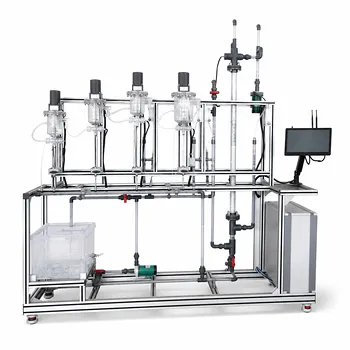
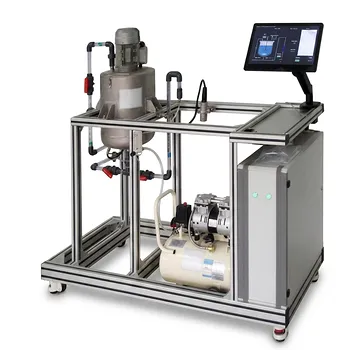
Ignoring aeration is a recipe for a dangerously oversized motor. Students must account for aeration when calculating mechanical stirrer power consumption in pilot plants because introducing gas into the liquid drastically reduces the power the impeller draws—typically by 20% to 69%. This happens because bubbles lower the apparent fluid density around the blades and fundamentally alter the flow patterns. If you skip this correction, your power requirement estimates will be far too high, leading to poor motor sizing, inflated energy budgets, and data that cannot reliably scale up.
Aeration transforms the fluid dynamics around a stirrer, causing a predictable and severe drop in power consumption. Learning to model this drop is not just an academic drill—it’s the practical skill that turns a pilot plant from a source of costly miscalculations into a meaningful predictor of industrial reactor performance.
The Physics of Aeration: Why Gas Bubbles Sap Impeller Power
To understand the “why,” you first need to see what a sparged gas does to an otherwise uniform liquid.
From a Dense, Continuous Liquid to a Lighter Dispersion
In an unaerated tank, the impeller works against a single-phase liquid of constant density. Power draw is a direct function of that density, the impeller speed, and the diameter. When gas is introduced, the vessel becomes a gas-liquid dispersion. The gas bubbles trapped in the fluid create a lower overall density around the impeller, which directly reduces the inertial forces the blades must overcome. This is the first, most intuitive reason for the power drop.
Cavities Behind the Blades: How Gas Disrupts the Flow Structure
The reduction in power isn’t just about average density. For a flat-blade turbine, gas accumulates in low-pressure zones behind the rotating blades, forming stable gas cavities. These cavities change the blade’s hydrodynamic profile and dramatically reduce the form drag that normally drives fluid motion. The impeller essentially “slips” through a cushion of gas, transferring far less energy to the liquid. This is why the power draw can drop to as low as 31% of the unaerated value under certain conditions.
Quantifying the Power Drop in Pilot-Scale Reactors
Knowing a drop exists is one thing. Being able to predict it with engineering accuracy is where real learning—and real design—happens.
The Aeration Number: The Key to a Predictable Phenomenon
The link between gas flow and power consumption is captured by a dimensionless group called the aeration number, ( N_a = \frac{Q_g}{n d^3} ), where ( Q_g ) is the volumetric gas flow rate, ( n ) is the rotational speed, and ( d ) is the impeller diameter. As ( N_a ) increases, indicating more gas relative to the pumping action, the power reduction ratio ( P_g / P ) (aerated to unaerated power) typically falls off in a predictable manner.
Empirical Correlations Students Rely On
Because the physics of multi-phase flow are complex, pilot-plant work depends on semi-empirical correlations validated by decades of data. These correlations give students a hands-on tool to model the power drop. A classic expression for a Rushton turbine, for example, takes the form:
[ P_g = 0.157 \left( \frac{P^2 n d^3}{Q_g^{0.56}} \right)^{0.45} ]
Other logarithmic variants bring in additional factors like the tank diameter ratio, Reynolds number, and Froude number to cover a wider range of operating conditions. Using these relationships, students learn that the power penalty—or, more accurately, the power savings—can fall anywhere within that 0.31 to 0.8 window depending on gas holdup, impeller speed, and sparger design.
The Real-World Stakes of Getting It Wrong
Failing to account for aeration doesn’t just produce a bad lab report. It unravels the very purpose of a pilot plant.
Motor Sizing and Energy Budgets
If you specify a motor based on unaerated power calculations, you will install a motor far larger and more expensive than necessary. This not only wastes capital but also forces you to operate the unit in a low-efficiency region where control is poor. Conversely, on the rare occasion that massive gas flooding causes instability, an incorrectly small motor could stall. Accounting for aeration is a process safety and economics essential.
Scale-Up Reliability from Pilot to Production
A pilot plant’s main job is to generate data that predicts full-scale behavior. The interaction between gas dispersion and mixing intensity is scale-dependent, and correlations that anchor to the aeration number help bridge that gap. If you train on a model that ignores aeration, your scale-up calculations for mass transfer, heat transfer, and blending will be fundamentally flawed. The result is a production reactor that may never meet its performance guarantee.
Understanding the Trade-offs
Objectively, applying these correlations adds complexity, and it’s not without its pitfalls.
- The gas flow rate is not always uniform. Sparger design, back-pressure fluctuations, and changing broth viscosity in bioprocesses can shift the actual ( Q_g ) away from the measured value, introducing error even if the correlation is perfect.
- Correlations are geometry-specific. An equation developed for a flat-blade turbine will mislead you if applied to a pitched-blade or hydrofoil impeller. Students must learn to match the correlation to the actual hardware, or they risk a false sense of precision.
- At very high gas loads, the tank floods. The impeller ceases to effectively disperse gas, and power draw becomes almost independent of speed. The empirical models break down in this regime, reminding you that every tool has a limit.
Making This Part of Your Pilot-Plant Workflow
Your approach to incorporating aeration corrections should depend on what you’re trying to achieve in the pilot run.
- If your primary focus is generating reliable scale-up data: Anchor your work to the aeration number. Choose a correlation validated for your specific impeller type and reactor geometry, and treat the unaerated power measurement as just the first step.
- If your primary focus is energy optimization: Run small experiments to map ( P_g/P ) versus gas flow rate. The actual power draw can be much lower than the theoretical maximum, and spotting the point where power plateaus will let you avoid wasting electricity on unnecessary agitation.
- If your primary focus is training operators or students: Deliberately flood the impeller once—let them see the sudden drop in power draw and the visual change in gas dispersion. That single demonstration cements the “why” behind the calculation more than a dozen simulations.
When you account for aeration, you stop seeing a stirrer as a simple power consumer and start understanding it as a dynamic interface between gas and liquid. That shift in perspective is what turns a pilot-plant exercise into real chemical engineering judgment.
Summary Table:
| Key Factor | Impact on Stirrer Power | Practical Significance |
|---|---|---|
| Density Reduction | Lowers apparent fluid density around blades | Prevents specifying oversized, inefficient motors |
| Gas Cavities | Forms low-pressure zones behind blades, reducing drag | Can drop power draw to 31% - 80% of unaerated value |
| Aeration Number | Connects gas flow to impeller speed and diameter | Essential dimensionless group for reliable scale-up |
Ready to bring hands-on, accurate reactor scaling to your students and researchers? LABPARK provides premium Educational and Vocational Unit Operations Pilot Plants in chemical engineering, bioprocess & biotech, and environmental & water treatment. We help universities, research institutes, and enterprises bridge the gap between theory and industrial reality with high-quality, reliable training equipment. Contact LABPARK today to discuss your laboratory needs and request a custom quote!
Related Products
- Multi-Reactor Educational Pilot Plant for Reaction Engineering Unit Operations
- Multi-Stage Stirred Tanks in Series Residence Time Distribution and Mixing Performance Determination Educational Pilot Plant
- Multi Functional Catalytic Reaction and Reactor Evaluation Educational Unit Operations Pilot Plant
- Fixed-Bed Chemical Reaction and Gas Dust Tar Removal Unit Operations Pilot Plant
- Internal Circulation Gradient Free Catalytic Reaction Educational Pilot Plant
People Also Ask
- What role do educational pilot plants play in scaling green chemistry? Bridging the Lab-to-Industry Gap
- How do educational unit operations pilot plants address safety and waste management when scaling up?
- How do educational unit operations pilot plants bridge theory and design? Bridge the Engineering Gap
- Why Compare Predicted and Experimental Excess Enthalpy? Key to Accurate Pilot Plant Scale-up
- Why Use PTFE & Hastelloy in Chemical Pilot Plants? Prevent Corrosion & Ensure Safety