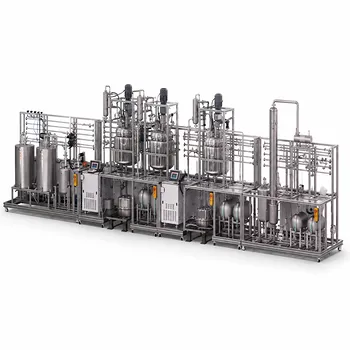
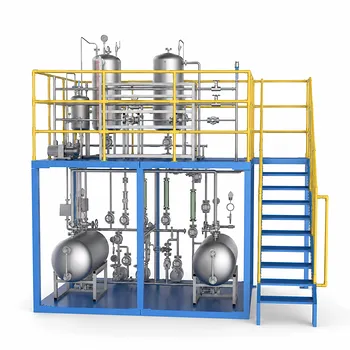
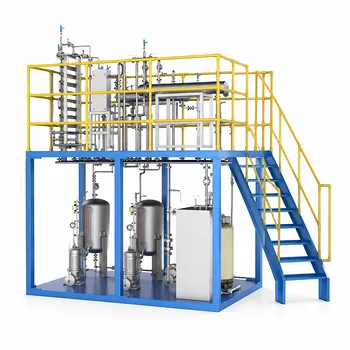
The leap from a 50-milliliter reaction flask to a 1,000-liter industrial reactor isn’t just bigger—it’s fundamentally different. Chemical synthesis unit operations pilot plants are crucial for training because they uniquely replicate the real-world physics of heat dissipation, viscosity changes, and mass transfer limitations that simply do not exist in bench-scale glassware. They give students hands-on experience in controlling exothermic reactions, tuning polymer molecular weight distributions, and managing the behavior of viscous materials—competencies that are invisible in a lab but essential for safe, scalable industrial production.
Scale-up is a physics problem, not a recipe problem. Pilot plants are the essential intermediate ground where students learn to wrestle with the heat, mass, and mixing dynamics that dictate success at scale—transforming abstract engineering theory into a tangible, trained intuition for the realities of chemical manufacturing.
The Deceptive Simplicity of Bench-Scale Chemistry
Laboratory flasks create a dangerously misleading impression of how polymer and organic reactions behave. The same chemistry that runs gently on a benchtop can become uncontrollably hazardous or fail to meet quality targets when scaled up, precisely because the physical environment changes.
The Heat Transfer Cliff
In a small flask, an exothermic reaction’s heat dissipates rapidly through the glass walls. At pilot scale, the volume grows cubically while the surface area for heat removal grows only quadratically. This means the same reaction that felt mildly warm in the lab can generate a thermal runaway in a pilot reactor if students haven’t been trained to manage cooling jackets, feed rates, and temperature profiles under realistic heat transfer limitations.
The Viscosity Trap
Many polymerization reactions see their viscosity increase by orders of magnitude as molecular weight builds. Mixing a highly viscous, gel-like material in a small beaker tells you nothing about the severe power requirements, shaft torque, and stagnant zones that appear in a stirred tank reactor. Pilot plants force students to confront these non-Newtonian fluid behaviors, selecting impeller types and agitation speeds that can actually maintain bulk motion and avoid local hot spots.
The Mixing and Mass Transfer Blind Spot
Bench-scale reactions are often kinetically controlled. In a large vessel, slow mixing and poor interfacial mass transfer can become the rate-limiting steps. A student who has only ever run a small, well-mixed round-bottom flask will never learn how to diagnose yield drops caused by gas-liquid dispersion inefficiency or by concentration gradients in a poorly baffled reactor—until they operate a pilot unit designed to reveal those flaws.
How Pilot Plants Replicate the Industrial Reality Students Must Master
Educational unit operations pilot plants are not oversized laboratory equipment. They are engineered to give students direct, tactile experience with the control knobs and problem indicators that industrial chemical engineers rely on daily.
Managing Exothermic Reactions Under Realistic Thermal Load
Instead of simply watching a thermometer, students learn to orchestrate jacket temperature ramps, controlled reagent dosing, and emergency quench systems. They feel the real-time interplay between cooling capacity and reaction heat generation, developing a visceral understanding of the thermal inertia that makes scale-up so risky.
Controlling Polymer Architecture and Molecular Weight
On a pilot reactor, students can actively manipulate molecular weight distribution through residence time, initiator dosing strategy, and temperature uniformity—parameters that are largely forgiving in a test tube but become the primary levers of product quality at scale. This hands-on tuning directly connects process conditions to the final polymer’s mechanical properties.
Handling the Physical Properties of Viscous Materials
Pilot trains students to think like process engineers: how to empty a reactor containing a 10,000-centipoise organic melt, how to prevent plugging in transfer lines, and how to sustain agitation without breaking the impeller shaft. These are not trivial tasks, and a single mistake at production scale can cost hours of downtime and thousands of kilograms of wasted product.
From Observation to Prediction: Bridging Theory and Practice
Pilot plants are also the critical link where simulation models get validated and refined. Without physical data, digital twins are just educated guesses.
Collecting Empirical Data to Ground Simulation Models
Process simulation tools can predict capacity and identify bottlenecks, but only if students feed them real heat-transfer coefficients, real reaction kinetics under mixing constraints, and real residence time distributions. Pilot plants generate that empirical data, teaching students that a model’s predictive power is only as strong as the physical experiments that anchor it.
Understanding the Process Signature
Scale-up isn’t about matching a single end-point parameter like purity. It’s about mapping product quality in a multivariate space and then reproducing the entire process path—the energy, mass, and momentum balances—that created that quality. With sensor-equipped pilot units, students learn to use historical data and latent variable methods to define these process signatures, preparing them for the tech-transfer teams that transfer products between sites.
De-risking the Commercial Leap
In industry, moving directly from milligrams to metric tons is an unacceptable financial gamble. Pilot plants allow students to experience the same iterative de-risking logic: test at a manageable volume, identify unforeseen side reactions or impurity build-up in recycle streams, and gather realistic economic data on yield and by-product handling. They learn that physical validation is a non-negotiable step before committing capital.
Understanding the Trade-offs of Pilot Plant Training
While the benefits are immense, relying on pilot plants in an educational setting also presents genuine challenges that must be addressed to maximize learning.
They Are Not Perfect Scale-Downs
A pilot reactor cannot perfectly mimic every full-scale phenomenon; for example, wall effects can still dominate heat transfer in a 20-liter vessel in ways they do not in a 20,000-liter reactor. Students must be taught to discern which physical behaviors scale linearly and which require corrected extrapolation, so they don’t assume the pilot tells the whole story.
Operational Cost and Maintenance
Running a safe pilot plant for polymers requires utilities, solvents, monomers, and robust supervisory control systems. Institutions must commit to the ongoing cost and safety management, or pilot plants risk becoming static museum pieces instead of dynamic learning tools.
The Risk of Misguided Focus on Hardware Over Method
The equipment alone does not teach. Without a structured curriculum that forces students to define a scale-up problem, design experiments, and analyze multivariate data, they may simply learn to turn valves without understanding why. The pilot plant must be woven into a pedagogy of process thinking, not just operation.
Making Pilot Plant Training Effective for Your Program
To translate access to pilot-plant hardware into genuinely prepared graduates, alignment with career outcomes is everything. Tailor the hands-on curriculum to specific training objectives.
- If your primary focus is preparing students for R&D roles in polymer and fine-chemical companies: Emphasize Design of Experiments (DOE) and the correlation of large-scale process variables (impeller speed, feed rate) with material properties like molecular weight distribution. Let them experience how small changes in a pilot kettle can shift a polymer’s performance curve.
- If your primary focus is instilling safety and process robustness: Design scenario-based exercises around managing a runaway exotherm or handling a viscous-reactor shutdown. The goal is for students to develop a reflexive respect for thermal hazards and the sheer physical forces at play in a large-scale synthesis.
- If your primary focus is bridging academic theory with industrial application: Require students to simulate a process first using computational models, then run the same chemistry in the pilot plant, and finally reconcile the predicted versus actual temperature profiles, conversion rates, and impurity levels. This closes the gap between equations and reality.
Give students the opportunity to fail safely at a small scale, and they will walk into a production environment with the judgment to succeed on the first try.
Summary Table:
| Scale-Up Challenge | Bench-Scale (Lab Flask) | Pilot-Scale (Pilot Plant) |
|---|---|---|
| Heat Transfer | Rapid dissipation, low risk of runaway | Limited surface-to-volume ratio, high thermal inertia |
| Viscosity & Mixing | Easy agitation, Newtonian behavior | High torque, non-Newtonian flow, potential hot spots |
| Mass Transfer | Kinetically controlled, uniform mixing | Mass-transfer limited, concentration gradients |
| Safety & Control | Simple manual monitoring | Complex PID control, dosing, and emergency quenching |
Empower the Next Generation of Process Engineers
Prepare your students or research teams for real-world industrial scale-up challenges. LABPARK provides high-quality Educational and Vocational Unit Operations Pilot Plants in chemical engineering, bioprocess & biotech, and environmental & water treatment for universities, research institutes, and enterprises.
Equip your laboratory with the tools to bridge the gap between academic theory and practical scale-up chemistry—contact us today to discuss your custom training solutions.
Related Products
- Carbon Dioxide Hydrogen Methanol Synthesis Educational Unit Operations Pilot Plant
- Ethyl Acetate Synthesis Unit Operations Pilot Plant for Practical Training
- Aspirin API Synthesis Unit Operations Training Pilot Plant
- Methanol Synthesis and Catalyst Performance Evaluation Educational Unit Operations Pilot Plant
- Carbon Dioxide Hydrogenation Methanol Synthesis Educational Unit Operations Pilot Plant
People Also Ask
- How do temp & pressure affect methanol synthesis pilot plants? Optimize equilibrium and catalyst performance.
- Why is a purge system necessary when operating a gas recirculation loop in a methanol synthesis pilot plant? (Guide)
- Why do modern methanol pilot plants operate at lower pressures? Catalyst & Feed Requirements Explained
- What are the operational requirements for catalyst activation? Safe Methanol Pilot Plant Operation
- Why is the chemical plant startup schedule crucial? De-risk scale-up with pilot plants.