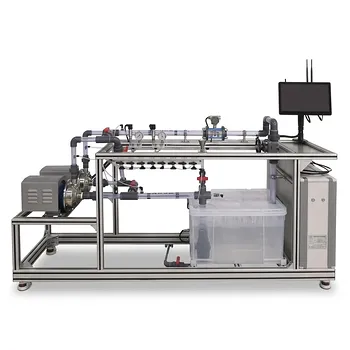
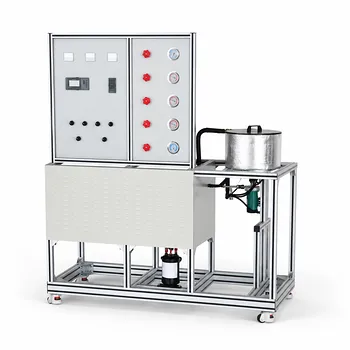
Surface tension doesn’t just scale down with a model—it waits to ambush your results. When you’re setting up a thin-sheet flow or spillway experiment on an educational hydraulics bench, the Weber number is your main defense against scale effects that silently break similitude. If the water film becomes too thin or the velocity too low, surface tension forces—negligible in the full-scale dam—suddenly dominate the tiny model, completely distorting the flow pattern you’re trying to observe.
The core problem isn’t just that surface tension is present; it’s that small-scale models easily fall into a regime where the Weber number is so low that fluid behavior is governed by surface tension instead of inertia. In spillway and thin-sheet flows, the practical takeaway is simple: you must maintain sufficient flow depth and velocity to keep the Weber number high enough that surface tension doesn’t overwhelm the flow—otherwise your “spillway” behaves like a film stretched over a frame, not like the prototype gravity-driven torrent.
The Challenge of Similitude in Small-Scale Models
When a hydraulics bench shrinks a prototype down to educational size, not all forces shrink equally. The Weber number is the tool that helps you identify when surface tension is pretending to be something it’s not.
What Is the Weber Number?
The Weber number ((N_W)) is the ratio of inertia forces to surface tension forces. It’s defined as:
[ N_W = \frac{V}{\sqrt{\sigma/(\rho L)}} ]
- (V) is a characteristic velocity.
- (\rho) is the fluid density.
- (L) is a characteristic length (often the flow depth or sheet thickness).
- (\sigma) is the surface tension coefficient.
A high Weber number means inertia calls the shots—surface tension is just along for the ride. A low Weber number means the liquid behaves more like a cohesive, stretchy membrane than a free-flowing stream.
Why Surface Tension Becomes a Problem at Small Scales
In a full-scale spillway, you rarely care about surface tension because inertia is enormous. Water roars down at high speed and in thick layers, crushing surface tension into insignificance.
But on a hydraulics bench model, the scale collapses. Now the tiniest film of water can become the dominant feature. If water flows over a model spillway crest in a sheet that is only a millimeter or two thick, the ratio of surface tension forces to inertia skyrockets—the Weber number plummets. The flow may cling, ripple, or even break up in ways that have nothing to do with gravity-driven spillway dynamics, because surface tension is now the lead actor. This violates similitude, making your experimental results meaningless as representations of the prototype.
Practical Implications for Educational Hydraulics Benches
The educational bench forces you to work in a narrow sweet spot. You must keep the model small enough to fit the bench, yet large and fast enough to stay in an inertia-dominated regime.
Minimum Flow Depth and Velocity
Your main safeguard is to avoid flow depths that dip into the surface-tension danger zone. A thin sheet of water, perhaps only 2–3 mm thick over a broad crest, will have a very low Weber number. By raising both the flow rate and the effective depth, you increase inertia relative to surface tension, pushing the Weber number back into the safe, prototype-like range.
Even a modest increase in water depth can dramatically cut down surface tension’s influence, because the characteristic length (L) enters the denominator of the Weber number’s surface tension term (( \sigma/(\rho L) )).
Avoiding Scale Effects
Scale effects are not a minor annoyance; they are a fundamental breakdown of your model’s purpose. If surface tension governs the model flow because the Weber number is too low, you are no longer observing a scale version of gravity-driven spillway behavior—you’re observing a different physics altogether.
To avoid this, always check the Weber number early in your experimental design. Compare it to the prototype’s Weber number. If the model’s Weber number is much lower, adjust the flow conditions or even enlarge the model to ensure that inertia forces dominate the flow just as they do in the full-scale structure.
Understanding the Trade-offs
Educational benches are constrained systems, so ignoring Weber number considerations leads to a false economy of time and resources.
- Pump capacity limits may make it tempting to run at the thinnest flow possible to create a “visible” sheet. But that thin sheet is exactly where surface tension ruins your data. You trade real hydraulic insight for a visually pretty but physically distorted film.
- Water recycling and model size often push designs toward miniature versions. A tiny model saves bench space and water, but it forces flow into a surface-tension-dominated regime unless you deliberately break the miniaturization by using artificially high flow rates and larger crest radii.
- The educational context carries a double risk: students may not yet suspect that surface tension could be a culprit. An instructor who fails to explain the Weber number’s role leaves learners with a mistaken intuition that “the model works just like the real thing, only smaller.”
Acknowledging these trade-offs doesn’t mean experimental setups are impossible; it means good design starts by checking that the Weber number is convincingly high enough for the flow to behave like a prototype.
Making the Right Choice for Your Goal
How you handle the Weber number depends squarely on what you need the experiment to teach.
- If your primary focus is a qualitative visual demonstration of spillway flow: Aim for the highest practical flow rate that your bench pump can sustain while maintaining a free, inertia-driven sheet. A thicker, faster sheet may not look as delicate, but it correctly represents the prototype’s dynamics.
- If your primary focus is quantitative measurement and scaling: Make a deliberate check of the Weber number. If it’s uncomfortably low, either increase the model scale, raise the flow depth, or consider using a fluid with lower surface tension (though water is standard). Never present quantitative results without documenting that surface tension effects are negligible.
When you respect the Weber number, you’re not just obeying textbook similitude—you’re ensuring that the cascade of water you see on the bench genuinely tells the same story as the one thundering down a prototype spillway.
Summary Table:
| Parameter / Regime | High Weber Number (Inertia Dominated) | Low Weber Number (Surface Tension Dominated) |
|---|---|---|
| Dominant Force | Inertia (Gravity-driven flow) | Surface Tension (Cohesive forces) |
| Flow Behavior | Free-flowing, matching prototype | Clinging, rippling, film-like behavior |
| Similitude | Maintained (Accurate scale modeling) | Violated (Distorted scale effects) |
| Action Required | Maintain sufficient depth & velocity | Increase model scale or boost flow rates |
Elevate Your Engineering Lab with LABPARK
Ensure experimental accuracy and eliminate scale-effect errors in fluid mechanics education. LABPARK provides state-of-the-art Educational and Vocational Unit Operations Pilot Plants in chemical engineering, bioprocess & biotech, and environmental & water treatment designed for universities, research institutes, and enterprises.
Ready to upgrade your laboratory equipment? Contact LABPARK today to discuss our custom pilot plant solutions and educational setups!
Related Products
- Liquid-Liquid Mass Transfer Coefficient Determination Educational Pilot Plant
- Plate Column Hydrodynamics Tray Demonstration Educational Pilot Plant
- Multifunctional Membrane Separation Educational Pilot Plant with Ultrafiltration, Nanofiltration, Reverse Osmosis
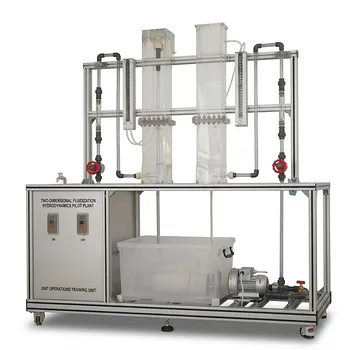
- Two-Dimensional Fluidization Hydrodynamics Educational Pilot Plant for Unit Operations Training
- Micro-Scale Gas-Solid Catalytic Reaction Educational Pilot Plant
People Also Ask
- Why Compare Membrane-Reservoir Models with Pilot Plant Data? Ensure Successful Process Scale-Up
- How does column packing affect absorption intensification, and how is it evaluated experimentally?
- What are the limitations of the Wilke-Chang correlation? Avoid critical mass transfer errors.
- What is the role of the Sherwood number ($Sh$) in pilot plants? Master mass transfer scale-up
- Why is the calculation of gas and liquid diffusion coefficients critical? Unlock Accurate Pilot Plant Scale-Up