A microscopic layer of scale is all it takes to compromise your pilot plant. The study of scale thermal conductivity is critical because scale deposits on heat exchange surfaces act as a potent thermal insulator—conducting heat 50 to 85 times slower than the underlying metal. This insulation leads directly to reduced heat transfer efficiency, localized overheating, and potential tube failure, while simultaneously corrupting the energy balance data you rely on to evaluate boiler feedwater treatment processes.
The enormous gap between the high thermal conductivity of metal tubes and the near-ceramic insulating properties of scale turns even a paper‑thin deposit into a performance‑shattering and safety‑critical defect. Understanding this gap is the foundation of both reliable pilot plant operation and meaningful evaluation of water pretreatment technologies.
The Physics of Heat Transfer and Scale’s Insulating Effect
Understanding Thermal Conductivity and Fourier’s Law
Heat transfer across a solid wall is governed by Fourier’s law of heat conduction. The rate of heat flow is directly proportional to the material’s thermal conductivity (λ).
Metals like carbon steel are chosen for boiler tubes precisely because they conduct heat rapidly. Carbon steel, for instance, has a thermal conductivity of 0.11 g‑cal/(sec)(cm²)(°C/cm). This high value ensures that the energy from combustion is efficiently transferred to the water inside the tubes.
The 50-to‑85‑Times Barrier
Scale compounds are the opposite. Calcium carbonate (CaCO₃), a common hardness scale, has a thermal conductivity of only 0.0022 g‑cal/(sec)(cm²)(°C/cm). Calcium sulfate (CaSO₄) is similarly low at 0.0031, and aluminum oxide (Al₂O₃) is even worse at 0.0013.
This means that carbon steel conducts heat roughly 50 to 85 times better than these deposits. A scale layer just a few tenths of a millimetre thick creates a thermal barrier comparable to adding a layer of high‑performance insulation to the tube wall.
From Thin Layer to Overheating
This insulation effect forces the metal on the fireside to run much hotter than intended. The heat struggles to pass through the scale, so the tube wall temperature climbs relentlessly.
Persistent overheating leads to creep, oxidation, and eventually tube rupture. In a pilot plant, this not only ruins an experimental campaign but also poses a genuine safety risk to operators. The metal failure is a direct consequence of the scale’s miserably poor thermal conductivity.
Why This Matters in a Pilot Plant Setting
Safeguarding Equipment and Personnel
A pilot plant is a condensed version of an industrial unit, and its small size means it has less thermal inertia. Temperature excursions happen faster. When scale partially insulates a heat exchanger tube, the metal can overheat and fail rapidly.
Understanding scale thermal conductivity is therefore a prerequisite for safe operation. It allows you to predict when a tube is approaching a dangerous temperature and to set meaningful clean‑up triggers based on heat transfer degradation, not just visual inspection.
Ensuring Accurate Experimental Results
Research and teaching pilot plants exist to generate reliable data for designing full‑scale plants. Scale introduces an uncontrolled variable that distorts every heat transfer measurement.
Energy balances become invalid because the rate of heat input to the fluid is no longer what the instrument readings suggest. Temperature‑dependent thermal conductivity effects (both of the metal and the scale) compound the error. Without accounting for scale, students and researchers will draw incorrect conclusions about process efficiency, chemical dosing, and equipment sizing. Supplementary experiments on conductivity require constant temperature conditions; scale‑induced hotspots violate this control and ruin the accuracy of thermodynamic constant derivations.
Evaluating Pretreatment Technologies
The core purpose of a boiler feedwater pilot plant is often to test whether a specific pretreatment—ion exchange, deaeration, or chemical inhibitor—can keep surfaces clean. The best way to judge that effectiveness is through thermal performance.
By studying the thermal conductivity of scale that does form, you can distinguish a marginally effective treatment from one that truly prevents the insulating deposits. A pretreatment that reduces scale thickness by 50% but leaves a tenacious, low‑conductivity film may be no better than one that leaves a thicker but more conductive deposit. The thermal conductivity number quantifies the real impact on heat transfer, making it the ultimate performance metric.
Understanding the Trade‑offs and Pitfalls
Focusing solely on thermal conductivity can still lead you astray if you ignore other operational realities. Scale also increases pressure drop by roughening tube surfaces, and it can promote under‑deposit corrosion that pinholes tubes long before they overheat. A deposit with slightly better conductivity might be more corrosive, so material selection and water chemistry interplay in ways that a single number can’t capture.
Additionally, thermal conductivity values are not constants. They change with temperature, and the scale composition in your pilot plant may differ from textbook examples. Relying on literature values without verifying the actual deposit chemistry can mislead your energy balance calculations. Finally, rigorous temperature control across the entire pilot unit is essential; failing to compensate for ambient heat loss or to maintain a constant cold‑side inlet temperature will introduce errors that dwarf the scale’s insulating effect, burying the very signal you are trying to detect.
Making the Right Choice for Your Pilot Plant Operation
Every decision you make around operation, measurement, and shutdown schedules should be rooted in the reality of scale’s extreme insulating capacity. Here is how to align that knowledge with your primary goal:
- If your primary focus is evaluating chemical treatment programs: Place continuous heat transfer monitoring at the centre of your test protocol, using overall heat transfer coefficient decline as a direct, real‑time indicator of scale’s insulating effect.
- If your primary focus is accurate energy balance calculations: Implement rigorous, automated temperature control on all streams and use a thermostatic bath for any offline conductivity measurements. Treat even a suspicion of scale as a reason to derate the tube’s effective thermal conductivity in your model.
- If your primary focus is operational safety: Define your shutdown limits not by hours of operation but by a maximum allowable reduction in heat transfer efficiency, because temperature rise inside the metal is directly linked to the scale’s conductivity—not just its thickness.
Mastering the study of scale thermal conductivity transforms it from a routine water chemistry concern into the precise diagnostic tool that ensures your pilot plant is safe, your data is trustworthy, and your treatment recommendations are built on unshakeable physical reality.
Summary Table:
| Material | Thermal Conductivity (g-cal/sec·cm²·°C/cm) | Insulation Impact Compared to Steel |
|---|---|---|
| Carbon Steel (Boiler Tube) | 0.1100 | Baseline (Efficient Heat Transfer) |
| Calcium Sulfate (Scale) | 0.0031 | ~35 times more insulating |
| Calcium Carbonate (Scale) | 0.0022 | ~50 times more insulating |
| Aluminum Oxide (Scale) | 0.0013 | ~85 times more insulating |
Optimize Your Water Treatment & Thermal Engineering Research with LABPARK
Scale formation can compromise both your pilot plant's safety and the accuracy of your experimental data. At LABPARK, we design and supply premium Educational and Vocational Unit Operations Pilot Plants in chemical engineering, bioprocess & biotech, and environmental & water treatment.
Specially tailored for universities, research institutes, and enterprises, our pilot plants feature precise instrumentation and advanced thermal monitoring to help you study scale effects, test pretreatment technologies, and ensure accurate energy balances.
Ready to elevate your laboratory capabilities? Contact LABPARK today to find the perfect pilot plant solution for your institution!
Related Products
- Dual-Mode Rectification Pilot Plant for Practical Training Unit Operations
- Hot Filtration Educational Unit Operations Pilot Plant Laboratory System
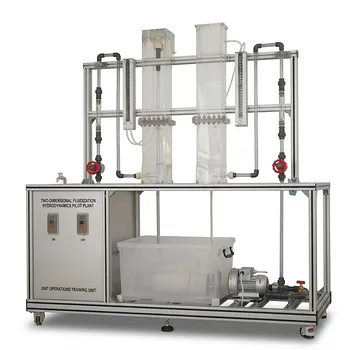
- Two-Dimensional Fluidization Hydrodynamics Educational Pilot Plant for Unit Operations Training
- Electrochemical Water Treatment Educational Unit Operations Pilot Plant
- Multi-Functional Membrane Separation Educational Pilot Plant for Unit Operations Lab
People Also Ask
- How does polyphosphate hydrolysis affect scale and corrosion in pilot plants? Essential Monitoring Guide
- How do predictive thermodynamic models integrate into pilot plants? Bridging Theory and Practice
- Why Use Center Points in Process Analyzer Calibration? Key Benefits Explained
- Which cross-validation strategy should be selected for pilot plant time-series & batch data? Avoid Data Leakage
- How can process control schemes be configured to teach basic and advanced control?