Catalytic activity is not a uniform property of a material—it is a defect-driven phenomenon.
When training students on catalytic reactors, a deep study of crystal defects transforms the catalyst from a mysterious “black box” into a predictable, engineerable component. It directly links atomic-level imperfections—like missing atoms or extra ions—to the macroscopic metrics chemical engineers care about: reaction rate, yield, selectivity, and reactor safety. Without this understanding, future engineers risk operating reactors with an incomplete model of what really drives their performance.
The study of crystal defects equips students with a causal, not just correlational, understanding of catalysis. It allows them to connect material science to unit operations, design better processes, and anticipate reactor behavior under stress—turning catalysis into a controllable variable rather than an empirical constant.
The Microscopic Origin of Macroscopic Reactor Performance
What Are Crystal Defects in a Catalyst?
Real catalyst crystals are never perfect. They contain point defects like vacancies (missing atoms) and interstitials (extra atoms wedged into the lattice).
Line defects (dislocations) and planar defects (grain boundaries) also exist. These imperfections break the periodic order of the surface.
A defect site is chemically less saturated, dangling bonds exposed, electronic configuration distorted—exactly what makes it reactive.
Why Defects Become Active Sites
The key is energy: atoms at a defect site have a higher surface free energy than atoms on a perfect terrace.
They are more eager to form bonds with incoming molecules, lowering the activation barrier for the rate-determining step.
This is why only a small fraction of a catalyst’s surface often dominates the overall activity. Students who grasp this stop thinking about “total surface area” alone and start thinking about active site density.
The Direct Link to Adsorption and Reaction Kinetics
Reaction kinetics in a catalytic reactor are not defined by an average catalytic surface; they are an ensemble of fast-on-defect and slow-on-perfect-site rates.
When students model a reactor, incorporating a term for defect concentration directly refines the rate law.
It also explains phenomena like structure sensitivity: reactions that speed up dramatically on certain crystal facets, which are really proxies for defect-rich geometries.
From Lecture Hall to Pilot Plant: The Educational Imperative
Bridging the Gap Between Materials Science and Unit Operations
Chemical engineering curricula often teach catalysis and reactor design in separate silos. Teaching crystal defects forcibly bridges this gap.
Students see that catalyst synthesis (calcining, doping, reduction) is an exercise in defect engineering, and reactor throughput is the direct consequence.
This integration is critical in pilot plant training, where they troubleshoot real reactors and must diagnose why activity decays.
Predicting Real Reactor Behavior
Defects are not static. Under reaction conditions, they can sinter, coalesce, or be blocked by coke.
Understanding this helps students predict deactivation curves, interpret catalyst regeneration cycles, and avoid operating in regimes that accelerate defect annihilation.
It also underpins the logic behind temperature-programmed desorption (TPD) and other characterization methods they encounter in the lab.
Designing for Safety and Efficiency
A reactor with poorly understood active site distribution can develop hot spots—local runaway exotherms on hyperactive defect clusters.
Students who appreciate defect-driven kinetics learn to design heat management strategies, select appropriate diluents, and set safe operating envelopes.
This makes crystal defect education a direct contributor to process safety, not just an academic curiosity.
Understanding the Trade-offs and Limitations
Not All Defects Are Desirable
Excess defects can promote unwanted side reactions, leading to lower selectivity or carbon deposition that deactivates the catalyst.
Students must learn that defect engineering is a balancing act: the goal is the right type and density of defect, not merely more defects.
Over-fixation on defects also risks ignoring the role of promoters, supports, and pore diffusion—a holistic view is essential.
The Classroom-to-Industry Pitfall
In industry, defect populations are rarely characterized directly; engineers rely on indirect measures like activity tests.
Training should therefore teach students to infer defect behavior from global reactor data while maintaining skepticism of over-simplified models.
This realism prevents the “perfect catalyst” fantasy and prepares them for messy, real-world optimization.
How to Apply This to Your Reactor Training Program
Use these targeted strategies to embed crystal defect theory into your curriculum effectively:
- If your primary focus is fundamental understanding: Start with scanning-tunneling-microscopy images and simple kinetic models that show how a 1% vacancy increase can double the rate. Let students calculate active site turnover frequencies.
- If your primary focus is reactor optimization: Have students run the same reaction over catalysts with different thermal histories, then fit the activity data to defect-annihilation models. This connects synthesis directly to operating cost.
- If your primary focus is process safety and troubleshooting: Use case studies of industrial catalyst failures caused by localized defect hotspots or sintering. Let students redesign the reactor temperature control to prevent a recurrence.
When you teach the reactor through the lens of crystal defects, you equip students with a mental model that turns the unit operation into a predictable, engineerable system—atom by atom.
Summary Table:
| Training Focus | Impact of Crystal Defects | Educational Value |
|---|---|---|
| Kinetics & Activity | Creates active sites with high surface free energy | Shifts student mindset from total area to active site density |
| Reactor Safety | Can cause localized hot spots & runaway reactions | Teaches students to design heat management & diluent strategies |
| Deactivation | Promotes sintering, coking, & defect annihilation | Helps students predict deactivation curves & regeneration cycles |
| Optimization | Balances defect density against selectivity loss | Prepares students for real-world, empirical process optimization |
Elevate Your Chemical Engineering Lab Training
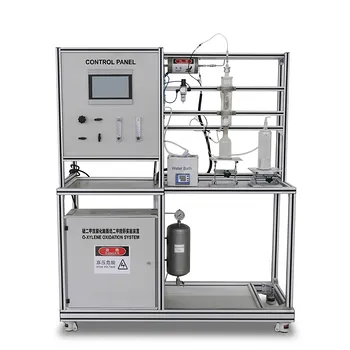
Bridging the gap between materials science and reactor operations requires hands-on, high-quality training equipment. LABPARK provides state-of-the-art Educational and Vocational Unit Operations Pilot Plants in chemical engineering, bioprocess & biotech, and environmental & water treatment. Designed specifically for universities, research institutes, and enterprises, our pilot plants empower students and researchers to safely study real-world catalysis, kinetics, and reactor dynamics.
Ready to upgrade your laboratory capabilities? Contact LABPARK today to request a quote or custom consultation!
Related Products
- Multi Functional Catalytic Reaction and Reactor Evaluation Educational Unit Operations Pilot Plant
- Micro-Scale Gas-Solid Catalytic Reaction Educational Pilot Plant
- Internal Circulation Gradient Free Catalytic Reaction Educational Pilot Plant
- Fixed Bed Gas Solid Catalytic Reaction Educational Pilot Plant
- Fluidized Bed Gas Solid Catalytic Reaction Educational Pilot Plant
People Also Ask
- What reaction engineering principles are shown in a catalytic reactor pilot plant? SO2 Oxidation Guide
- How does feed gas flow rate affect catalytic RFR yields? Optimize Pilot Plant Performance
- Why is FTIR integration in catalytic pilot plants important? Real-Time Student Insights
- How to analyze active metal distribution & identify catalyst poisoning in pilot plants? Expert Diagnostic Guide
- How to study catalyst poisoning & regeneration? Master catalytic reaction life cycles.