Ignoring their interdependence is a recipe for flawed design. Simultaneous estimation of the reaction rate constant and dispersion coefficient is essential because the outlet concentration you measure in a laminar flow tubular reactor is a single, coupled response of both chemistry and physics. Estimating them together from the same experimental data prevents the dangerous propagation of errors that inevitably occurs when one parameter is fixed using an independent, often unreliable, measurement. This approach delivers a self-consistent model that faithfully represents the true, intertwined processes in your pilot unit.
Your reactor’s outlet concentration doesn’t care whether a pulse was broadened by slow reaction or poor mixing—it only sees their combined footprint. Decoupling them artificially forces error into both parameters. Simultaneous estimation honors that fundamental coupling, giving you a parameter set that works as a system, not as isolated guesses.
The Inseparable Duo: Reaction and Radial Transport
In a laminar flow tube, the parabolic velocity profile creates a distribution of residence times across the streamlines. A molecule near the wall lingers far longer than one at the center. Consequently, the conversion you measure is not simply a function of reaction kinetics; it is profoundly shaped by how quickly reactants can migrate radially from slow-moving layers to faster ones.
How Velocity Profile and Radial Mixing Shape Concentration
A reactant molecule traveling along the wall has ample time to convert, while a centerline molecule may exit unconverted. Radial diffusion (or dispersion) counteracts this, shuttling material across streamlines. This mixing gives the overall conversion an apparent “sense” of both the rate constant and the dispersion coefficient. The outlet concentration is therefore a single fingerprint of their simultaneous action—not a sum of independent contributions.
Why Assuming a Fixed Dispersion Coefficient is Risky
A common shortcut is to measure the dispersion coefficient separately, for instance via a tracer pulse in a non-reacting flow, and then hold it constant while regressing the rate constant. This is perilous. The tracer study may be conducted at different temperature, viscosity, or flow conditions, and it misses any reaction-induced property changes. If that pre-assumed dispersion value is off by even a small amount, the fitted rate constant will drift to compensate, absorbing the model mismatch. You end up with a kinetic parameter that is no longer a true rate constant—it’s a hybrid of chemistry and incorrectly accounted physics.
The Peril of Parameter Error Propagation
In nonlinear regression, errors in one fixed parameter cascade directly into the estimated values of the others. This creates a false sense of certainty about your kinetic data.
The Domino Effect of Incorrect Assumptions
If the fixed dispersion coefficient is too low, the model will think the reactor behaves more like segregated layers. To match the observed conversion, the algorithm will artificially raise the rate constant, making the reaction appear faster than it truly is. The error is systematic, not random. This biased kinetic constant can mislead scale-up calculations, catalyst efficiency assessments, and safety analysis. The resulting model looks good on the fit plot but fails predictively.
How Simultaneous Estimation Breaks the Cycle
When both parameters are free, the regression optimization sees the full landscape. It can find the unique combination of rate constant and dispersion that truly minimizes the residual between model and data. The two parameters are now self-consistent: they mutually constrain each other based on the actual concentration field. A slightly higher dispersion will naturally demand a slightly lower rate constant to achieve the same global conversion, and the algorithm can objectively explore this trade-off using the data itself. This yields parameters that are physically meaningful, not just statistically convenient.
Understanding the Trade-offs
Simultaneous estimation is powerful, but it is not free. You must be aware of the challenges it introduces.
Increased Data Requirements and Computational Cost
Fitting two tightly coupled parameters demands richer data. A single steady-state conversion point is often insufficient to separate the effects—you need velocity-averaged outlet concentrations at multiple axial positions or at varying flow rates. The optimization landscape also becomes more complex, with potential for multiple local minima. In practice, this means you must invest in a well-designed experimental matrix and a robust parameter estimation routine, but the reward is a model that generalizes beyond the fitted points.
The Risk of Multi-Parameter Correlation
If your data lacks sufficient sensitivity, the rate constant and dispersion coefficient can become highly correlated. The fitting algorithm may then give you a range of equally plausible pairs, leading to large individual uncertainties. This is not a failure of the simultaneous approach; it is an honest diagnosis that your experiment cannot decouple the two phenomena with the available information. You then know you need to augment your data—perhaps by adding tracer co-injection or temperature-sweep experiments—rather than hiding the correlation behind a fixed assumption.
Making the Right Choice for Your Goal
The decision of whether to fix or fit a parameter hinges on what you ultimately need the model to accomplish. Use the following guiding principles based on your primary focus.
- If your primary focus is obtaining intrinsic kinetic constants: Simultaneous estimation is non-negotiable. It prevents the dispersion uncertainty from bleeding into your rate constant, giving you a chemically meaningful number that you can compare across scales and reactor types.
- If your primary focus is building a predictive reactor-scale model: Fit both parameters. A model with self-consistent transport and kinetics will extrapolate more reliably to new flow rates and concentrations because it doesn’t carry a hidden, pre-assumed dispersion bias.
- If your primary focus is troubleshooting an existing unit with limited data: Recognize the limitation. If you must fix the dispersion coefficient from a separate correlation, perform a sensitivity analysis. Vary the assumed dispersion by ±20% and see how much your fitted rate constant changes. This tells you the worst-case error you are accepting.
When chemistry and physics dance, you must listen to the whole rhythm. Simultaneous estimation forces your model to hear both partners, delivering a trustworthy choreography for your reactor design.
Summary Table:
| Estimation Method | Kinetic Parameter Accuracy | Scale-up Reliability | Experimental Data Needs |
|---|---|---|---|
| Simultaneous Estimation | High (prevents error propagation) | High (self-consistent model) | High (requires multi-point data) |
| Sequential/Fixed Estimation | Low (absorbs transport mismatches) | Low (prone to extrapolation failures) | Low (uses basic tracer studies) |
Scale Up with Precision: Choose LABPARK Pilot Plants
Accurate kinetic modeling depends on reliable experimental data. LABPARK offers state-of-the-art Educational and Vocational Unit Operations Pilot Plants in chemical engineering, bioprocess & biotech, and environmental & water treatment. Tailored for universities, research institutes, and enterprises, our systems provide the precise control and rich data needed to successfully estimate complex parameters and avoid scale-up failures.
Ready to elevate your laboratory’s research and training capabilities? Contact LABPARK today to request a quote or consultation.
Related Products
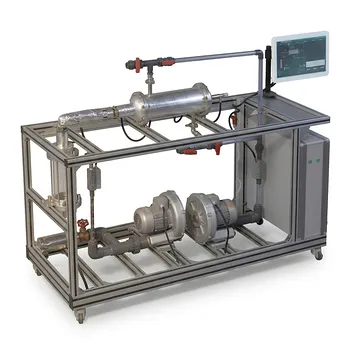
- Tubular Reactor Flow Characteristics Determination Educational Unit Operations Pilot Plant
- Residence Time Distribution and Reactor Flow Characteristics Determination Educational Pilot Plant
- Educational Unit Operations Pilot Plant for Intraparticle Diffusion Effective Factor Measurement
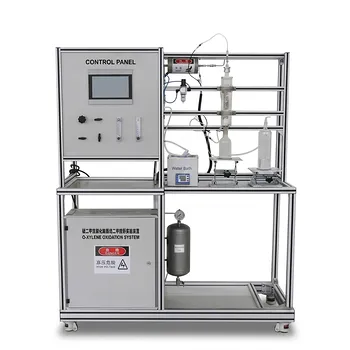
- O-Xylene Oxidation to Phthalic Anhydride Educational Unit Operations Pilot Plant
- Fixed-Bed Chemical Reaction and Gas Dust Tar Removal Unit Operations Pilot Plant
People Also Ask
- How do educational unit operations pilot plants address safety and waste management when scaling up?
- How do educational unit operations pilot plants bridge theory and design? Bridge the Engineering Gap
- What are the formulas for single-pass vs overall conversion in pilot plants? Master reactor mass balances
- Why are implicit numerical methods preferred for stiff kinetics? Optimize Reactor Simulation
- How Do Pilot Plants Teach Limiting Reactants, Yield, & Selectivity? Real-World ChE Practice