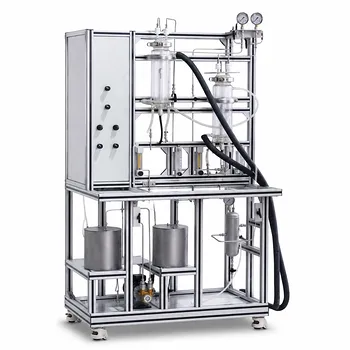
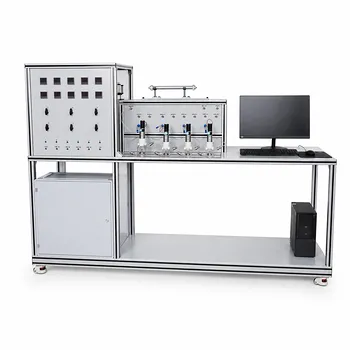
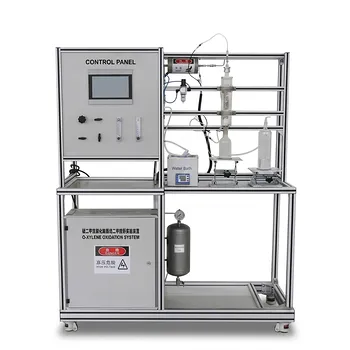
The integration of catalytic shift reactors is critical because they are the most direct and practical teaching tool for the core of syngas conditioning. These reactors physically demonstrate how to adjust the all-important hydrogen-to-carbon-oxide ratio required for downstream synthesis or methanation. More than just a gas conversion step, a shift reactor in a pilot plant is an integrated lesson in exothermic reaction engineering, multi-stage thermal management, and the real-world choreography of bypass streams to achieve target gas compositions.
A catalytic shift reactor is far more than a syngas conditioner. In an educational pilot plant, it serves as a living curriculum—immersing students in reaction equilibrium, temperature staging, and catalyst dynamics while directly tackling the hardest challenge of gas synthesis: making the right gas, at the right ratio, under safe, controllable conditions.
The Shift Reactor as a Pedagogical Powerhouse
The primary reference identifies the twin functions of a shift reactor: compositional control and operational education. But its true pedagogical depth becomes clear when you see how it concentrates multiple core chemical engineering principles into a single, observable process.
Mastering Exothermic Equilibrium in Real Time
The water-gas shift reaction is exothermic and equilibrium-limited. This forces students to confront a fundamental conflict: high temperatures speed up kinetics but hurt equilibrium conversion.
In a pilot plant, learners can alter feed temperatures, measure outlet compositions, and watch the shift in equilibrium constants firsthand. They quickly grasp why industrial processes use multiple adiabatic stages with inter-stage cooling—a design principle that is often abstract in textbooks but visceral when you touch the cold inlet and hot outlet lines.
Multi-Stage Temperature Control and Bypass Management
Achieving the precise H₂/COₓ ratio is never simply a matter of running a single bed at one temperature. Temperature control across high-temperature (HT) and low-temperature (LT) shift stages is paramount.
Students learn to operate the HT shift for rapid bulk conversion, then the LT shift for final equilibrium pushing. Even more instructive is bypass stream management—splitting a portion of the feed around a reactor to fine-tune the final gas ratio without over-converting. This hands-on division of flows teaches process flexibility and control far more powerfully than any simulation.
Catalyst Activity, Deactivation, and Regeneration
Shift catalysts (often iron-chrome for HT, copper-zinc for LT) introduce the reality of catalyst deactivation and activation procedures. An educational plant can incorporate in-situ temperature-programmed reduction (TPR) to activate the catalyst before reaction cycles.
Students observe how the bed transitions from inert oxide to active metal, connect pre-treatment to downstream activity, and measure deactivation over time. This instills the principle that a reactor is only as good as the catalytic surface inside it, a lesson that scales directly to industrial practice.
Bridging the Gap Between Theory and Industrial Practice
The shift reactor’s educational value explodes when you connect it to the entire gas synthesis chain. It stops being an isolated unit and becomes the linchpin of an integrated plant.
From Lab-Scale Kinetics to Plant-Scale Reality
Catalyst screening in a small test rig cannot replicate the real-world stressors that shift catalysts face: recycling effects, trace impurities, and prolonged thermal cycling. A pilot shift reactor simulates actual feed gases (with small amounts of sulfur or residual hydrocarbons) that subtly poison active sites.
This environment teaches students why catalyst selectivity and stability are just as critical as initial activity. They learn to evaluate deactivation rates and regeneration methods—skills that prevent catastrophic failures during scale-up.
Protecting Downstream Catalysts: Gas Conditioning as a Critical Unit Operation
The shift reactor is only one link in a sequential gas-conditioning chain. In a well-designed educational pilot plant, the effluent from a reformer flows through HT shift, LT shift, and then a methanation reactor.
Students measure the stepwise reduction of carbon monoxide and carbon dioxide, witnessing how residual CO—even at low ppm levels—would poison an iron-based ammonia synthesis catalyst downstream. This makes the abstract concept of catalyst poisoning tangible: the shift reactor is the guardian that keeps the entire synthesis loop alive.
Integrating Reaction and Separation: A Systems-Thinking Approach
Efficient gas synthesis isn’t just about making molecules; it’s about making the right molecules and separating them. A shift reactor explicitly alters the CO/CO₂ ratio, which dramatically impacts downstream separation unit size and energy costs.
Students can compare cases: a syngas with too much CO wastes hydrogen and burdens a later CO₂ removal unit; proper shifting reduces that load. This integration of reaction engineering with separation principles teaches the systems-level thinking that defines profitable chemical plants.
Understanding the Trade-offs and Challenges
No educational tool is perfect. Integrating a shift reactor brings complexities that, if not managed, can overwhelm the learning objectives.
Complexity vs. Educational Value
A multi-stage shift system with bypass lines, inter-coolers, and safety interlocks is operationally complex. For undergraduates, the sheer number of valves and temperature controllers can obscure the core reaction engineering lesson.
Mitigation: Start with a single-bed, isothermal laboratory reactor to cement equilibrium concepts. Then graduate to a multi-stage adiabatic pilot plant. Decouple the control system learning from the reaction learning to reduce cognitive load.
Catalyst Deactivation and Safety Concerns
Pilot shift reactors using real syngas introduce flammable and toxic gases (CO, H₂) at elevated temperatures. Catalyst beds can sinter, channel, or even form hot spots, risking a runaway.
Mitigation: Incorporate redundant temperature sensors, emergency shut-off systems, and strict standard operating procedures. Use carbon monoxide detectors and inert gas purging as non-negotiable design elements. This teaches inherent safety design as part of reactor engineering.
Pressure Drop and Reactor Design Limitations
Packing fine catalyst powders into small-diameter reactor tubes or microchannels can create severe pressure drops—easily exceeding safe limits even at low gas flow rates. This restricts achievable throughput and can misrepresent industrial fluid dynamics.
Mitigation: Introduce alternative catalyst integration concepts, such as washcoated structured packings or open-foam metal supports. This demonstrates how modern reactor design solves a fundamental transport problem, linking fluid mechanics directly to catalyst performance.
Making the Right Choice for Your Educational Goal
The way you integrate a shift reactor should mirror your primary learning outcome. Adapt the complexity and auxiliary systems to match.
- If your primary focus is fundamental reaction engineering: Use a single-stage, well-instrumented reactor. Emphasize equilibrium data collection, kinetic parameter estimation, and temperature profiles. Keep bypasses simple.
- If your primary focus is process control and plant operations: Implement the full multi-stage HT/LT shift chain with bypass stream management. Integrate a distributed control system and teach startup/shutdown logic. Prioritize safe handling of hazardous gases.
- If your primary focus is integrated plant design: Connect the shift reactor to an upstream reformer and a downstream synthesis loop (e.g., methanol or ammonia). Include purification steps like methanation or pressure-swing adsorption. Students learn to optimize the entire train, not just one unit.
- If your primary focus is catalyst research and development: Add in-situ characterization tools like TPR and gas analyzers at multiple sampling ports. Use the pilot plant to test novel catalyst formulations under industrial-like gas compositions and deactivation conditions.
Integrating a catalytic shift reactor is not just about adding another unit operation—it’s about embedding the entire discipline of reaction engineering, safety, and process integration into a tangible, measurable experience that prepares students for the complexities of real chemical plants.
Summary Table:
| Educational Goal | Key Reactor Configuration | Core Practical Concept |
|---|---|---|
| Reaction Kinetics | Single-stage, isothermal | Equilibrium limits & temp profiles |
| Process Control | Multi-stage HT/LT with bypass | Thermal management & flow control |
| Plant Integration | Reformer-to-synthesis loop | Catalyst poisoning & separation |
| Catalyst R&D | In-situ tools (TPR) & sampling | Activation, stability & deactivation |
Bring Industrial-Scale Learning to Your Lab
Looking to equip your students or research team with real-world chemical engineering experience? LABPARK provides advanced Educational and Vocational Unit Operations Pilot Plants in chemical engineering, bioprocess & biotech, and environmental & water treatment for universities, research institutes, and enterprises.
Our custom-designed catalytic reactor pilot plants ensure maximum safety, process flexibility, and hands-on pedagogical value.
Ready to elevate your engineering curriculum? Contact LABPARK today to discuss your laboratory's unique requirements!
Related Products
- Multi Functional Catalytic Reaction and Reactor Evaluation Educational Unit Operations Pilot Plant
- Internal Circulation Gradient Free Catalytic Reaction Educational Pilot Plant
- Micro-Scale Gas-Solid Catalytic Reaction Educational Pilot Plant
- Fixed Bed Gas Solid Catalytic Reaction Educational Pilot Plant
- Fixed-Bed Chemical Reaction and Gas Dust Tar Removal Unit Operations Pilot Plant
People Also Ask
- What reaction engineering principles are shown in a catalytic reactor pilot plant? SO2 Oxidation Guide
- Why is FTIR integration in catalytic pilot plants important? Real-Time Student Insights
- How to analyze active metal distribution & identify catalyst poisoning in pilot plants? Expert Diagnostic Guide
- How do temperature limits and WHSV influence catalytic reactor optimization? Scale-Up Guide
- Why is XPS Critical for Catalytic Reactor Pilot Plants? Optimize Catalyst Performance