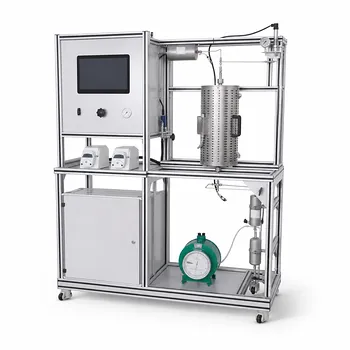
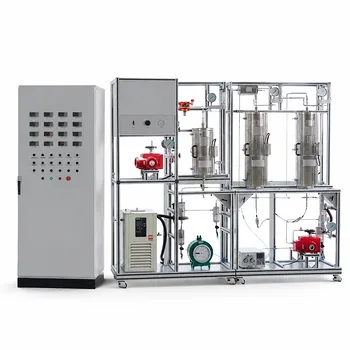
The free radical mechanism isn't just chemistry—it's the key that unlocks the kinetic data from your pilot plant. Without it, the reactor's temperature and conversion measurements are just numbers. The mechanism provides the molecular-level blueprint that justifies using first-order kinetics. This allows you to transform raw pilot plant data into reaction rate constants ($k$) and, by running experiments at different temperatures, to calculate the activation energy ($E$) and pre-exponential factor ($A$) for the hydrocarbon feed. In short, the mechanism makes the data interpretable, predictive, and scalable.
While a cracking reactor pilot plant generates data on conversion, temperature, and product yields, it's the free radical chain mechanism that provides the kinetic rationale for modeling the reaction as first-order. Understanding this connection is critical because it validates the simplified model you use to extract Arrhenius parameters ($E$, $A$), which are essential for reactor design and scale-up. The mechanism also explains byproduct formation, enabling you to deconvolute selectivity from the same data stream.
The Mechanism as the Kinetic Blueprint
The free radical mechanism is not a piece of academic trivia—it's the conceptual framework that turns a complex network into a manageable rate law. This directly governs how you analyze the pilot plant's temperature-conversion data pairs.
From Radical Chain to First-Order Model
Thermal cracking follows a cycle of initiation, propagation, and termination steps. The overall decomposition of the parent hydrocarbon is driven by the propagation loop, where radicals attack fresh feed molecules.
The concentration of active radicals reaches a pseudo-steady state very quickly. This allows the overall cracking rate to be expressed as a function of the feed hydrocarbon concentration alone. The result is a first-order kinetic model that matches the primary reference's statement. In your pilot plant, this model directly relates the measured conversion ($x$) to the rate constant ($k$) and residence time.
Extracting Activation Energy and Pre-Exponential Factor
Once you accept the first-order model, you can run the pilot plant at various temperatures while holding other parameters constant. The Arrhenius equation links $k$ to $E$ and $A$.
By plotting $\ln(k)$ versus $1/T$, you obtain a straight line whose slope gives $-E/R$ and whose intercept yields $\ln(A)$. These parameters are not empirical fits—they are rooted in the radical chain's energy barriers. This is why the mechanism is critical: it gives you permission to use this linearized analysis and trust the physical meaning of $E$ and $A$ for scale-up calculations.
Interpreting Byproducts and Selectivity
Your pilot plant's online gas chromatograph delivers a stream of data on methane, heavier hydrocarbons, and hydrogen. The free radical mechanism provides the roadmap for understanding why these byproducts exist and how their yields shift with operating conditions.
The Role of Propagation and Termination Steps
The propagation steps do more than just sustain the chain—they partition carbon into different product molecules. For example, in ethane cracking, methyl radicals abstract hydrogen to form methane, while ethyl radicals decompose to ethene and a hydrogen atom.
Termination steps recombine radicals into heavier byproducts, such as butane or higher olefins. When you change the temperature or residence time, the balance between propagation and termination shifts, directly altering the product distribution. The mechanism gives you a predictive understanding of these shifts, which is essential for assessing selectivity from kinetic data.
Using Gas Chromatography Data to Validate the Mechanism
By measuring the yields of methane, ethene, and heavier components, you can cross-validate your kinetic assumptions. If the first-order model holds, the sum of certain product yields should follow a predictable trend with conversion. Deviations signal that the mechanism's simplifications—like the steady-state radical concentration—are breaking down. Thus, the mechanism also serves as a diagnostic tool for your data quality and model fidelity.
Understanding the Trade-offs
No model is perfect, and the critical role of the free radical mechanism is also to define the boundaries of your simplified kinetic analysis. Ignoring its complexity leads to misinterpretation.
The Hidden Complexity of the Radical Network
The primary reference correctly states the primary cracking step can be modeled as first-order. But the real mechanism involves hundreds of radical pathways, especially for heavier feeds. Secondary reactions of primary products can consume ethene and produce coke precursors. A simple first-order model will absorb these complexities into an apparent rate constant, which may not hold true when scaling from pilot to commercial scale.
When First-Order Assumptions Break Down
The pseudo-steady-state assumption on radical concentration can fail at very short residence times or during start-up transients. If your pilot plant data exhibit a non-linear relationship between $\ln(1-x)$ and space time, the first-order model is no longer adequate. Recognizing this is only possible if you understand the mechanism's limitations. For deeper conversions, secondary reactions become significant, and a lumped kinetic network—still rooted in radical chemistry—may be required.
Making the Right Choice for Your Analysis Strategy
How you leverage the free radical mechanism depends on what you aim to extract from your pilot plant data.
- If your primary focus is determining Arrhenius parameters for scale-up: Rely on the mechanism to justify the first-order model at low to moderate conversions where secondary reactions are minimal. Use multiple temperature runs to extract $E$ and $A$ with confidence.
- If your primary focus is understanding product selectivity and byproduct yields: Use the detailed propagation and termination steps as a qualitative guide. Map the major byproducts (e.g., methane, heavier olefins) to specific radical pathways, and analyze trends as you vary residence time and temperature.
- If your primary focus is building a rigorous kinetic model for a new feed: Begin with the free radical mechanism to propose a reaction network, but use the pilot plant data to estimate individual rate constants for key steps, recognizing that the simple first-order approach may need to be expanded into a lumped model.
The free radical mechanism is the bridge between a raw data point and a predictive kinetic parameter—master it, and your pilot plant becomes a true engineering tool, not just a measurement device.
Summary Table:
| Kinetic Phase / Concept | Role of Free Radical Mechanism | Practical Value in Pilot Plants |
|---|---|---|
| Model Validation | Establishes a pseudo-steady state for radical species | Justifies using a simplified first-order kinetic model |
| Arrhenius Parameters | Connects temperature and conversion rates | Enables calculation of activation energy ($E$) and pre-exponential factor ($A$) |
| Selectivity & Yields | Maps propagation and termination pathways | Explains byproduct formation (e.g., methane, heavy olefins) |
| Boundary Detection | Highlights secondary reaction pathways | Identifies when first-order assumptions fail at high conversion |
Bridge the Gap Between Kinetic Theory and Process Scale-Up
At LABPARK, we empower universities, research institutes, and enterprises with state-of-the-art Educational and Vocational Unit Operations Pilot Plants in chemical engineering, bioprocess & biotech, and environmental & water treatment. Our high-precision pilot plants are engineered to deliver reliable, reproducible kinetic data, allowing your team to confidently analyze complex mechanisms and validate reactor designs.
Ready to elevate your research and engineering training? Contact LABPARK today to find the perfect pilot plant solution for your lab!
Related Products
- Fixed Bed Gas Solid Catalytic Reaction Educational Pilot Plant
- Multi-Reactor Educational Pilot Plant for Reaction Engineering Unit Operations
- Residence Time Distribution and Reactor Flow Characteristics Determination Educational Pilot Plant
- Fixed-Bed Chemical Reaction and Gas Dust Tar Removal Unit Operations Pilot Plant
- Tubular Reactor Flow Characteristics Determination Educational Unit Operations Pilot Plant
People Also Ask
- How do reactor pilot plants safely study gas-solid reactions? Master kinetics with thermal & flow control.
- How does the Mears criterion evaluate transport resistance? Key Guide to Intrinsic Kinetics
- Fluidized vs. Fixed Bed Reactors: Comparing Heat & Complexity in Pilot Plants
- Why is a multibed configuration necessary for exothermic reactions? Optimize your pilot plant trajectory.
- What are the differences between pseudohomogeneous and heterogeneous models in pilot plants?