Determining the axial dispersion coefficient is fundamental because it directly quantifies the non-ideal mixing that dictates dissolved oxygen (DO) distribution along the reactor height. Without this coefficient, you cannot predict whether the top of your bubble column falls into an oxygen-starved "dead zone," making the difference between a healthy culture and a failed fermentation. It transforms reactor optimization from a guessing game into a precise, predictable engineering calculation.
The core challenge in a pilot-scale bubble column is the spatial gradient of dissolved oxygen. A zero DO concentration at the top of the column means parts of your culture are oxygen-limited. The axial dispersion coefficient (( D_L )) is the critical parameter that defines this gradient, unlocking the ability to accurately model oxygen mass balances, determine the true volumetric mass transfer coefficient (( k_La )), and right-size your gas compression system.
The Critical Link: Mixing, Gradients, and Cell Health
The surface-level need to maintain dissolved oxygen reveals a deep, physics-based requirement to manage concentration gradients. This is where the axial dispersion coefficient becomes indispensable.
The Non-Negotiable: Avoiding Oxygen Starvation
For any aerobic process, the operational imperative is simple: the dissolved oxygen concentration must remain above zero everywhere in the reactor. In a tall bubble column, oxygen is consumed as the liquid travels upward. The oxygen level at the reactor's top is the most vulnerable point. By plugging the axial dispersion coefficient into an oxygen mass balance, you can calculate the precise DO concentration profile. This calculation confirms that your operating conditions guarantee a non-zero DO level at the column's exit, preventing metabolic shutdown.
The Single Parameter That Defines a Spectrum of Flow
Fluid flow in real reactors is never purely plug flow or completely mixed. The axial dispersion model elegantly captures this reality using ( D_L ) as a single, one-dimensional diffusional term. A very low ( D_L ) implies near-plug-flow behavior, which creates steep, potentially dangerous axial oxygen gradients. A high ( D_L ) indicates significant backmixing, which flattens these gradients and promotes homogeneity. This single parameter provides a mathematically accessible way to characterize the entire spectrum of mixing states, replacing intractable partial differential equations with a practical design tool.
From Coefficient to Operation: How DL Enables Optimization
Knowing the mixing state is more than an academic exercise; it is the key that unlocks every major operational lever for a pilot-scale reactor.
Decoupling kLa from the Mixing Veil
A fundamental challenge in bioreactor analysis is that the measured oxygen transfer rate is a product of both the true mass transfer (( k_La )) and the mixing pattern. In a poorly mixed system, a "measured" ( k_La ) might appear low simply because oxygen-starved fluid elements cycle through the reactor. The axial dispersion coefficient allows students and researchers to factor out the influence of backmixing. This decoupling is essential for determining the true, intrinsic ( k_La )—a scalable property—separating it from the scale-dependent hydrodynamics of the pilot plant.
Scaling Up Without the Guesswork
Pilot-scale reactors are explicitly designed to predict industrial-scale performance, but they are far more sensitive to axial dispersion. Laboratory-scale units, with their smaller bed depths, often operate at lower Peclet numbers where mixing is significant. An accurate ( D_L ) value allows you to model and account for this enhanced backmixing. This ensures that kinetic data and conversion rates observed in your pilot plant are correctly interpreted, preventing the disastrous assumption that a well-mixed lab reactor will behave identically to an industrial column operating near plug flow.
A Practical Tool for Mathematical Modeling
Unlike complex multi-parameter models that fit residence time distribution (RTD) data perfectly but result in unsolvable equations, the axial dispersion model is purpose-built for simulation. Its single-parameter nature allows it to be integrated directly into broader reactor design algorithms. This is how you optimize compressor requirements and gas flow rates. Linking ( D_L ) to column diameter and superficial gas velocity gives you a predictive knob: turn up the gas flow, see how ( D_L ) changes, and instantly calculate the new, optimized DO profile without an exhaustive experimental campaign.
Understanding the Trade-offs and Limitations
Absolute objectivity requires acknowledging what the axial dispersion model cannot do. Its strength as a simplified tool also defines its boundaries.
The False Security of a Single Parameter
The elegance of using one parameter is also its primary limitation. The model assumes that all complex backmixing phenomena—turbulent eddies, bubble-induced circulation, and molecular diffusion—can be lumped into a single diffusional term. While it captures the macro-scale RTD effectively, it may fail to predict localized micro-mixing effects. Relying on ( D_L ) alone without understanding the flow regime’s fundamentals can mask issues like stagnant zones that exist outside the model's one-dimensional assumption.
Sensitivity at the Pilot Scale
While a blessing for study, the prominence of axial dispersion at the pilot scale is a trap for the unwary. Phenomena like steady-state multiplicity can appear in a well-mixed lab reactor that will not exist in an industrial column with a Peclet number of over 600. A system optimized solely around a lab-scale ( D_L ) may be fragile. The coefficient's importance demands that you treat it as a descriptive, scale-dependent property, not an intrinsic scale-independent one, always correlating its value back to the physical parameters of your specific system.
Making the Right Choice for Your Goal
The path you take with your ( D_L ) value depends entirely on your end objective. Apply it strategically.
- If your primary focus is accurate scale-up: Use ( D_L ) to decouple the true ( k_La ) from pilot-scale hydrodynamics. This prevents you from underestimating industrial performance by wrongly extrapolating lab-scale mixing artifacts.
- If your primary focus is operational optimization: Directly correlate ( D_L ) to your superficial gas velocity and column diameter. Use this relationship to model new DO profiles and find the minimum gas flow rate that eliminates zero-oxygen zones, minimizing compression costs.
- If your primary focus is educational model validation: Leverage the single-parameter mathematical accessibility of the axial dispersion model to teach reactor non-ideality. Use it as a bridge between RTD data and practical reactor simulation without overwhelming complexity.
Mastering the determination of the axial dispersion coefficient is what elevates a routine DO measurement into a powerful predictive tool for smarter, scalable bioreactor design.
Summary Table:
| Key Parameter / Concept | Role in Optimization | Impact on Reactor Performance |
|---|---|---|
| Axial Dispersion Coefficient ($D_L$) | Quantifies non-ideal mixing and backmixing along reactor height | Defines DO concentration profile; prevents oxygen-starved zones |
| True Mass Transfer ($k_La$) | Decouples intrinsic mass transfer from scale-dependent mixing | Enables accurate scale-up and precise gas compression sizing |
| Flow Spectrum Analysis | Bridges plug flow and complete mixing using one-dimensional diffusion | Provides a practical, simplified tool for reactor design and simulation |
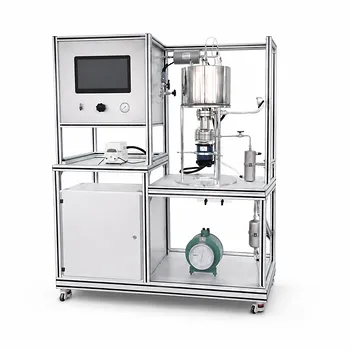
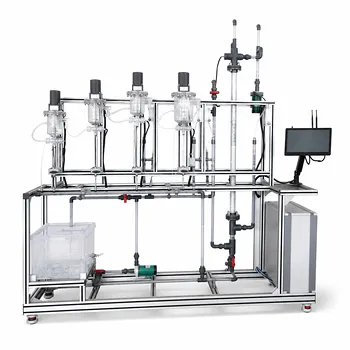
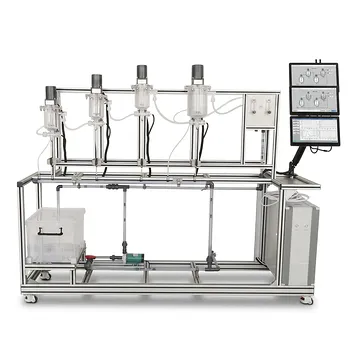
Are you looking to enhance your research and teaching capabilities? LABPARK provides premium Educational and Vocational Unit Operations Pilot Plants in chemical engineering, bioprocess & biotech, and environmental & water treatment for universities, research institutes, and enterprises. Our state-of-the-art pilot plants help you accurately model reactor hydrodynamics, calculate key dispersion parameters, and optimize dissolved oxygen levels.
Take your pilot-scale research and training to the next level—contact our experts today to find the perfect system for your institution!
Related Products
- Plate Column Hydrodynamics Tray Demonstration Educational Pilot Plant
- Micro-Scale Gas-Solid Catalytic Reaction Educational Pilot Plant
- Bench Scale Dual Column Gas Separation and Capture Educational Pilot Plant
- Absorption and Desorption Educational Unit Operations Pilot Plant
- Educational Rotary Disc Liquid-Liquid Extraction Pilot Plant
People Also Ask
- How to update chemometric calibration models in pilot plants? Best practices for process engineers.
- How does nuclear yield inefficiency translate to chemical engineering education? Optimize kinetics with pilot plants.
- How can educational pilot plants be used to teach process safety and risk assessment in chemical engineering curricula?
- Why Correct Sig Figs & Rounding Matter in Educational Pilot Plants: Ensure Data Accuracy
- Why Calculate Sieve Tray Pressure Drop? Optimize Distillation Pilot Plant Performance