The adiabatic flame temperature is the single most important thermal benchmark in a combustion pilot plant. It defines the absolute maximum temperature a system could ever see if every joule of chemical energy were released with zero heat loss. Engineers rely on this calculation to select materials that can survive the worst-case scenario, size cooling equipment that prevents thermal runaway, and hard-code safety limits that protect both the plant and its operators. Without it, you are designing blind against the most destructive force in the process.
In a combustion pilot plant, the adiabatic flame temperature represents the ultimate thermal stress boundary—assuming complete combustion and perfect insulation. It drives every critical material, cooling, and safety decision. Treating it as a foundational design parameter is not optional; it’s the difference between a controlled experiment and a catastrophic failure.
Understanding the Adiabatic Flame Temperature in a Pilot Plant Setting
The Definition: A Theoretical Maximum
The adiabatic flame temperature (T_ad) is the temperature reached when a fuel is burned completely with the theoretical amount of air under zero heat exchange with the surroundings. No pilot plant ever truly achieves it, because some heat always radiates away, absorbs into vessel walls, or remains trapped in unburned products.
Yet it is the worst-case thermal ceiling for the system.
Why It Represents the Ultimate Thermal Stress Limit
If every safety system failed and insulation were perfect, the combustion zone would approach T_ad. That temperature becomes the peak thermal load the equipment must be able to withstand for at least a brief period. Materials, refractory linings, and cooling systems are therefore selected not for normal operating temperatures, but for this absolute limit.
In essence, T_ad is the thermodynamic "redline" of the pilot plant.
Design Criticality: Protecting the Plant from Thermal Stress
Selecting Refractory Materials and Alloys
Combustion chambers, burner tiles, and flame-facing components must be built from materials whose service temperature exceeds T_ad. Ceramic refractories and high-nickel alloys are chosen directly based on this calculated value.
If T_ad is 1,800 °C, a material with a maximum use temperature of 1,600 °C would fail catastrophically during an upset. The calculation prevents such mismatches.
Sizing Cooling Jackets and Heat Removal Systems
Cooling jackets, quench sections, and air dilution systems are designed to remove enough energy to keep metal temperatures far below T_ad. The heat duty calculation starts with the enthalpy release that would produce T_ad, then subtracts the desired safe operating temperature difference.
Without this starting point, you cannot correctly size the heat exchangers, coolant flow rates, or emergency quenching systems that prevent meltdown.
Setting High-Temperature Safety Interlocks
The pilot plant control system uses T_ad to define critical trip points. If a thermocouple reads a temperature approaching a fraction of T_ad (often 80–90%), the system can automatically cut fuel flow, increase purge air, or initiate emergency cooling.
These interlocks are the last line of defense against thermal runaway, and they are calibrated directly from the adiabatic calculation.
Operational Dependability and Experimental Integrity
Ensuring Safe Operating Envelopes
Every experiment runs at a fraction of T_ad. Knowing this exact ceiling allows operators to map out safe fuel-to-air ratios and flow rates that avoid accidental excursions into destructive temperature regions.
It turns trial-and-error into a predictable, parameterised operational envelope.
Supporting Scale-Up and Data Validity
Pilot plant data is used to validate kinetic models and design commercial units. The adiabiatic flame temperature serves as a reference state for heat balance calculations. Just as adiabatic conditions in a tubular reactor define limiting temperature profiles, T_ad fixes the energy input baseline—if your pilot-plant measurements cannot be reconciled with this thermodynamic limit, your heat balance or sensor network is flawed.
Avoiding Thermal Feedback Loops
Combustion pilot plants can experience exothermic runaway if flame temperature escalates beyond material limits. The T_ad value is used to design feedback controls that prevent chain reactions—where a hotter flame heats incoming reactants, which further accelerates kinetics, pushing temperature even higher. The calculation informs the gain settings of your control loops.
Understanding the Trade-offs and Practical Limitations
The Unachievable Ideal
T_ad assumes complete combustion and perfect insulation, neither of which exist in a real pilot plant. Designing exclusively for T_ad can lead to over-engineering—excessively thick refractories, oversized cooling jackets, and unnecessarily expensive alloys. The challenge is to apply a practical safety factor without inflating the capital cost beyond reason.
The Insulation Paradox
To study adiabatic-like phenomena, pilot plants often add heavy insulation to minimize heat loss. However, that same insulation can trap heat and bring the system dangerously close to T_ad during a malfunction. The very tool that improves adiabatic data fidelity also introduces a higher risk of thermal overshoot—a trade-off that requires careful balancing of insulation thickness against active cooling capacity.
Static vs. Transient Stress
T_ad is a single-point calculation, but real thermal damage often occurs due to rapid temperature changes (thermal shock) or localised hot spots. While T_ad sets the absolute upper bound, materials and operating procedures must also account for ramp rates and temperature gradients that the simple adiabatic number doesn't capture.
How to Apply This to Your Combustion Pilot Plant
The adiabatic flame temperature must never be treated as a one-time spreadsheet number. Its role is to anchor every thermal decision.
- If your primary focus is safety and asset protection: Use T_ad to set hard trip temperatures (typically 75–85% of T_ad) and to select materials with a certified service temperature well above the calculated value, including a margin for material aging.
- If your primary focus is experimental accuracy and heat balance validation: Treat T_ad as a thermodynamic benchmark; any measured temperature significantly below it after accounting for known losses should prompt a review of your calorimetry, flow metering, or sensor placement.
- If your primary focus is scale-up and technology transfer: Document how your cooling system, refractory choice, and safety logic were derived from T_ad. This provides a defensible, physics-based foundation when engineering teams question why a larger reactor must replicate the same thermal safety margins.
- If your primary focus is cost-optimized design: Avoid the temptation to size everything for the theoretical maximum. Instead, couple the T_ad calculation with a realistic heat loss model and a defined safety factor (e.g., 1.2x the maximum expected operating temperature) to strike the balance between protection and capital expenditure.
The adiabatic flame temperature is not just a number—it’s the thermal signature of your entire combustion pilot plant, and every safe, successful experiment begins with respecting that boundary.
Summary Table:
| Key Design Area | Role of T_ad | Practical Application |
|---|---|---|
| Material Selection | Defines upper thermal limits | Choosing refractories & alloys exceeding T_ad |
| Cooling Systems | Calculates maximum heat load | Sizing heat exchangers & quench flow rates |
| Safety Interlocks | Establishes critical trip points | Setting automated fuel cut-offs (75–85% of T_ad) |
| Model Validation | Serves as thermodynamic benchmark | Checking experimental heat balance & sensor accuracy |
Build a safer, more precise testing environment with LABPARK. We provide state-of-the-art Educational and Vocational Unit Operations Pilot Plants in chemical engineering, bioprocess & biotech, and environmental & water treatment. Tailored for universities, research institutes, and enterprises, our plants are engineered to respect critical thermodynamic boundaries and ensure reliable scale-up. Contact our technical team today to design your next pilot plant solution!
Related Products
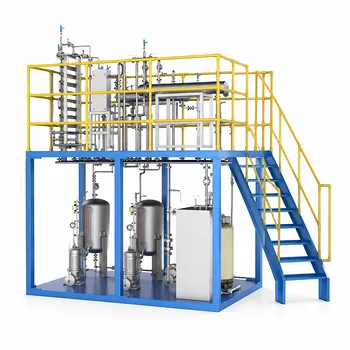
- Multimodal Absorption and Desorption Pilot Plant for Unit Operations Training
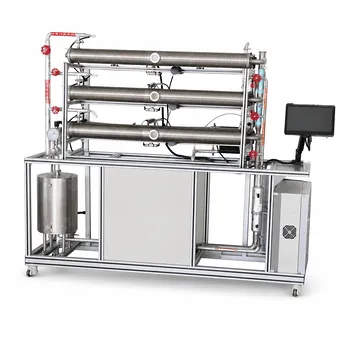
- Three-Tube Heat Transfer Educational Pilot Plant for Unit Operations Training
- Multi-Reactor Educational Pilot Plant for Reaction Engineering Unit Operations
- Solid Waste Pyrolysis and Refining Educational Pilot Plant for Unit Operations
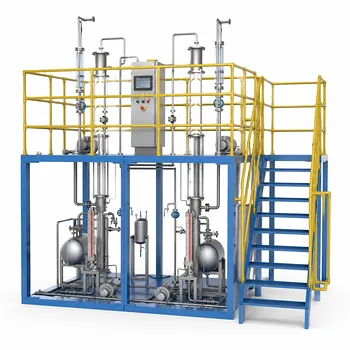
- Dual-Mode Rectification Pilot Plant for Practical Training Unit Operations
People Also Ask
- How does polyphosphate hydrolysis affect scale and corrosion in pilot plants? Essential Monitoring Guide
- How are gauge pressure and absolute pressure calculated and distinguished during unit operations pilot plant experiments?
- How does colloid & pore size relationship affect membrane blocking in pilot plant filtration runs?
- How to Choose Differential vs. Integral Balances in Unit Operations Pilot Plants
- What role do unit operations pilot plants play in reducing technical risks? De-Risk Your Scale-Up Process