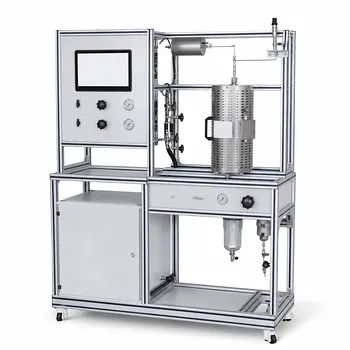
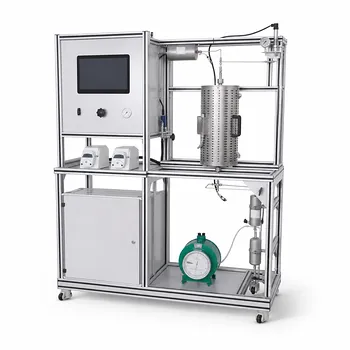
The energy balance in your pilot plant reactor can be off by 10% or more if you ignore a single critical detail: the physical state of your products. The aggregation state of reactants and products directly dictates the total heat of reaction because phase changes absorb or release significant latent energy. In pilot-scale reactors, neglecting whether water leaves as a liquid or a gas, for example, can lead to dangerously inaccurate heat transfer calculations, flawed utility planning, and compromised safety margins.
The energy released or absorbed during a chemical reaction is not just about breaking and forming chemical bonds. It also includes the energy required to vaporize a liquid or condense a gas. In a pilot plant, failing to specify the phase of every component means your entire thermal design—from heat exchanger sizing to emergency cooling systems—is built on a number that could be wrong by tens of kilojoules per mole.
The Thermodynamic Foundation: Phase Change Enthalpy
Any energy balance on a reactive system must account for both sensible heat (temperature change) and latent heat (phase change). When a product is formed in a different phase than its reference state, the phase change enthalpy adjusts the overall heat of reaction.
Why the Same Product Can Have a Different Heat of Reaction
Standard enthalpies of formation are phase-specific. Standard formation enthalpy of liquid water is different from that of water vapor. The difference is exactly the latent heat of vaporization at that temperature.
Take the primary reference example of methane combustion:
- When water is produced as a liquid, the heat of reaction is -890.3 kJ/mol.
- When water is produced as a gas, the heat of reaction drops to -802.3 kJ/mol.
- The 88 kJ/mol gap is the energy that would have been released if the steam had condensed.
If your pilot plant reactor operates at a temperature where the water leaves as vapor, but you mistakenly use the liquid-water value, you will overestimate the heat liberated by roughly 10%. The error cascades through the entire energy balance.
The Domino Effect on Pilot Plant Design
Getting the aggregation state wrong doesn’t just remain an academic error. In a pilot plant, where the goal is to generate data for scale-up, that mistake distorts every downstream design decision.
Heat Transfer Area and Utility Miscalculation
The heat of reaction directly determines the required heat duty that the reactor’s thermal jacket or external heat exchangers must handle. Using an incorrect ΔHr leads to:
- Undersized cooling systems, which can cause dangerous temperature runaways in exothermic reactions.
- Oversized utility systems, inflating capital costs for steam boilers or chillers.
- Inaccurate estimates of cooling water or heating steam flow rates, breaking the plant’s overall energy balance.
Distorted Temperature Profiles and Safety Risks
In a pilot-scale plug flow reactor, the energy balance predicts the temperature profile along the catalyst bed. If the product phase is misidentified, the calculated temperature at each point will be wrong. This can mask a true hot spot—a region where excessive exothermic activity could sinter the catalyst or melt reactor internals.
The safest energy balance assumes the worst-case phase scenario for heat release. For an exothermic reaction, that typically means assuming all products leave in the most condensed state possible, releasing maximum energy. This builds a robust safety margin into the thermal design.
Corrupted Scale-Up Economics
Pilot plants provide the raw material consumption per unit of product that design engineers use for commercial-scale costing. If the heat duty is wrong because phase enthalpies were neglected, the estimated costs for heating and cooling utilities will be incorrect. The resulting economic feasibility analysis is then unreliable, potentially leading to a failed scale-up investment.
The Procedure: How to Get It Right
A rigorous energy balance procedure—as outlined in the supplementary references and standard chemical engineering practice—explicitly forces you to confront aggregation state.
1. Build the Material Balance First, With Phase Composition
You cannot begin an energy balance without a complete material balance. Use phase equilibrium relationships (like Raoult’s law or equation-of-state models) to determine whether a component is liquid, gas, or a mixture at the specific reactor pressure and temperature. For example, in a steam reforming reactor, water enters as vapor and leaves as vapor unless the outlet is quenched below the dew point.
2. Define Your Reference States with Precision
Choose a consistent set of reference conditions, typically elemental species at 25 °C and 1 atm in their natural phase. From there, the specific enthalpy of any stream component depends on:
- Its temperature.
- Its pressure.
- Its phase (solid, liquid, or gas).
A table of inlet-outlet enthalpies must list each substance with its actual phase at the inlet and outlet. The latent heat appears either explicitly in a phase-change step or implicitly because you selected the correct phase-specific enthalpy value.
3. Substitute the Correct ΔH into the Energy Balance
Once the total enthalpy change for the reacting stream is calculated, plug it into the general energy balance: Q – Ws = ΔH + ΔEk + ΔEp
For a steady-state flow reactor with no shaft work and negligible kinetic/potential energy changes, this simplifies to Q = ΔH. The heat transfer rate Q then sizes your equipment. If your ΔH is off by the latent heat of water, your Q is off by the same amount.
4. Verify with Online Analytical Instruments
Pilot plants use gas chromatographs and mass flow controllers to measure the actual outlet composition and flow rates. By comparing the measured product ratios (e.g., hydrogen-to-water vapor) with the theoretical material balance, you can confirm the actual phase conditions. If the analysis shows a condensate stream exists, the energy balance must reflect that liquid’s formation enthalpy.
Common Pitfalls and Trade-offs
Even experienced engineers can make mistakes when linking aggregation state to energy balances.
Pitfall: Textbook Tunnel Vision
Many textbooks list a "standard heat of reaction" with a small note about the product phase. It’s tempting to grab that number without asking whether your pilot reactor effluent is at a temperature where that phase holds true. Always check the phase every component would have at your actual operating pressure and temperature.
Trade-off: Deliberate Condensation for Heat Recovery
Sometimes you will intentionally change the aggregation state for economic reasons. Condensing a product stream in a heat exchanger recovers latent heat that can preheat the feed. This changes the effective heat balance for the reactor section. While beneficial for energy efficiency, it complicates the calculation because you must now account for a phase change happening in a unit downstream of the reactor.
Pitfall: Multi-Phase Feeds and Products
When liquid reactants generate a gaseous byproduct, the vaporization energy required to form that gas absorbs some of the reaction’s heat. The energy balance must include the enthalpy of that vaporization. Ignoring it will make an exothermic reaction appear less exothermic, hiding the true cooling demand.
Trade-off: Complexity vs. Precision
Insisting on a perfect phase-differentiated energy balance adds analytical and computational effort. For a quick feasibility check, some engineers use a standard-state heat of reaction. In a pilot plant intended to generate scale-up data, however, this simplification is unacceptable. The purpose of the pilot run is to eliminate such assumptions.
Making the Right Choice for Your Goal
Your approach to aggregation state in energy balances should align with your primary pilot-plant objective.
- If your primary focus is reactor sizing: Use a heat of reaction calculated explicitly with the products in their actual exit phases at the reactor’s design temperature and pressure.
- If your primary focus is safety analysis: Assume the most exothermic phase scenario—typically the most condensed product state—to ensure your emergency cooling and relief systems are not undersized.
- If your primary focus is utility optimization: Explore whether intentionally condensing a product can recover latent heat to reduce overall plant steam or cooling water consumption.
- If your primary focus is process scale-up: Treat the pilot plant as the definitive test. Use online analytical data to verify the actual phase composition, then lock that into the energy balance model you will give to the design engineers.
By rooting your energy balances in the real, measured aggregation state of your reactants and products, you transform a theoretical calculation into a reliable foundation for commercial success.
Summary Table:
| Product State (Water) | Heat of Reaction (ΔHr) | Phase Change Energy | Pilot Plant Design Impact |
|---|---|---|---|
| Liquid ($H_2O_{(l)}$) | -890.3 kJ/mol | Base Reference | Can overestimate heat release by ~10% if products vaporize. |
| Gas ($H_2O_{(g)}$) | -802.3 kJ/mol | +88 kJ/mol (Latent Heat) | Prevents cooling system undersizing and reactor hotspot risks. |
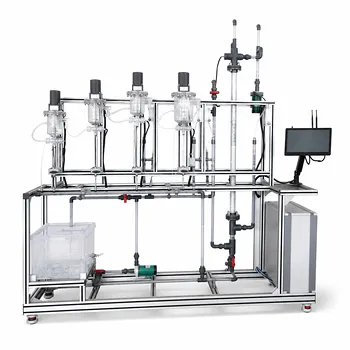
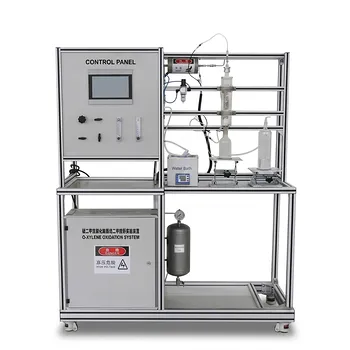
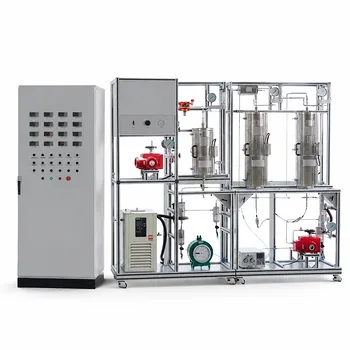
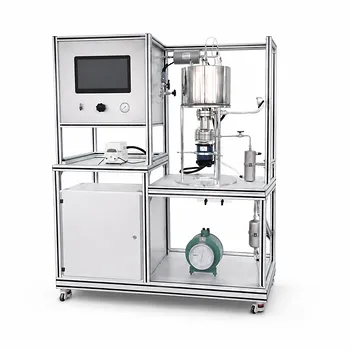
Accurate energy balances are the foundation of successful process scale-up. LABPARK provides state-of-the-art Educational and Vocational Unit Operations Pilot Plants in chemical engineering, bioprocess & biotech, and environmental & water treatment. Tailored for universities, research institutes, and enterprises, our pilot plants enable precise data collection and thermodynamic verification. Contact LABPARK today to discuss your pilot-scale testing and equipment needs!
Related Products
- Fixed-Bed Chemical Reaction and Gas Dust Tar Removal Unit Operations Pilot Plant
- Fixed Bed Gas Solid Catalytic Reaction Educational Pilot Plant
- Multi-Reactor Educational Pilot Plant for Reaction Engineering Unit Operations
- Residence Time Distribution and Reactor Flow Characteristics Determination Educational Pilot Plant
- Tubular Reactor Flow Characteristics Determination Educational Unit Operations Pilot Plant
People Also Ask
- How to Estimate Tc & Pc of Unknown Hydrocarbons in Pilot Plant Experiments | Guide
- What role do customizable reactor pilot plants play in evaluating heat and catalyst performance? Scale-up Guide
- How do hydraulic gradients and energy gradients differ in a piping system? Key Differences
- How does polyphosphate hydrolysis affect scale and corrosion in pilot plants? Essential Monitoring Guide
- Why are runaway reactions critical in chemical engineering? Learn how pilot plants train students in process safety.