It is not that exothermic reactions are inherently safe at the bench; it is that laboratory glassware acts as a highly efficient radiator, masking the thermal runaway that can erupt in a large-scale vessel. In a tiny flask, the heat generated by a reaction disappears into the room before it can build up, so you see no dramatic temperature spike. At pilot or industrial scale, the same reaction can retain nearly all its heat, racing toward a runaway you never saw coming.
The core challenge is that the rapid heat loss in small-scale glassware creates a false picture of safety. To scale up safely, researchers must stop looking at behavior in everyday flasks and instead quantify the reaction’s true heat-release potential under adiabatic (zero-heat-loss) conditions—typically using specialized calorimeters.
Why Small-Scale Glassware Hides Thermal Runaway
The Massive Difference in Heat Loss Rates
The numbers are startling. A 10 mL test tube loses heat at a rate of 5.91 W/(kg K) —at 80 °C, it sheds 1 °C in just 11 seconds. A 2500 L pilot reactor loses heat at just 0.054 W/(kg K) —losing that same degree takes 21 minutes.
This means the small vessel is constantly cooled by its environment, preventing the temperature from climbing. The large vessel traps the heat, allowing it to accumulate.
The Surface-to-Volume Trap
As you scale up, the ratio of heat‑transfer area to volume ($A_h/V$) collapses. A typical small reactor might have $9.5\text{ m}^{-1}$, while a larger one falls to $2.6\text{ m}^{-1}$. Heat generation scales with volume ($L^3$), but heat removal scales only with area ($L^2$). The bigger the vessel, the harder it becomes to dissipate heat naturally.
From Near-Isothermal to Near-Adiabatic
In a small flask, rapid heat loss keeps the mixture close to the bath temperature—near-isothermal behavior. No runaway. In a large vessel, minimal heat loss lets the reaction approach adiabatic conditions, where all the heat stays in the system. The temperature can spike uncontrolled, and what seemed tame on the bench becomes a runaway at scale.
Quantifying the True Runaway Potential for Safe Scale-Up
Adiabatic Calorimetry: The Gold Standard
To bridge the gap, you must perform adiabatic testing with instruments like Dewar calorimeters, ARC (Accelerating Rate Calorimetry), or Phi-TEC II. These devices deliberately minimize heat loss to mimic the worst‑case, barely‑cooled state of a large reactor. They measure the adiabatic temperature rise and the time to maximum rate, the two pillars of runaway assessment.
Key Parameters to Measure
- Adiabatic Temperature Rise ($\Delta T_{\text{ad}}$): The total temperature increase if all reaction heat stays in the batch. This tells you the ultimate hazard potential.
- Time to Maximum Rate (under adiabatic conditions): An indicator of how quickly the runaway will unfold, critical for sizing emergency relief systems.
Using Pilot Plants for Hybrid Confirmation
Adiabatic calorimetry gives the worst‑case data under perfect mixing. However, real‑scale mixing and fluid dynamics create concentration gradients that affect both safety and product quality. A pilot plant—typically at least 10 % of the industrial size—lets you test heat and mass transfer under realistic, non‑adiabatic conditions, validate your calorimetry‑based kinetic models, and establish safe operating limits.
Understanding the Trade-offs of Lab-Scale Safety Testing
Adiabatic testing does not replicate imperfect mixing. Calorimeters use small samples and vigorous stirring; a production vessel may have dead zones that concentrate heat or unreacted material.
Sample aging or impurities matter. Industrial raw materials may contain trace impurities that alter decomposition energy—effects your lab‑grade reagent tests can miss.
Cost and effort versus risk. Specialized calorimeters demand skilled operators and analysis time, but a single runaway event is exponentially more expensive.
False negatives are possible. If you rely only on open glassware observations, you may miss the recipe for a disaster. Never use “it looked fine in the beaker” as a safety argument.
How to Apply This to Your Scale-Up Project
Your strategy should match your primary goal.
- If your primary focus is reaction hazard identification: Use adiabatic calorimetry to measure $\Delta T_{\text{ad}}$ and the time to maximum rate. Never rely on a simple beaker observation.
- If your primary focus is heat transfer system design: Match the reactor’s cooling capacity to the heat generation rate, calculated from the adiabatic data and the plant’s $A_h/V$ ratio.
- If your primary focus is process validation and mixing effects: Incorporate a pilot‑plant trial (at least 10 % of full scale) to catch concentration gradients and confirm selectivity, while using calorimetry data to set the safety boundaries.
By accepting that a quiet beaker can mask a violent kettle, and by quantifying the true heat‑release potential upfront with adiabatic tools, you transform scale‑up from a guess into a scientific exercise.
Summary Table:
| Parameter | Lab Glassware (Small-Scale) | Pilot / Industrial Reactor |
|---|---|---|
| Heat Loss Rate | High (~5.91 W/(kg K)) | Low (~0.054 W/(kg K)) |
| Cooling Time (1°C drop) | ~11 seconds | ~21 minutes |
| Area-to-Volume Ratio ($A_h/V$) | High (~9.5 m⁻¹) | Low (~2.6 m⁻¹) |
| Thermal Behavior | Near-Isothermal (Runaway Masked) | Near-Adiabatic (Runaway Risk) |
Bridge the Gap from Lab to Pilot Scale Safely
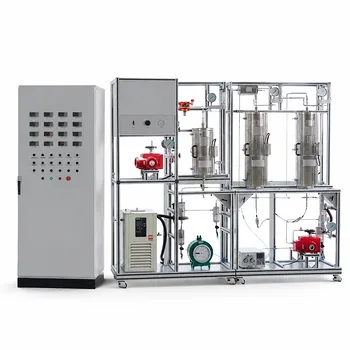
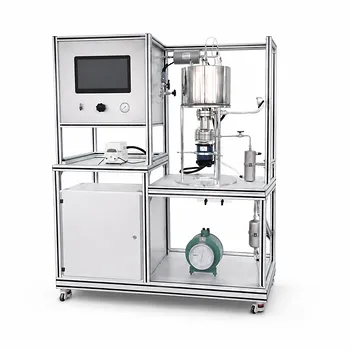
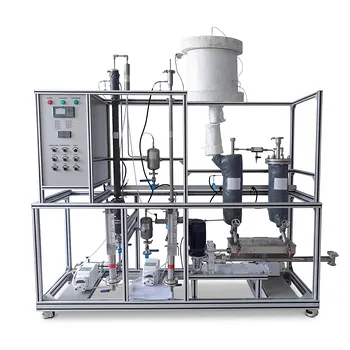
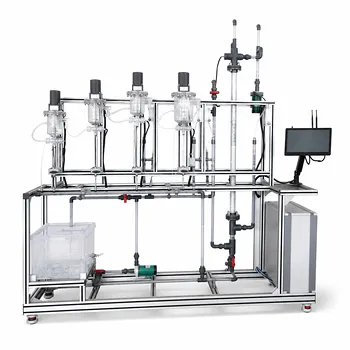
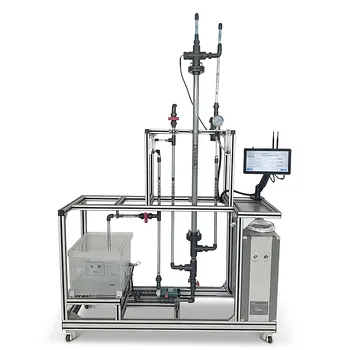
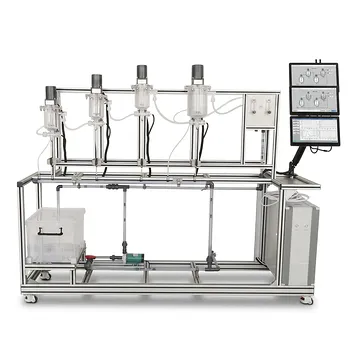
Transitioning chemical processes from benchtop glassware to pilot scale requires precise control over heat transfer and mixing dynamics. LABPARK provides state-of-the-art Educational and Vocational Unit Operations Pilot Plants across chemical engineering, bioprocess & biotech, and environmental & water treatment. We empower universities, research institutes, and enterprises to validate scale-up models under realistic, safe operating conditions.
Ready to secure your process scale-up? Contact LABPARK today to explore our pilot-scale solutions!
Related Products
- Micro-Scale Gas-Solid Catalytic Reaction Educational Pilot Plant
- Methanol Synthesis and Catalyst Performance Evaluation Educational Unit Operations Pilot Plant
- Crude Benzene Hydrogenation Educational Unit Operations Pilot Plant
- 100L Continuous Loop Hydrogenation Educational Unit Operations Pilot Plant
- Fixed Bed Gas Solid Catalytic Reaction Educational Pilot Plant
People Also Ask
- Fluidized vs. Fixed Bed Reactors: Comparing Heat & Complexity in Pilot Plants
- Why is a multibed configuration necessary for exothermic reactions? Optimize your pilot plant trajectory.
- Why is thermal management a major challenge in methane oxidative coupling? Reactor Solutions for Pilot Plants
- How does the Mears criterion evaluate transport resistance? Key Guide to Intrinsic Kinetics
- How do reactor pilot plants safely study gas-solid reactions? Master kinetics with thermal & flow control.