Chloride ions are the ultimate inert tracer—they don’t scale, don’t react, and reliably reveal exactly how concentrated your boiler or cooling water has become.
Operators use chloride concentration as a primary control parameter because it acts as a chemically stable marker. By comparing the chloride level in the circulating water to that in the feedwater, you can calculate the cycles of concentration and set an optimal blowdown rate. This alone prevents the accumulation of total dissolved solids (TDS) that cause foaming, carryover, and scaling, while avoiding wasteful blowdown of heated, treated water.
A chloride ion does not precipitate, does not plate out on hot surfaces, and does not become part of sludge. That inertness transforms it into a flawless mirror of water evaporation—showing exactly how many times the incoming water has been concentrated. Precise blowdown control and the resulting protection of equipment reliability all flow from this one trustworthy number.
The Silent Indicator: How a Tracer Simplifies Boiler Control
The Blowdown Balancing Act
A boiler or cooling tower constantly evaporates water, leaving behind dissolved solids. If solids build up unchecked, foaming, scale, and loss of heat transfer efficiency follow. The only escape is blowdown—intentionally draining concentrated water and replacing it with fresh feed. But blowdown discards both water and the heat it contains. The operator’s dilemma is always to remove just enough to keep solids safe, without wasting energy or water.
A reliable indicator is needed to make that judgment. Without it, you’re flying blind.
Why Chloride Is the Ideal Canary in the Coal Mine
Chloride’s dominance as a control parameter comes from a single, powerful property: it remains completely dissolved under all boiler and cooling system conditions.
Unlike calcium, magnesium, or silica, chloride ions do not precipitate as scale. They don’t adsorb onto metal surfaces. They don’t break down thermally. This means every chloride ion that enters with the feed stays in the circulating water, faithfully tracking the evaporative concentration of the entire water body.
Other ions can “disappear” as they scale out, making their concentration ratios misleading. Chloride never lies about how much the water has been concentrated.
The Math Behind the Control: Cycles of Concentration
Defining the Ratio
Cycles of concentration (COC) is the single most important number in your water balance. It’s defined simply: COC = Chloride in boiler/cooling water ÷ Chloride in feedwater If the feed contains 50 mg/L and the recirculating water holds 500 mg/L, you’re at 10 cycles. The water has been evaporated tenfold.
The Link to Blowdown Rate
Blowdown rate directly connects to this ratio. To hold a target COC, you adjust blowdown so that the chloride ratio (and thus overall solids concentration) stays constant.
A rising chloride ratio warns that solids are accumulating—blowdown must increase. A falling ratio signals you’re wasting water and heat—blowdown can be reduced. Chloride turns blowdown from guesswork into a precise, automated feedback loop.
Why Not Just Measure Total Dissolved Solids (TDS) Directly?
The Pitfall of Precipitation
Measuring TDS by evaporation or conductivity seems intuitive, but it masks a critical flaw. TDS includes hardness and silica that can drop out of solution as scale. As a result, the TDS concentration may appear to plateau or even decline while the true concentration of corrosive and scale-forming ions is still rising. Chloride, by contrast, never leaves the liquid phase, so it tells the whole truth.
Measurement Practicality
Direct TDS measurement via gravimetry is slow and lab-bound. Conductivity is fast but highly temperature-sensitive and responds differently to various ions; a sudden shift in water chemistry can make the same conductivity reading represent a completely different solids load.
The potentiometric titration of chloride—using a silver electrode and a glass reference electrode—is both highly accurate and reproducible. It provides a hard, trustworthy number that can anchor a control strategy, as confirmed by standard water treatment practice.
The Measurement Backbone: Ensuring Reliable Chloride Data
Potentiometric Precision
When chloride is the linchpin of your control, its measurement must be bulletproof. The potentiometric method delivers just that. It directly detects the endpoint of silver chloride precipitation, giving sharp, repeatable results that operators can bank on.
Taming the Interferences
A few common interferences can skew the titration, but they are easily neutralized:
- Sulfide interference: Sulfide forms black silver sulfide (Ag₂S), masking the endpoint. Acidifying the sample with nitric acid and boiling for five minutes expels sulfide and clears the way.
- Ferrocyanide interference: Ferrocyanide causes multiple potential breaks. Adding a slight excess of 5% copper sulfate solution precipitates it as copper ferrocyanide; simply filter and titrate the clear filtrate.
These simple pretreatments keep the chloride reading clean and reliable, even in challenging pilot-plant matrices.
Understanding the Trade-offs
Interference Sensitivity Needs Operator Skill
While interferences can be handled, they do demand a trained eye. A pilot plant running at fluctuating conditions may occasionally see sulfide slugs or carryover of treatment chemicals containing ferrocyanide. If the pretreatment step is skipped or done poorly, the chloride value becomes meaningless. Reliability depends on disciplined sample preparation.
Batch vs. Real-Time Control
The standard potentiometric titration is a batch method. It provides a gold‑standard number, but not a continuous one. For automated blowdown control, many systems rely on online conductivity meters. Chloride measurements then serve as the routine calibration check, correcting any drift in the online sensor. This hybrid approach marries the traceability of chloride with the speed of real‑time monitoring.
External Chloride Sources Can Muddy the Picture
If a recirculating cooling system has a process leak, or if certain treatment chemicals add chloride, the simple feed-to-system ratio no longer reflects pure evaporation. The background chloride must be accounted for, or you risk misjudging the true cycles. In such cases, a mass balance that includes all chloride inputs is essential.
Making the Right Choice for Your Pilot Plant Control
A pilot plant is where you prove control strategies before full‑scale deployment. Your choice of control parameter directly influences the quality of that proof and the safety of your operation.
- If your primary focus is precise blowdown optimization: Rely on chloride as the primary control parameter. Its chemically inert tracer property gives you the most accurate cycles‑of‑concentration ratio, eliminating guesswork from blowdown scheduling.
- If your primary focus is real‑time operational feedback: Use an online conductivity meter for instantaneous blowdown valve control, but calibrate it frequently against laboratory chloride measurements. Let chloride be your reference standard.
- If your primary focus is troubleshooting scaling or corrosion: Use chloride to establish the true concentration factor, then overlay that with pH, alkalinity, and specific ion data to diagnose the root cause. Chloride’s unwavering trend keeps your investigation grounded.
Ultimately, chloride’s unique ability to remain an uncompromised witness to evaporation makes it the definitive parameter for safeguarding boiler and cooling system chemistry, from pilot scale to full‑scale operation.
Summary Table:
| Parameter | Behavior in System | Suitability for COC Calculation | Primary Measurement Method |
|---|---|---|---|
| Chloride | Remains fully dissolved; no scaling or precipitation | Excellent (acts as an inert tracer) | Potentiometric titration |
| TDS / Conductivity | Scales out; precipitates onto hot surfaces | Poor (masks true concentration changes) | Conductivity meter / Gravimetry |
Optimize Your Process Control with LABPARK Pilot Plants
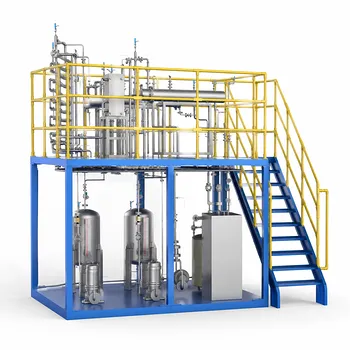
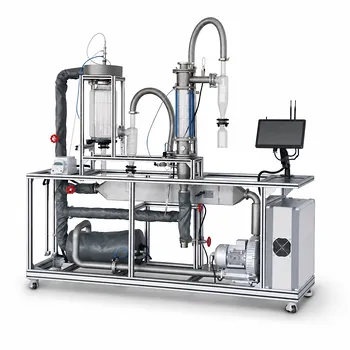
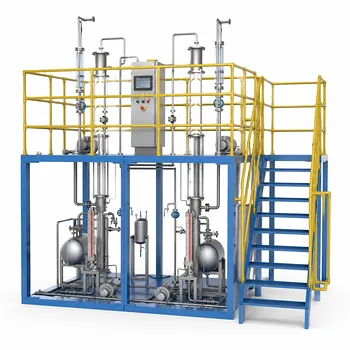
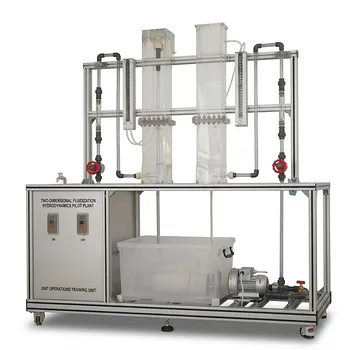
Are you looking to enhance your research precision or vocational training capabilities? LABPARK provides high-quality Educational and Vocational Unit Operations Pilot Plants in chemical engineering, bioprocess & biotech, and environmental & water treatment designed specifically for universities, research institutes, and enterprises.
Contact us today to discuss your project requirements and discover how our advanced pilot systems can elevate your experimental and training outcomes!
Related Products
- Bio-fermentation Ethanol Production Practical Training Unit Operations Pilot Plant
- Multi-Modal Distillation Unit Operations Training Pilot Plant
- Fixed-Bed Chemical Reaction and Gas Dust Tar Removal Unit Operations Pilot Plant
- Multi Pump Fluid Transport Process Piping Unit Operations Training Pilot Plant
- Methane Cracking Educational Unit Operations Pilot Plant
People Also Ask
- How do unit operations pilot plants assist students in understanding and applying material and energy balances?
- How do pilot plants teach scale-up? Bridging Lab to Commercial Production
- How does equipment material choice impact pilot plant bare module cost? Optimize CapEx & Design
- How do environmental pilot plants facilitate bioremediation study? Scale cleanup processes.
- How are gauge pressure and absolute pressure calculated and distinguished during unit operations pilot plant experiments?