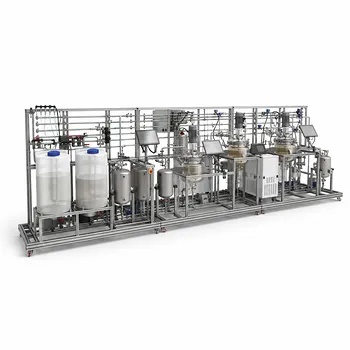
Hands-on training with unit operations pilot plants compresses the entire conventional scale-up sequence into a teachable moment. By physically operating an intermediate-scale system, students move beyond recipe-following to confront the irreversible truths of process scale-up—heat transfer limitations, fluid dynamic shifts, impurity accumulation, and the critical need to validate mathematical models. This immersive experience rewires how a future engineer thinks, transforming the abstract concept of scale-up into a tangible, predictive skill.
The real lesson of a pilot plant is not that bigger equipment makes more product, but that size fundamentally rewrites the rules of chemistry and physics. Mastering that rewrite is what turns a laboratory discovery into a safe, profitable commercial process—and hands-on pilot training is the fastest way to internalize it.
The Anatomy of a Conventional Scale-Up Sequence
The journey from an idea in a flask to a product on a truck follows a deliberate, risk-managed path. Understanding this sequence is the map; pilot-scale training is the dress rehearsal.
Stages That Reduce Uncertainty
Classical process development moves through laboratory, miniplant, pilot plant, and demonstration plant stages before reaching full commercial scale. Each stage answers a different question: from “can we make it?” to “can we make it safely, consistently, and economically?”
Where the Knowledge Gaps Live
The transition from kilo-lab (100g–10kg) to pilot plant (50–4,000L) is particularly treacherous. Phenomena that were negligible in glassware suddenly dominate, and reactions that ran perfectly on the bench can stall, overheat, or generate dangerous by-products. Pilot-scale experience is where students learn not just that these gaps exist, but how to detect and close them.
Why Pilot Plants Are the Missing Link in Education
A textbook can explain the theory of scale-up, but only a physical pilot plant can create the visceral, sensor-laden feedback that builds true engineering judgment.
Bridging the Gap Between Theory and Practice
In a unit operations pilot plant, students set flow rates, control temperatures, and manage recycle loops on equipment that mirrors industrial reality. They feel the consequences of decisions in real time—pressure drops, fouling, off-spec product—and that feedback is what cements the connection between a mathematical model and a running process.
Accelerating the Learning Curve
By condensing weeks of industrial operation into a structured educational module, pilot plants let students experience the entire conventional scale-up sequence in a compressed timeframe. They move from initial lab data to pilot runs, then reconcile results with predictions, effectively rehearsing the career-long skill of process development.
Uncovering the Invisible: Physical Phenomena That Glassware Hides
What makes a beaker reaction gentle and a plant reactor brutal is the emergence of transport limitations. Hands-on pilot training makes these invisible forces visible.
Heat and Mass Transfer Transformations
Laboratory glassware has enormous surface-area-to-volume ratios, masking severe heat transfer limitations. In a pilot-scale vessel, exotherms can run away, and mixing that seemed trivial becomes a mass-transfer bottleneck. Students learn to map temperature gradients, adjust jacket utilities, and recognize when poor mixing is sabotaging yield—lessons that are impossible to learn from a stir bar.
Fluid Dynamics and Residence Time Distribution
Flow patterns that are perfectly uniform in a small tube become complex in larger equipment. Pilot plants introduce non-ideal residence time distributions, back-mixing, and dead zones. By tracking tracer studies or monitoring step-change responses, students develop the intuition to spot these irregularities and compensate with design or operational changes.
The Recycle Stream Reality
Lab experiments rarely operate with extensive recycle. Pilot plants close the loop, forcing students to witness the slow, insidious accumulation of impurities in recycle streams. This single experience rewires a chemist’s mindset, making them permanently suspicious of closed-loop purity and eager to model buildup over time.
Learning to Think in Multivariate Space
Scale-up is not a univariate problem. Teaching engineers to think in terms of process signatures is one of the highest-value outcomes of pilot training.
Beyond Single-Parameter Comparisons
Comparing a lab batch and a pilot batch by looking at endpoint quality alone is a dangerous oversimplification. In a pilot plant, students learn to map product quality in a multivariate space, tracking the trajectories of size, mass, and energy balances. They discover that the path matters as much as the destination.
Capturing the Process Signature
With modern sensors, pilot-scale units generate rich historical datasets. Students apply latent variable methods to extract the hidden process signature—a fingerprint of how parameters must shift to maintain consistent quality across scales. This data-driven skill aligns directly with the industry’s shift toward predictive engineering and away from trial-and-error.
From Art to Science: Model Validation and Predictive Scale-Up
The most profound transformation happening in process development is the move from “run it and see what happens” to “simulate it, then confirm.” Pilot plants are the proving ground for that shift.
Validating the Mathematical Foundation
A simulation is only as good as its assumptions. In a pilot plant, students feed real-scale data back into their models—heat transfer coefficients, kinetic parameters, pressure drops—and watch models either align or fail. This iterative loop of prediction and validation teaches the critical discipline of trusting models only after they have earned it.
Enabling Right-First-Time Scale-Up
The modern industrial mantra is right-first-time scale-up, where fewer intermediate trials are performed because predictive power is high. By practicing model validation in an educational pilot plant, students internalize the workflow that will allow them to skip expensive mistakes later. They learn to use parallel process development and numerical experiments to reduce physical runs, a skill that directly impacts capital efficiency.
Dealing with Real-World Operational Constraints
Pilot plants are not just smaller commercial plants; they have their own unique operating rules. Recognizing these mismatches prevents catastrophic assumptions.
Flexibility vs. Standardization
A pilot plant is typically designed for flexibility—you can reconfigure it, change unit operations, and run in campaign mode. A commercial plant is standardized and runs around the clock. By juggling setup changes in a pilot plant, students learn how early-stage flexibility must later be translated into a continuous, fixed-pattern operation.
The Rhythm of Operation
Pilot plants often run 5 days a week, not 24/7. This means process shutdowns, weekend hold points, and longer analytical turnaround times. Experiencing these rhythms firsthand teaches students how operational constraints influence everything from scheduling to purity profiles, and why a process that works on a Monday might fail on a Friday if not designed for intermittent operation.
Varying Automation Levels
From manual valves to full DCS control, pilot plants can have mixed automation levels. Students forced to manually log temperatures and open valves learn the human error potential that automation mitigates, while those using advanced control systems see how over-reliance on automation can mask process instability.
Hidden Dangers: Impurity Accumulation and Catalyst Deactivation
The most expensive scale-up failures often come from time-dependent phenomena that short lab runs never reveal. Pilot plants are the first chance to see these slow-motion disasters unfold.
The Long-Run Revelation
Initial lab experiments screen catalysts for a few hours using pure feeds. A pilot plant that runs for days or weeks reveals catalyst deactivation from coking or poisoning and the relentless buildup of by-products in recycle streams. Students track these slow kinetics, learning to design for regeneration and purge streams from day one.
Safe Exposure to Hazardous Behavior
When impurities concentrate, they can change reaction kinetics or create thermal hazards. A pilot-scale environment, with proper safety systems, lets students observe these threshold behaviors under controlled conditions, building a respect for thermodynamics that academic safety lectures never could.
Recognizing the Limitations: What Pilot Training Cannot Replicate
No educational pilot plant is a perfect simulation of a commercial facility. An honest advisor acknowledges these gaps to set realistic expectations.
Size and Throughput Differences
A pilot plant’s reactor volume (50–4,000L) is still smaller than a full commercial unit (400–12,000L+). While heat and mass transfer trends are directionally correct, exact commercial performance still demands additional modeling and full-scale demonstration. Students must understand that the pilot plant validates the model, not the exact plant.
The Pace of Real Manufacturing
A commercial facility operates continuously under economic pressure; a student pilot plant is a learning environment. Elements like supply chain logistics, operator fatigue, and long-term reliability are hard to simulate. The best programs supplement pilot training with industrial case studies to fill this gap.
Making the Most of Pilot Plant Training for Your Career
The impact of hands-on pilot plant experience depends entirely on how you engage with it. Adjust your focus based on your ultimate role.
- If your primary focus is to build deep process intuition: Treat every deviation from the lab as a clue. Investigate why yield changed at scale, and you will become an engineer who can anticipate trouble before it happens.
- If your primary focus is to lead modern R&D teams: Hone your model-validation workflow. Use the pilot data to challenge your assumptions and document the gap between prediction and reality—that gap is your most valuable scale-up metric.
- If your primary focus is to avoid costly scale-up failures: Practice running long-duration campaigns with recycle loops and analytical monitoring. Learn to detect the slow accumulation of impurities and catalyst decay, because these are the gremlins that destroy commercial profitability.
- If your primary focus is to integrate data science into process development: Exploit every sensor and dataset. Develop multivariate process signatures and use them to define a scaleable operating region, preparing yourself for the digital twin era.
Hands-on training with unit operations pilot plants transforms scale-up from a fear-inducing black box into a disciplined, predictable sequence of engineering decisions—and that transformation is the single greatest asset a chemical engineering student can carry into industry.
Summary Table:
| Scale-Up Stage | Equipment Scale | Key Educational Focus | Critical Phenomena Revealed |
|---|---|---|---|
| Laboratory / Kilo-Lab | Glassware (100g - 10kg) | Chemistry & feasibility | Yield, basic reaction pathways (hides heat/mass limits) |
| Pilot Plant | 50L - 4,000L | Scale-up sequence & model validation | Heat/mass transfer limits, recycle impurities, fluid dynamics |
| Commercial Plant | 400L - 12,000L+ | Continuous, profitable production | Long-term catalyst life, automation, plant economics |
Bring Theory to Life with LABPARK Pilot Plants
Prepare your students and researchers for real-world engineering challenges. LABPARK provides state-of-the-art Educational and Vocational Unit Operations Pilot Plants tailored for universities, research institutes, and enterprises.
Our systems span key disciplines including:
- Chemical Engineering
- Bioprocess & Biotech
- Environmental & Water Treatment
Equip your lab with the tools to master scale-up dynamics, validate mathematical models, and build true process intuition. Contact LABPARK today to request a quote or custom design!
Related Products
- General Purpose Cosmetics Production Unit Operations Training Pilot Plant
- Multi Pump Fluid Transport Process Piping Unit Operations Training Pilot Plant
- Multi-Functional Drying Educational Unit Operations Pilot Plant
- Fixed-Bed Chemical Reaction and Gas Dust Tar Removal Unit Operations Pilot Plant
- 100L Continuous Loop Hydrogenation Educational Unit Operations Pilot Plant
People Also Ask
- How do deviations in estimating latent heat impact pilot plant thermal systems? Avoid hardware mis-sizing.
- Why is the chemical plant startup schedule crucial? De-risk scale-up with pilot plants.
- When to transition from PID to adaptive control in pilot plants? Key process indicators.
- Why Compare Predicted and Experimental Excess Enthalpy? Key to Accurate Pilot Plant Scale-up
- Why Use PTFE & Hastelloy in Chemical Pilot Plants? Prevent Corrosion & Ensure Safety