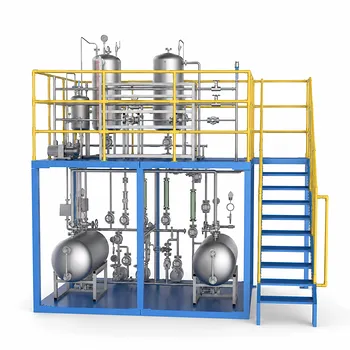
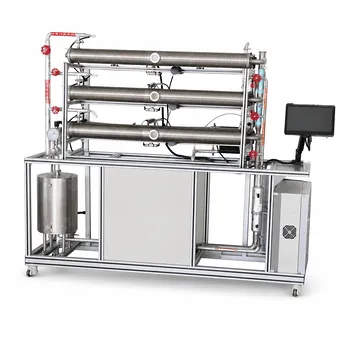
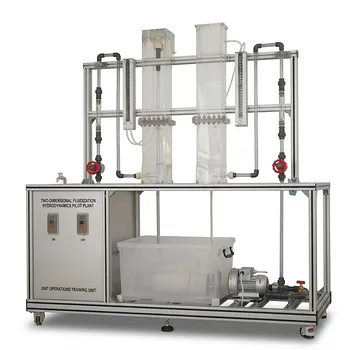
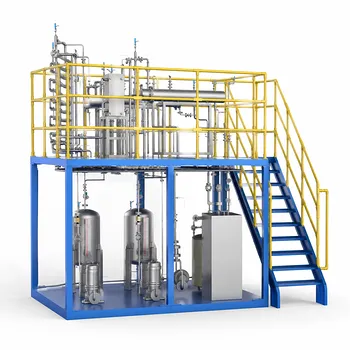
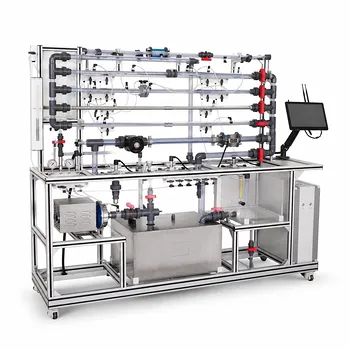
Theory meets reality. Unit operations pilot plants give students a physical, scaled-down version of industrial equipment—reactors, distillation columns, heat exchangers—where they can measure real inputs, outputs, and accumulation. By collecting actual flow rates, temperatures, and compositions, they directly apply the laws of conservation of mass and energy to a living process. This transforms abstract equations into a concrete, investigative task: they see where material goes missing and why energy doesn’t add up, learning to diagnose inefficiencies and account for environmental heat losses in ways no textbook problem can replicate.
Pilot plants force students to reconcile theoretical balance sheets with measured reality. The moment a heat loss term can’t be ignored or a side reaction silently consumes a reactant, the student shifts from solving equations to managing a real system—building the diagnostic and optimization instincts that define a competent process engineer.
Bridging the Gap Between Theory and Practice
Textbook mass and energy balances often assume perfect mixing, ideal gas behavior, and 100% recovery. A pilot plant replaces those assumptions with empirical evidence.
From Equations to Empirical Evidence
In a classroom, students calculate conversion rates from a given stoichiometric equation. On a pilot unit—like an ethylbenzene dehydrogenation reactor—they measure the actual feed and product stream compositions.
This comparison reveals side reactions producing benzene, toluene, and light gases. The student must then recalculate the real conversion and selectivity, understanding that a simple balanced equation rarely tells the whole story.
The Power of Physical Measurement
By instrumenting a pilot column or dryer with temperature and flow sensors, students gather real-time data. They can close the mass balance on water evaporation: measuring inlet and outlet air humidity and feed flow to calculate the moisture removal rate (W = G(X1 - X2)).
This tangible operation cements the link between the governing equations and the physical world. The numbers aren’t given; they are earned through instrument readings and sample analysis.
Accounting for the Real World: Losses and Inefficiencies
The most profound lesson comes from discovering what the textbook leaves out: mass and energy that slip through the cracks of ideal models.
Seeing What Textbooks Ignore
On a real unit, a mass balance almost never closes perfectly. Students find mass loss from vented gases, sampling, residues left in vessels, or fugitive emissions.
A pilot plant forces them to quantify these losses and decide whether they are measurement errors or genuine sink terms. This is the essence of rigorous process accounting.
Identifying Heat Loss and Side Reactions
Energy balances are equally humbling. Students measure enthalpy streams in and out of a reactor or heat exchanger and apply the accumulation equation (Energy accumulated = Energy in - Energy out).
When the sum shows a negative accumulation for an endothermic process, they must verify whether the external heat supply matches the demand—and then explain the gap. Environmental heat losses through uninsulated surfaces become a measurable term, not a footnote.
Validating and Refining Process Models
Pilot plants serve as a reality check for theoretical designs and simulation models.
Comparing Design Calculations to Actual Performance
Initial design balances are built on assumed heat transfer coefficients and separation efficiencies. Running the same process at lab scale yields actual temperature profiles and composition data.
By computing empirical heat transfer coefficients and comparing them to the software’s defaults, students learn to refine predictive models. This validation step is critical before scaling to production.
Tuning Parameters Through Experimentation
A pilot plant enables deliberate variation. Changing feed rates, heating duty, or batch sizes reveals how system response deviates from linear theory.
Students can then correlate process variables—perhaps using empirical latent variable models—to predict outcomes like powder segregation or drying uniformity. This turns a static balance into a dynamic learning tool.
Developing Diagnostic and Control Skills
Beyond number-crunching, pilot plants teach students to identify what matters most for product quality and safety.
Identifying Critical Process Parameters (CPPs)
While operating a unit like a mixer or an extraction column, students observe which variables—agitation speed, feed temperature, pH—directly affect output.
They learn to designate these as Critical Process Parameters and apply risk assessment tools like Failure Mode and Effects Analysis (FMEA). The balance equations become the foundation for a control strategy.
Applying Risk Assessment and Predictive Models
When a material balance suddenly shifts, the student must trace the cause: a failing sensor, a leakage, or an unintended side reaction. This diagnostic process is where theoretical knowledge transforms into operational intelligence.
By integrating first-principles balances with real-time data analytics, students begin to predict off‑spec events before they happen—a skill that directly serves process design and plant operation.
Understanding the Trade-offs
Pilot plants are invaluable, but they come with limitations that shape the learning experience.
The Challenge of Real-World Data
Real data is noisy. Sensor drift, calibration errors, and human sampling variability can obscure the true balance. Students must learn to assess data quality and apply statistical reasoning, which adds complexity beyond simple plug-and-crank calculations.
Scale and Simplicity Limitations
A pilot unit often operates at conditions that differ from full-scale industrial units—lower pressures, smaller diameters, different surface-to-volume ratios. An energy balance closed on a pilot may still be misleading when scaled up.
However, these discrepancies themselves become teachable moments. Understanding why a pilot-scale heat loss is proportionally higher builds intuition for dimensional analysis and scale-up methodology.
Making the Right Choice for Your Learning Goal
How you leverage a unit operations pilot plant depends on your primary objective. Use it with intention.
- If your primary focus is mastering the fundamentals of material and energy balances: Start with simple, well-instrumented units like a steam-heated dryer or a single-stage flash evaporator. Focus on closing the balances meticulously and categorizing all loss terms.
- If your primary focus is process design and scale-up validation: Run the pilot to challenge design simulation assumptions, then use the empirical data to recalibrate heat transfer coefficients, separation efficiencies, and kinetic parameters before committing to larger investment.
- If your primary focus is developing operational and troubleshooting skills: Introduce deliberate disturbances—reduce cooling water, change feed composition. Use the balance equations to pinpoint the failure mode and propose corrective actions, systematically applying FMEA logic.
- If your primary focus is control and automation: Equip the plant with modern sensors and data acquisition. Practice building dynamic material and energy balance models that can run in parallel with the plant to detect anomalies in real time.
Wrestling with real streams and unpredictable losses forges an unshakable understanding: what goes in must come out—or be accounted for. That mastery of material and energy accountability is the bedrock of every safe, efficient, and scalable process.
Summary Table:
| Learning Stage | Theoretical Concept (Textbook) | Pilot Plant Reality (Hands-on) |
|---|---|---|
| Data Collection | Ideal assumptions & given constants | Real-time sensor readings & raw data variation |
| Mass Balance | 100% conversion & perfect recovery | Mass loss from venting, residues, and sampling |
| Energy Balance | Perfect insulation & zero ambient loss | Measurable environmental heat loss & side reactions |
| Model Validation | Static, pre-defined formulas | Dynamic parameter tuning & empirical coefficient verification |
Bring Chemical Engineering Theory to Life with LABPARK
Bridge the gap between textbook equations and industrial reality. LABPARK provides state-of-the-art Educational and Vocational Unit Operations Pilot Plants in chemical engineering, bioprocess & biotech, and environmental & water treatment.
Designed specifically for universities, research institutes, and enterprises, our pilot plants empower students and researchers to master real-world process dynamics and energy balances.
Ready to upgrade your engineering lab? Contact us today to find the perfect hands-on training solution for your institution!
Related Products
- General Purpose Cosmetics Production Unit Operations Training Pilot Plant
- Multi Pump Fluid Transport Process Piping Unit Operations Training Pilot Plant
- Multi-Functional Drying Educational Unit Operations Pilot Plant
- Fixed-Bed Chemical Reaction and Gas Dust Tar Removal Unit Operations Pilot Plant
- 100L Continuous Loop Hydrogenation Educational Unit Operations Pilot Plant
People Also Ask
- How do deviations in estimating latent heat impact pilot plant thermal systems? Avoid hardware mis-sizing.
- Why is the chemical plant startup schedule crucial? De-risk scale-up with pilot plants.
- When to transition from PID to adaptive control in pilot plants? Key process indicators.
- Why Compare Predicted and Experimental Excess Enthalpy? Key to Accurate Pilot Plant Scale-up
- Why Use PTFE & Hastelloy in Chemical Pilot Plants? Prevent Corrosion & Ensure Safety