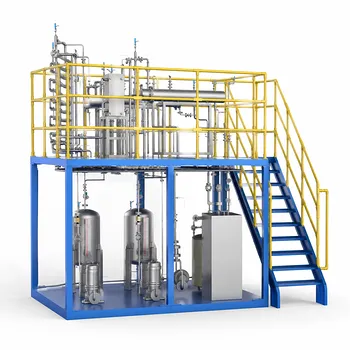
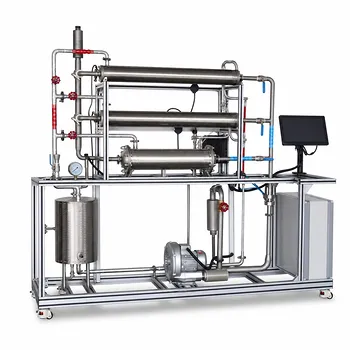
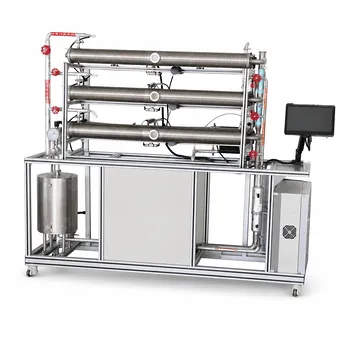
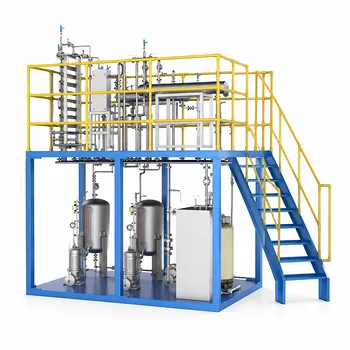
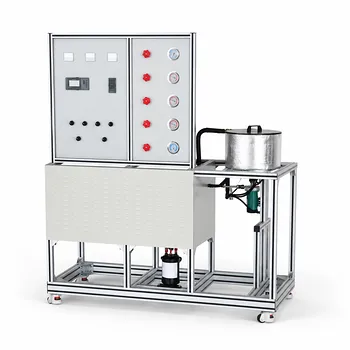
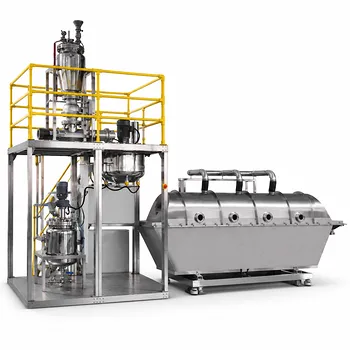
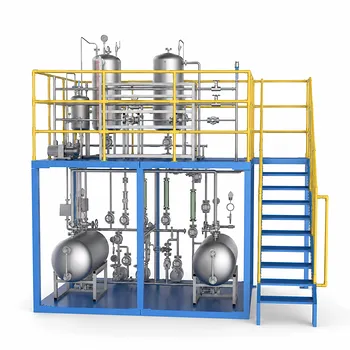
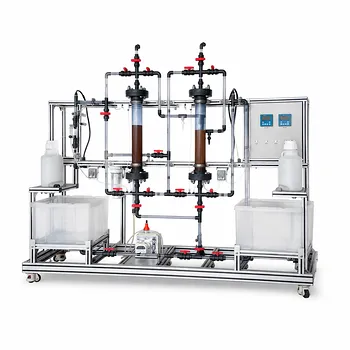
Even identical instruments are never truly identical. When deploying multiple unit operations pilot plants across educational or research sites, calibration transfer is essential because it allows a single multivariate calibration model to be applied to all analyzers, despite unavoidable differences in instrument response. Without it, each unit would require its own costly, time-intensive model—wasting resources and destroying data consistency between labs.
Transferring a calibration model from a master analyzer to identical slave units is the most cost-effective way to standardize data quality across a network of pilot plants. It eliminates redundant model development effort while ensuring all research sites obtain comparable, trustworthy experimental results.
The Hidden Variability in “Identical” Pilot Plant Analyzers
Why Identical Models Don’t Produce Identical Responses
Even when you purchase the same make and model of online analyzer for every pilot plant, raw spectral responses will differ. Manufacturing tolerances in optics, electronics, and flow cells introduce subtle but meaningful drift. Component aging, alignment shifts, and slight discrepancies in sampling interfaces further compound these differences. A mathematical model trained on one unit’s signal simply won’t translate accurately to another.
The Direct Impact on Multi-Site Education and Research
If a university deploys ten identical distillation columns across different labs, each one effectively becomes a unique instrument. A calibration model built on the master unit cannot be loaded onto the other nine and deliver reliable predictions. Students and researchers in separate locations would generate mismatched data, undermining collaborative experiments, shared curricula, and the ability to reproduce results.
The Real-World Cost of Building a Model for Every Unit
The Calibration Bottleneck
Developing a robust multivariate calibration model is resource-intensive. It demands collecting dozens of reference samples, running them on the analyzer, measuring true property values through off-line lab methods, and executing complex chemometric modeling. Repeating this entire campaign for each pilot plant consumes weeks of personnel time and significant budgets in reagents and consumables.
Why Educational Budgets Can’t Afford Redundancy
In academic and research environments, both funding and skilled labor are scarce. Requiring full calibration for every duplicate unit quickly becomes financially unsustainable. The cost of model development could easily surpass the savings gained by adding extra pilot plants, completely undermining the value of scaling up experimental capacity.
How Calibration Transfer Solves the Core Challenge
One Master Model, Many Slave Instruments
Calibration transfer directly addresses this problem by allowing a calibration model developed on a single master pilot plant analyzer to be used on the slave analyzers of all other units. Instead of building new models, a mathematical adjustment is applied—either to the model itself or to the slave’s data—so that predictions from every instrument match those of the master. This minimizes calibration costs and standardizes data quality across the entire network.
The Two Main Approaches: Model Correction vs. Signal Correction
Calibration transfer modifies the model coefficients using a small set of transfer samples measured on both master and slave. The original model is transformed to perform accurately on the slave. Instrument standardization does the opposite: it mathematically preprocesses the slave’s spectral responses to mimic the master’s response profile before feeding them into the unchanged model. Both paths dramatically reduce the need for new reference analyses, making multi-unit deployment financially and logistically viable.
Understanding the Trade-offs and Practical Limits
Transfer Performance Is Never Perfect
A transferred calibration model rarely achieves exactly the same prediction accuracy as on the original master. Some degradation is expected, especially if slave analyzers have larger mechanical or optical differences. The quality of the transfer hinges on instrument stability and the representativeness of the chosen transfer samples. Poorly selected samples can introduce systematic bias.
When a Local Recalibration Might Still Be Necessary
Calibration transfer works best when instruments are truly of the same make and model and have similar baseline performance. If a slave unit has undergone major repair or has a significantly different sampling interface, a simple transfer may fail. In these cases, a full or partial recalibration on that specific unit may be unavoidable. Always validate transferred models with an independent test set on every slave instrument.
Making the Right Choice for Your Laboratory Network
After balancing cost, consistency, and acceptable performance trade-offs, here’s how to decide your approach:
- If your primary focus is minimizing total investment across many identical pilot plants: Use calibration transfer from a carefully maintained master unit. The initial effort of building one robust model pays dividends across every subsequent unit, keeping per-unit startup costs extremely low.
- If your primary focus is absolute measurement accuracy for published, multi-site research: Validate transferred models rigorously with local standards. If any slave shows unacceptable bias, invest in a unit-specific correction or a limited recalibration using a smaller sample set.
- If your primary focus is educational consistency and a uniform student experience: Calibration transfer ensures that an online analyzer reports the same purity trend for a given process condition, regardless of which pilot plant a student operates. This standardizes learning outcomes and makes shared lab manuals feasible.
- If your primary focus is future-proofing the network: Document all transfer protocols and retain a sealed set of transfer samples. As new units are added or existing ones repaired, you can quickly re-transfer the model without starting from scratch.
Ultimately, calibration transfer transforms a collection of similar pilot plants into a truly unified experimental platform, enabling reproducible science and scalable engineering education without breaking the budget.
Summary Table:
| Aspect | Calibration Transfer | Individual Calibration |
|---|---|---|
| Setup Cost | Low (Single master model applied to all units) | High (Separate model built for each unit) |
| Time Investment | Fast (Mathematical adjustment to slave units) | Slow (Weeks of sampling & testing per unit) |
| Data Consistency | High (Standardized response across all sites) | Low (Risk of localized instrument drift/bias) |
| Resource Demand | Minimal (Only requires a few transfer samples) | Heavy (Demands extensive reference analysis) |
Scale Your Multi-Site Lab Network Effortlessly with LABPARK
Ensuring consistent, reproducible data across multiple laboratories shouldn't drain your engineering budget. LABPARK provides premium Educational and Vocational Unit Operations Pilot Plants in chemical engineering, bioprocess & biotech, and environmental & water treatment tailored for universities, research institutes, and enterprises.
We design our systems to support seamless calibration and integration, ensuring that your students and researchers achieve standardized, high-quality results across every site.
Ready to elevate your practical training and research capacity? Contact LABPARK today to explore our pilot plant solutions and request a custom quote!
Related Products
- Comprehensive Multi-Modal Heat Transfer Unit Operations Pilot Plant for Engineering Training
- Dual-Mode Rectification Pilot Plant for Practical Training Unit Operations
- Comprehensive Heat Transfer Coefficient Determination Educational Unit Operations Pilot Plant
- Three-Tube Heat Transfer Educational Pilot Plant for Unit Operations Training
- Dual Mode Heat Transfer Pilot Plant for Unit Operations Training
People Also Ask
- When is ε-NTU preferred over LMTD in pilot plants? Predict heat exchanger performance without iteration.
- What engineering trade-offs must students analyze in a heat transfer pilot plant? Balance performance & cost.
- How does cascade control achieve superior disturbance rejection in heat transfer pilot plants?
- Why is emissivity critical in heat transfer pilot plants? Bridge the Gap Between Theory & Industrial Design
- How does thermal conductivity affect pilot plant performance? Optimize heat transfer & accuracy