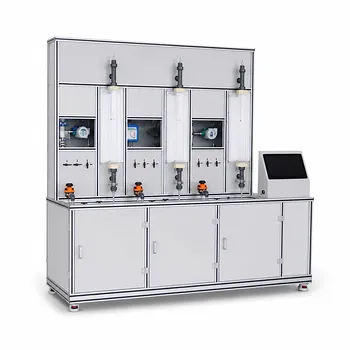
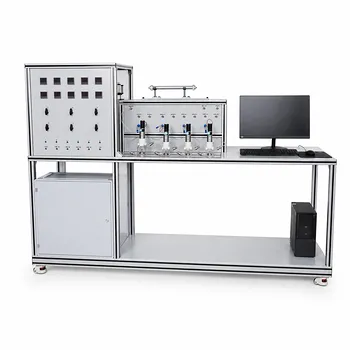
The core struggle in isolating reaction intermediates lies in the relentless backmixing of a single-phase CSTR. In such a perfectly mixed vessel, a series-parallel reaction’s first step forms the desired intermediate, but that intermediate immediately encounters fresh reactants everywhere in the tank, driving the over‑reaction to undesired products. A heterogeneous gas‑liquid reactor resolves this by introducing a tunable mass‑transfer step. By setting the effective diffusion time between the two reaction steps’ characteristic times, the first reaction becomes diffusion‑controlled while the second stays under kinetic control, physically separating the pathways and enabling nearly 100% selectivity for the intermediate.
The ideal single‑phase CSTR makes it impossible to “catch” an intermediate—backmixing ensures it reacts further. A heterogeneous gas‑liquid reactor uses mass‑transfer limitations to create a temporal and spatial gap between the first and second reaction steps, effectively quenching the intermediate before it can degrade.
The Selectivity Trap in Single‑Phase CSTRs
Perfect Mixing Creates a Uniform Reaction Environment
In a series‑parallel reaction, the target intermediate P is produced by the first addition step and can then react in a second substitution step to form an undesired Q. Because a CSTR instantly mixes all contents down to the outlet concentration, the intermediate, reactants, and products coexist in the same homogeneous phase at every point. There is no gradient that protects P—any P molecule is just as likely to encounter a reactive partner as the primary reactants are.
Backmixing Drives Down Intermediate Yield
Unlike a plug‑flow reactor that preserves concentration profiles and limits over‑reaction, a CSTR operates at the lowest reactant concentration and the highest product concentration. The reactor’s backmixing ensures that P, once formed, is continuously recycled into high‑concentration zones of the second reactant, pushing the system toward the thermodynamic sink of Q. This is why pilot‑scale CSTRs often yield only a modest fraction of the intermediate that kinetics would suggest is feasible.
Why Pilot Plants Magnify the Problem
Pilot plants must replicate industrial mixing and residence‑time behavior. In a single‑phase CSTR pilot unit, the same perfect mixing that simplifies heat removal and scale‑up directly sabotages intermediate selectivity. Operators soon learn that no amount of fine‑tuning of temperature or feed rate can overcome the fundamental limitation: the tank is a single, shared reaction volume where all steps compete simultaneously.
How Heterogeneous Gas‑Liquid Reactor Design Solves the Problem
Exploiting Mass Transfer to Impose a Kinetic Hierarchy
When one reactant is a gas and the other is in the liquid phase, the overall rate of the first reaction becomes a function not only of intrinsic kinetics but also of mass‑transfer resistance at the gas‑liquid interface. By adjusting the agitation speed or gas dispersion, the pilot‑plant operator changes the effective diffusion time—the time required for a gas molecule to travel from the bubble surface into the bulk liquid where it reacts.
Physically Decoupling the Two Reaction Steps
The breakthrough is to tune the diffusion time so it falls between the characteristic reaction times of the first and second steps. The first addition reaction (fast intrinsic kinetics) enters the diffusional sub‑regime: its apparent rate is governed entirely by how quickly gas dissolves. The second substitution reaction, with a longer intrinsic time constant, remains in the kinetic sub‑regime, limited by its own slow chemistry. The result is that the two steps do not occur simultaneously in the same liquid phase—the intermediate P is generated only when gas transfers, and the second reaction is too slow to consume it before it is swept out.
Achieving Nearly 100% Selectivity with Agitation Control
In practice, a pilot‑scale heterogeneous reactor can push intermediate selectivity close to unity. The agitator speed becomes a selectivity dial: faster mixing shortens the diffusion time, potentially activating both steps, while slower mixing keeps the first step mass‑transfer‑limited and the second kinetically frozen. Careful design of the impeller, baffles, and gas sparger allows engineers to lock the diffusion time exactly within the required window, something impossible in a homogeneous liquid CSTR.
Understanding the Trade‑offs
Reduced Overall Reaction Rate Due to Mass Transfer Limitation
Intentionally slowing the first step through diffusion control means the reactor processes gas at a lower rate than the intrinsic kinetics would allow. Selectivity gains come at the expense of overall productivity—the reactor volume needed for a given output will be larger, or the residence time must increase.
Increased Complexity in Reactor Design and Scale‑Up
A heterogeneous gas‑liquid system introduces additional degrees of freedom: interfacial area, mass‑transfer coefficients, bubble coalescence, and gas holdup. Scaling up a pilot result requires detailed validation of mixing and mass‑transfer correlations, far beyond the simple heat‑transfer and residence‑time considerations of a single‑phase CSTR.
Sensitivity to Operating Conditions
The narrow window of diffusion times that yields high selectivity is sensitive to feed impurities, temperature swings, and changes in liquid viscosity. If the diffusion time drifts outside the target range, selectivity can collapse abruptly, making robust process control and online monitoring essential.
Making the Right Choice for Your Goal
Each reactor configuration suits a different priority. Use the following guide when deciding between a single‑phase CSTR and a heterogeneous gas‑liquid pilot plant for series‑parallel reactions.
- If your primary focus is maximizing intermediate selectivity above all else: The gas‑liquid reactor is the only viable path—tuned mass transfer can decouple reaction steps and deliver near‑perfect yields of the intermediate that a CSTR cannot match.
- If your primary focus is simple, robust operation with high single‑pass conversion: A single‑phase CSTR may still be appropriate, but you must accept that the intermediate will be contaminated by over‑reaction products and plan for downstream separation.
- If your primary focus is pilot‑scale data for process development and scale‑up: A modular gas‑liquid pilot plant allows you to directly measure the impact of mixing and mass transfer on selectivity, generating the design‑of‑experiments dataset needed to confidently scale up a heterogeneous production process.
- If your primary focus is flexibility to study multiple reaction regimes: A heterogeneous reactor is a valuable teaching and R&D tool, allowing operators to switch between kinetic, diffusion, and intermediate regimes simply by changing agitation speed or gas flow.
Embrace the reactor that matches the reaction physics: a single‑phase CSTR is a race toward equilibrium, but a well‑tuned heterogeneous gas‑liquid system can intercept the intermediate and hold it at the finish line.
Summary Table:
| Feature | Single-Phase CSTR | Heterogeneous Gas-Liquid Reactor |
|---|---|---|
| Mixing Type | Perfect mixing (high backmixing) | Tunable mass-transfer (gas-liquid interface) |
| Selectivity Control | Low (over-reaction dominates) | High (diffusion time decouples reaction steps) |
| Intermediate Yield | Modest (limited by thermodynamics) | High (up to ~100% via agitation control) |
| Scale-up Complexity | Low (simple kinetics & residence time) | High (complex mass-transfer & mixing dynamics) |
| Best Suited For | High conversion, simple reactions | High-selectivity intermediate separation |
Optimize Your Reaction Engineering with LABPARK
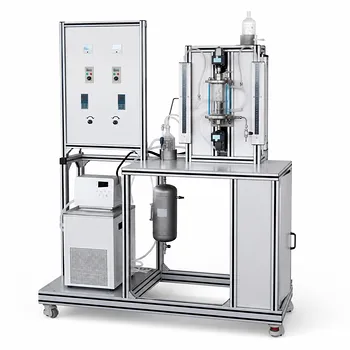
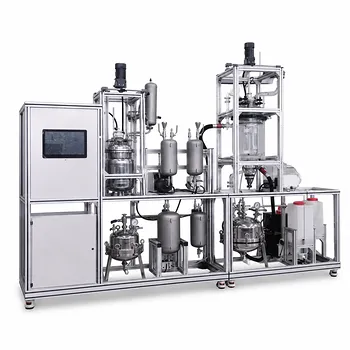
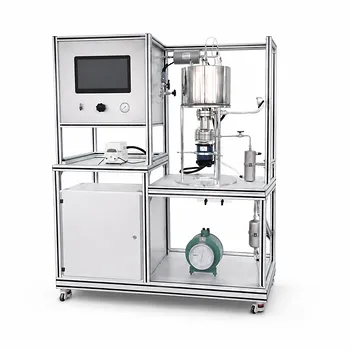
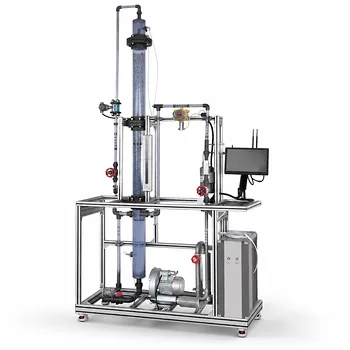
Are you looking to bridge the gap between theory and industrial reality in your lab or pilot plant? LABPARK provides state-of-the-art Educational and Vocational Unit Operations Pilot Plants tailored for universities, research institutes, and enterprises.
Whether you are teaching complex gas-liquid mass transfer or scaling up chemical processes, our advanced pilot systems in chemical engineering, bioprocess & biotech, and environmental & water treatment deliver the precise control and reliability you need to succeed.
Contact LABPARK today to discover how our pilot plants can elevate your research, teaching, and process development!
Related Products
- Fixed Bed Gas Solid Catalytic Reaction Educational Pilot Plant
- Gas-Solid Heterogeneous Separation Demonstration Educational Unit Operations Pilot Plant
- Dual-Drive Stirred Gas-Liquid Mass Transfer Coefficient Determination Pilot Plant
- Micro-Scale Gas-Solid Catalytic Reaction Educational Pilot Plant
- Fluidized Bed Gas Solid Catalytic Reaction Educational Pilot Plant
People Also Ask
- How do reactor pilot plants safely study gas-solid reactions? Master kinetics with thermal & flow control.
- How does the Mears criterion evaluate transport resistance? Key Guide to Intrinsic Kinetics
- Fluidized vs. Fixed Bed Reactors: Comparing Heat & Complexity in Pilot Plants
- Why is a multibed configuration necessary for exothermic reactions? Optimize your pilot plant trajectory.
- How is the friction factor determined for fixed-bed pilot plants? Select the best pressure drop correlation.