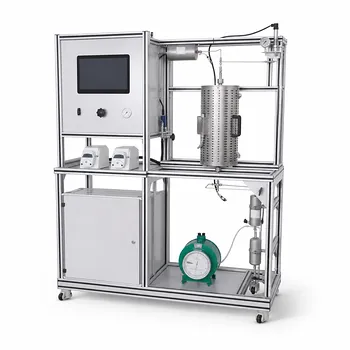
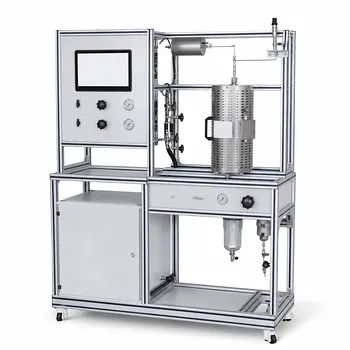
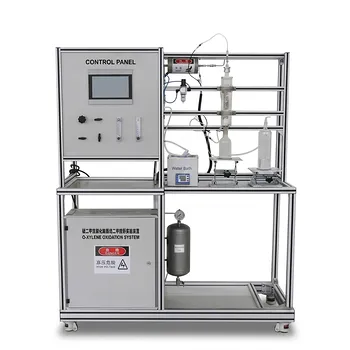
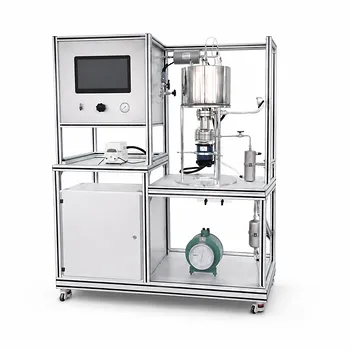
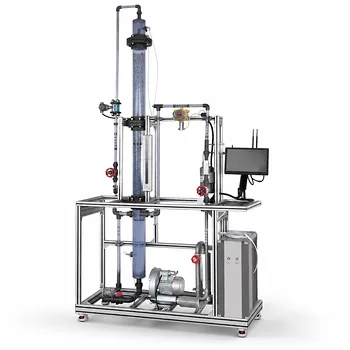
Directly scaling up a laboratory fixed‑bed reactor to commercial dimensions is a recipe for failure. A pilot‑scale unit operations plant is essential because it reveals complex hydrodynamic and gas redistribution behaviors that are completely absent in benchtop equipment. By running a realistic intermediate‑scale experiment, engineers obtain the semi‑empirical data needed to tune reactor models and ensure that the final commercial unit operates safely, efficiently, and at the expected yield.
The core challenge of scaling fixed‑bed catalytic reactors is that flow, mixing, and concentration fields change dramatically with size. A pilot plant is the only practical way to capture those changes, de-risk the design, and bridge the gap between theoretical kinetics and industrial reality.
The Hidden Complexity of Fixed‑Bed Reactor Hydrodynamics
Laboratory reactors are small enough to maintain nearly ideal plug‑flow. Commercial reactors are not. The shift introduces fluid‑mechanical phenomena that can destroy selectivity, create hot spots, or starve the catalyst of reactants.
Why Similarity Theory Breaks Down
You cannot simply apply geometrical similarity to scale a fixed‑bed reactor. The hydrodynamic regime – flow maldistribution, wall effects, and the way gases mix – is fundamentally different at large diameters and high space velocities.
Commercial units demand complex internal hardware (distributors, quench boxes, heat exchangers) whose effects do not scale linearly. Laboratory‑scale models cannot replicate these interactions, so the designer has no reliable theoretical shortcut.
The Role of Gas Redistribution in Multibed Reactors
In a multibed reactor, hot gas leaves a catalyst bed, passes through an external or inter‑bed heat exchanger, and must be re‑introduced evenly into the next bed. At pilot scale you can physically study how the gas plume redistributes itself, because poor redistribution creates large stagnant or bypass regions that degrade performance.
This behavior is not captured by kinetics alone. A pilot plant lets you measure pressure drops, temperature profiles, and residence‑time distributions under conditions that mimic the final commercial flow path.
Tuning Effective Parameters with Semi‑Empirical Data
Mathematical models of commercial reactors rely on “effective” parameters – effective thermal conductivity, effective diffusivity, axial dispersion coefficients. These are not fundamental constants; they depend on flow rate, pellet size, and bed geometry.
A pilot‑scale unit provides the semi‑empirical data to fit these parameters. You run the reactor, collect concentration and temperature profiles, and then adjust your model until it faithfully reproduces the observed behavior. That calibrated model becomes your reliable basis for designing the full‑scale plant.
Mitigating Commercial Risk: Beyond Hydrodynamics
Hydrodynamics is only one piece of the puzzle. The pilot plant also serves as a proving ground for the catalyst, mass‑transfer characteristics, and auxiliary unit operations that will define the commercial process.
Validating Catalyst Performance Under Realistic Conditions
Laboratory tests rarely expose a catalyst to the recycled impurities, thermal cycling, or mechanical stresses that prevail in a commercial loop. A pilot plant mimics those stressors, giving you accurate data on activity, selectivity, and deactivation rates.
This testing is crucial because catalyst cost is a tiny fraction of total operating expenses, but a premature shut‑down for catalyst replacement can be devastating. The pilot plant confirms that your chosen material will last under actual plant conditions.
Mass Transfer and Kinetic Control
The largest risk when scaling up is that the reaction shifts from kinetic control to mass‑transfer control. If the dissolved gas concentration in the liquid (or within the pellet) drops below the laboratory value, the entire rate expression changes.
Pilot‑scale reactors allow you to measure and match the volumetric mass‑transfer coefficient (kLa). By maintaining near‑saturation gas concentrations – i.e., [H₂]plant ≈ [H₂]lab – you ensure that the intrinsic kinetics still dominate, and product selectivity remains predictable.
Proving Technical Feasibility of Unit Operations
A fixed‑bed reactor never operates in isolation. It is surrounded by heat exchange, product separation, and recycle loops. A unit operations pilot plant tests the entire train, identifying corrosion rates, solids handling problems, and control failures that a kinetic study alone cannot foresee.
This physical validation flags weak points early, helping engineers design backup systems, interlocks, and safe operating envelopes before money is committed to a full‑scale facility.
Understanding the Trade‑offs of Pilot Plant Scale‑Up
Pilot plants are not a silver bullet. They demand significant capital, staffing, and time – often months of continuous operation to gather statistically meaningful data. However, the trade‑off is that skipping this step can easily multiply costs by factors of ten if a commercial reactor fails to meet specification or suffers a catastrophic runaway.
The pilot scale itself must be chosen carefully. Too small, and you fail to capture the maldistribution effects. Too large, and you waste resources. An optimally designed pilot unit is large enough to exhibit the critical flow phenomena while remaining small enough for safe, flexible experimentation. The data it produces are empirical, not first‑principles – but that is precisely what makes them invaluable for tuning the predictive models.
How to Apply This to Your Project
A successful scale‑up strategy always includes a well‑designed piloting phase. The exact focus depends on your primary goal.
- If your primary focus is minimizing technical risk from hydrodynamics: Design the pilot reactor to replicate the full‑scale gas redistribution pattern, especially for multibed configurations with external heat exchangers. Use the measured profiles to tune your CFD and reactor‑engineering models.
- If your primary focus is catalyst selection and lifetime: Run long‑duration pilot campaigns with actual feed impurities and realistic recycle loops to capture deactivation kinetics. Confirm that the selectivity holds as the catalyst ages.
- If your primary focus is economic validation and process integration: Operate the pilot plant as a full unit operations chain. Gather mass balances, energy consumption, and maintenance data to vet the production cost and identify the most vulnerable equipment items.
Pilot‑scale unit operations plants are not an optional academic exercise – they are the engineering insurance that transforms a laboratory recipe into a profitable, safe commercial reality.
Summary Table:
| Scale-Up Stage | Key Objectives | Critical Risks Mitigated |
|---|---|---|
| Laboratory Scale | Determine intrinsic kinetics & catalyst activity | Incorrect chemical pathway assumptions |
| Pilot-Scale Plant | Study hydrodynamics, heat/mass transfer, & catalyst lifetime | Flow maldistribution, hot spots, mass-transfer limits |
| Commercial Scale | Maximize yield, safe continuous operation, & profitability | Runaway reactions, premature catalyst failure, off-spec products |
Bring Industrial-Scale Reality to Your Facility with LABPARK
Bridging the gap between laboratory benchtop experiments and commercial production requires precise, hands-on validation.
LABPARK provides state-of-the-art Educational and Vocational Unit Operations Pilot Plants tailored for universities, research institutes, and enterprises. Our customizable systems help you master scaling challenges across key fields:
- Chemical Engineering (including catalytic reactors, distillation, and heat exchange systems)
- Bioprocess & Biotechnology
- Environmental & Water Treatment
Equip your students, researchers, and engineers with the physical tools needed to de-risk chemical processes, optimize reactor hydrodynamics, and safely transition to commercial scale.
Contact LABPARK today to discuss your technical specifications and request a customized pilot plant solution!
Related Products
- Fixed Bed Gas Solid Catalytic Reaction Educational Pilot Plant
- Fixed-Bed Chemical Reaction and Gas Dust Tar Removal Unit Operations Pilot Plant
- Multi Functional Catalytic Reaction and Reactor Evaluation Educational Unit Operations Pilot Plant
- Ethylbenzene Dehydrogenation Educational Unit Operations Pilot Plant
- Educational Unit Operations Pilot Plant for Intraparticle Diffusion Effective Factor Measurement
People Also Ask
- How do reactor pilot plants safely study gas-solid reactions? Master kinetics with thermal & flow control.
- How does the Mears criterion evaluate transport resistance? Key Guide to Intrinsic Kinetics
- Fluidized vs. Fixed Bed Reactors: Comparing Heat & Complexity in Pilot Plants
- Why is a multibed configuration necessary for exothermic reactions? Optimize your pilot plant trajectory.
- How is the friction factor determined for fixed-bed pilot plants? Select the best pressure drop correlation.