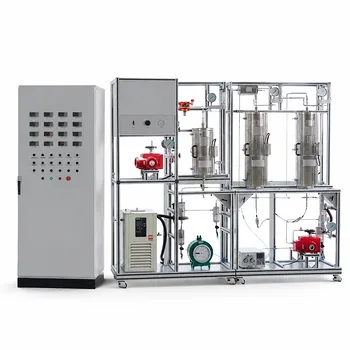
The single most important reason you cannot use a steady-state calculation for the heating and cooling cycles in a batch reactor pilot plant is that the entire process is, by definition, an unsteady-state operation. The temperature inside the vessel, the rate of heat transfer, and the amount of heat accumulated by the reacting mass all change continuously with time. A steady-state energy balance—where all variables are treated as constants—would therefore give you a dangerously incomplete snapshot, ignoring the dynamic peaks that truly dictate equipment sizing and control.
Batch reactors are inherently transient. A differential energy balance captures the moment-by-moment relationship between heat accumulation and transfer, which is the only way to identify the maximum instantaneous heating or cooling demand and to design a system that can handle it safely and efficiently. Without this, you are guessing at the most critical design parameters.
The Nature of Batch Operations: Inherently Unsteady-State
A batch reactor does not have streams continuously flowing in and out. Instead, all reactants are charged, and the system evolves through a temperature program from start to finish. This means every thermal property is a moving target.
Temperature is a Moving Target
In a continuous stirred-tank reactor operating at steady-state, the outlet temperature is fixed. You can plug it into a simple equation like (Q = \dot{m} C_p \Delta T) and get a single, constant heat duty. That calculation tells you the net energy balance at one point in time.
In a batch reactor, however, the vessel contents are being heated up, held at a reaction temperature, and then deliberately cooled down. The bulk temperature (T) changes over time, which directly changes the driving force for heat transfer ((\Delta T_m)), the accumulation term, and the required jacket or coil utility temperature.
Why Steady-State Simplifications Break Down
Steady-state methods assume that the rate of energy entering equals the rate of energy leaving, with zero accumulation. This holds perfectly for a continuous heat exchanger with fixed inlet and outlet conditions. But a batch reactor’s entire purpose is to accumulate heat (during heat-up) or remove accumulated heat (during cool-down and exothermic reaction). The accumulation term—(MC_p \frac{dT}{dt})—is the very thing you are trying to control.
Ignoring it would mean you fail to cut the cooling water flow quickly enough when an exothermic reaction accelerates or you dramatically undersize the heating system because you never ask: “How fast must I raise the temperature to hit this cycle time target?”
The Critical Role of Time: Sizing Heat Transfer Area
The primary reference makes it clear: the differential balance (MC_p \frac{dT}{dt} = UA\Delta T_m) is the tool used to determine the transient rates of heat accumulation and transfer. This is the only way to find the maximum heating or cooling rate required during the entire batch cycle. That peak rate dictates the required heat transfer area (A) and the capacity of the utility system (steam, chilled water, etc.). A steady-state calculation would give you an average duty—almost certainly lower than the peak—leading to an under-designed, and potentially unsafe, pilot plant.
The Differential Energy Balance: The Tool for Transient Analysis
The differential energy balance is not an optional complexity; it is the direct mathematical representation of a batch reactor’s physics. It explicitly links what you can control (utility temperature, heat transfer area) to what you must achieve (a defined temperature-time profile).
Deconstructing the Equation (MC_p \frac{dT}{dt} = UA\Delta T_m)
This single expression packs in everything a pilot plant designer needs. (MC_p \frac{dT}{dt}) is the rate of heat accumulation within the reactor contents, calculated using the total mass ((M)) and its specific heat ((C_p)). If the temperature is rising, this term is positive. It is the net gain.
This accumulation must equal the rate of heat transfer across the jacket or coil, given by (UA\Delta T_m). Here, (U) is the overall heat transfer coefficient, (A) is the surface area, and (\Delta T_m) is the log-mean temperature difference between the reactor contents and the utility fluid. As the batch heats, (\Delta T_m) changes continuously. The equation tells you exactly how fast the temperature can rise given your hardware limitations.
How to Determine the Maximum Instantaneous Load
During a typical heating cycle, the temperature difference (\Delta T_m) is largest at the very beginning (when the reactor is cold and the jacket is hot). The rate of temperature rise, (dT/dt), is therefore highest at the start of heating, often tapering off as the setpoint is approached. The maximum heat transfer rate is then calculated as (Q_{max} = UA(\Delta T_m)_{max}). This is the “worst-case” load your utility system must supply.
A steady-state calculation could not pinpoint this moment. It would average energy consumption over the full cycle, missing this critical demand spike that determines if your boiler can actually keep up.
Control Algorithm Design and Thermal Overshoot Prevention
The same transient analysis is the foundation for process control. To prevent thermal overshoot—where the reaction mass gets too hot, potentially forming impurities or triggering a runaway—the control system must begin to reduce heating input before the target temperature is reached. This requires a model that predicts how (dT/dt) will respond to changes in jacket temperature. The differential balance provides exactly that model.
Coupled with a feedback loop (e.g., PID), you can program the jacket to cool down as the reactor approaches setpoint, bringing (dT/dt) smoothly to zero. Without a differential understanding, you are left with a crude on/off scheme that either overshoots dramatically or painfully extends the batch cycle time.
The Practical Pitfalls of Ignoring the Transient
Choosing a steady-state shortcut in a batch reactor pilot plant introduces three severe risks that directly contradict the goals of scale-up research.
The Danger of Under-Sized Equipment
The most immediate consequence is that the heat exchanger jacket or coil will be too small. A steady-state energy balance might compute an average heat duty of 5 kW, but the dynamic analysis reveals a 10 kW peak for 15 minutes. If the jacket cannot deliver 10 kW, the heating phase will stretch out, making the target cycle time impossible. In an exothermic cooling cycle, the inability to remove heat at the peak generation rate can lead to reaction temperature runaway.
The Risk of Thermal Runaway and Safety Hazards
Pilot plants are research tools, often handling novel chemistries where the reaction enthalpy is not perfectly known. A differential analysis explicitly forces you to ask “what if?” scenarios—for example, what is the maximum possible temperature rise if cooling suddenly fails? The accumulation term (MC_p \frac{dT}{dt}) directly feeds into thermal safety calculations like Time to Maximum Rate (TMR) under adiabatic conditions. A steady-state mindset, which treats energy flow as balanced, is blind to this runaway potential.
The Cost of Excessively Long Batch Cycles
On the other end of the spectrum, an engineer who recognizes the need for transient analysis but cannot model it precisely may overcompensate. They might specify an enormous safety margin on the heat transfer area “just to be safe.” While this avoids an undersized system, it drives up capital cost, utility usage, and instrumental complexity. A rigorous differential model gives confidence to operate with a fit-for-purpose design, minimizing overall batch cycle times without compromising safety.
Making the Right Calculation for Your Pilot Plant Design
Your specific goal within the pilot plant dictates which facet of the transient analysis deserves the most attention. However, the fundamental answer remains unchanged: you must use a differential energy balance to see the true dynamic picture.
- If your primary focus is process safety and runaway prevention: Use the differential balance to map the maximum cooling load during the exothermic peak and verify that the jacketed system can remove heat faster than the reaction generates it at all times.
- If your primary focus is minimizing cycle time for productivity: Model the entire heating and cooling profile with the differential equation to identify where the largest bottleneck in heat transfer occurs, then optimize the jacket temperature setpoints accordingly.
- If your primary focus is scale-up data generation: Extract the transient overall heat transfer coefficient (U) and the time-dependent heat of reaction from pilot data using the differential form—these are the rate-based parameters essential for designing production-scale batch vessels.
- If your primary focus is developing a robust control algorithm: Implement the equation (MC_p \frac{dT}{dt} = UA(T_{jacket} - T)) within a model-predictive controller to achieve a seamless approach to setpoint with zero overshoot.
A differential energy balance is not just a more complex way of solving the same problem; it is the only lens that brings the critical moments of a batch reactor’s life into focus, transforming an average and often misleading picture into an exact, actionable design and operating blueprint.
Summary Table:
| Feature / Parameter | Steady-State Calculation | Differential Energy Balance |
|---|---|---|
| System Assumption | Constants over time (No accumulation) | Transient/time-varying variables |
| Heat Accumulation ($MC_p \frac{dT}{dt}$) | Ignored (assumed to be 0) | Evaluated continuously over the cycle |
| Heat Load Assessment | Average heat duty only | Maximum peak instantaneous load |
| Sizing Risk | High (leads to under-sized equipment) | Low (designs for worst-case dynamics) |
| Process Control Design | Ineffective for PID/overshoot control | Essential for model-based temperature control |
Optimize Your Batch Process Scale-Up with LABPARK
Need robust and safe thermal control in your research or training systems? LABPARK provides premium Educational and Vocational Unit Operations Pilot Plants across chemical engineering, bioprocess & biotech, and environmental & water treatment.
We help universities, research institutes, and enterprises design and implement pilot plants that ensure accurate transient thermal modeling, safe scale-up data generation, and maximum operational safety.
Ready to elevate your engineering lab? Contact us today to get started!
Related Products
- Multi-Reactor Educational Pilot Plant for Reaction Engineering Unit Operations
- Fixed-Bed Chemical Reaction and Gas Dust Tar Removal Unit Operations Pilot Plant
- Tubular Reactor Flow Characteristics Determination Educational Unit Operations Pilot Plant
- 100L Continuous Loop Hydrogenation Educational Unit Operations Pilot Plant
- Methanol Synthesis and Catalyst Performance Evaluation Educational Unit Operations Pilot Plant
People Also Ask
- How do educational unit operations pilot plants address safety and waste management when scaling up?
- How do educational unit operations pilot plants bridge theory and design? Bridge the Engineering Gap
- Why Compare Predicted and Experimental Excess Enthalpy? Key to Accurate Pilot Plant Scale-up
- How to study gasification in pilot plants? Compare exit gas composition & efficiency
- Why Use PTFE & Hastelloy in Chemical Pilot Plants? Prevent Corrosion & Ensure Safety