Gas-fluidized bed reactors in pilot plants frequently surprise researchers with sluggish gas mixing and disappointingly low mass transfer coefficients—and the reason lies deep in the fluid dynamics. When fine solid particles pack closely together, they suppress the gas-phase turbulence that would normally stir the reactor. As a result, the interstitial gas flow remains streamline and orderly, moving at a velocity barely above the minimum fluidization point. With a Reynolds number on the order of 10⁻¹ for typical 100 µm particles, turbulent eddies cannot form. Consequently, mass and heat transfer coefficients remain stranded near their theoretical lower limits, and any process that relies on thorough gas blending or rapid interphase transport will suffer.
The root cause of poor gas mixing and low transfer coefficients in gas-fluidized beds is the natural suppression of turbulence by densely packed particles. This forces the gas into a laminar, streamline flow pattern, crippling the ability to mix reactant gases or transfer mass efficiently—unless the system intentionally promotes cross-phase exchange or uses porous particles to carry gases between phases.
Why the Physics of Fluidized Beds Chokes Mixing
The Interstitial Flow is Forced into a Streamline Prison
Inside the dense suspension of particles, the gaps that gas can flow through are tiny and tortuous. Closely spaced solids act like a turbulence damper, preventing the formation of the chaotic eddies that drive mixing in open spaces or empty pipes. The gas meanders along predictable paths, barely mingling with gas from neighboring channels.
For nonporous particles, this streamline nature means there is virtually no convective mixing of the gas phase itself. If two reactant gases are introduced separately, they may travel long distances without ever encountering one another at a molecular level. That lack of mixing directly translates into poor conversion and inefficient use of raw materials in pilot-plant trials.
Low Interstitial Velocity Locks Transfer Coefficients at Their Floor
Because the gas in the interstitial space maintains a velocity close to the minimum fluidization velocity (Uₘf), the relative motion between gas and individual particles is extremely gentle. The particle Reynolds number based on that slip velocity is tiny—often just a fraction of unity.
Under such low‑Reynolds‑number conditions, convective heat and mass transfer coefficients cannot increase beyond the values dictated by pure molecular diffusion. The Sherwood and Nusselt numbers remain near their theoretical minima, meaning the boundary layers around particles are thick and stubbornly resistive. Even if the bed looks vigorously agitated from the outside, the interfacial transport between gas and solids can be severely starved.
How This Chokes Reactor Performance
Starving Reactions That Need Gas‑Gas Contact
When a pilot plant feeds reactants as separate gaseous streams, the poor interstitial mixing creates segregated flow paths. Gas “A” and gas “B” may only meet where they both diffuse into the same particle or where large bubbles provide some chaotic blending. The result is a reaction system operating far below its intrinsic kinetic potential.
This manifests as:
- Lower conversion per pass than predicted by idealized models.
- Unwanted selectivity shifts if intermediate products depend on precise gas‑phase stoichiometry.
- Longer residence times needed to achieve target yields, undermining the pilot plant’s throughput and data quality.
Insidious Impact on Scale‑Up Predictions
Pilot plants exist to generate scale‑up data. If mixing and mass transfer are pathologically low due to streamline interstitial flow, the measured global kinetics become distorted by transport limitations. A researcher may mistakenly attribute slow performance to the chemistry itself, designing a larger reactor with incorrect residence times or catalyst volumes.
Moreover, the contact‑time distribution becomes sensitive to these hidden resistances. When mass transfer resistance is significant, changing the reactor length or velocity profile shifts not just the average residence time but the whole distribution—making it nearly impossible to keep both gas‑phase RTD and catalyst contact time constant during scale‑up. This can derail an entire development program.
The Hidden Benefit: Uniform Temperature, at a Cost
Fluidized beds do have one saving grace compared to fixed beds: the intense solids backmixing that creates a boiling‑liquid‑like behavior. This annihilates hot spots and guarantees a nearly isothermal bed, even in highly exothermic reactions.
However, that same vigorous solids mixing introduces a concentration backmixing penalty. The upward and downward circulation of particles flattens the concentration profile along the reactor height, reducing the average driving force for reaction. So a fluidized bed pilot plant might show excellent thermal safety but disappointing conversion—exactly the trade‑off rooted in the interplay between sluggish gas‑side transport and aggressive solids mixing.
Navigating Fluidization Regimes to Unlock Better Performance
From Minimum Fluidization to Bubbling: A Jump in Transport
As gas velocity rises, the bed transitions through distinct fluidization regimes—from fixed bed to minimum fluidization, then to bubbling, slugging, and eventually turbulent. At low velocities, the bed merely unlocks particles; mass transfer is still dominated by the streamline interstitial phase.
The emergence of bubbles changes everything. In the bubbling and slugging regimes, rising gas pockets agitate the solids violently, smashing particles into each other and continuously renewing the gas‑solid interface. This can drive heat transfer coefficients up to around 200 W/(m²·°C) and significantly boost mass transfer. Pilot plants that operate too close to Uₘf effectively starve themselves of this mechanical advantage.
Bubbles as the Unexpected Mixing Allies
Within bubbles, the gas is relatively unconstrained and can mix. More importantly, bubbles act as moving reservoirs that exchange gas with the emulsion phase. As they rise, they leak and reabsorb fluid, creating a cross‑phase mixing mechanism that bypasses the streamline interstitial flow.
The efficiency of this process depends on bubble size and dynamics. In shallow beds, smaller bubbles dominate, and lateral solids mixing becomes the controlling factor for conversion. In deeper beds with large bubbles, the mass transfer across the bubble‑emulsion interface takes over. Understanding which regime a pilot plant is operating in is essential for diagnosing poor performance and for correctly modeling the process.
Common Pitfalls That Amplify Poor Mixing
Relying on Nonporous Particles Without Cross‑Phase Strategy
A classic mistake is to select nonporous particles for their mechanical simplicity and then introduce unmixed reactant gases. The streamline interstitial phase offers no help, and if the bed barely reaches a vigorous bubbling state, mass transfer plummets.
The fix? Use porous catalyst particles that can absorb, transport, and release gases between phases. Even a limited internal porosity allows gas pockets that have reacted in one region to carry species elsewhere, effectively creating a solid‑state mixing pathway. This can lift the conversion out of the diffusion‑starved basement without requiring huge gas flows.
Misinterpreting Pilot Plant Data Through an Idealized Lens
Pilot plant operators often compare experimental results to plug‑flow or perfectly mixed reactor models. When the real fluidized bed suffers from streamline interstitial flow and poor gas‑gas mixing, the data look like a failed experiment.
In reality, the laminar‑like gas paths and strong solids backmixing produce a unique RTD that must be explicitly measured—for instance, via tracer studies. Lumping these effects into a simple efficiency factor without understanding their origin risks carrying hidden transport limitations into the full‑scale design, where they may magnify into catastrophic underperformance.
Neglecting the Scale‑Dependent Shift in Controlling Mechanism
A pilot plant may exhibit consistent, usable performance because its bed height and bubble characteristics are in one regime (e.g., small bubbles, lateral mixing dominant). Scale‑up that increases bed depth and bubble size can flip the controlling mechanism to interfacial mass transfer resistance. The resulting drop in conversion is then misinterpreted as a chemical kinetics or catalyst deactivation issue, when it is purely a fluid‑dynamic shift.
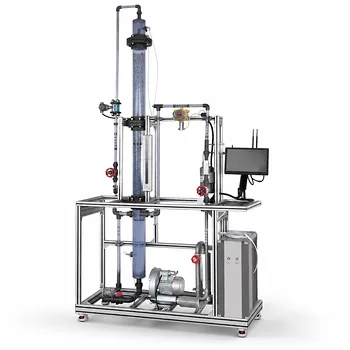
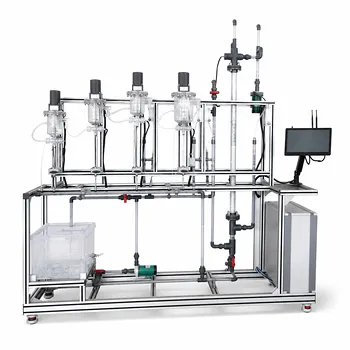
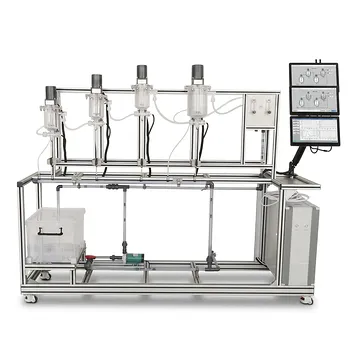
Pilot plants with transparent columns and visual access are invaluable here: they let researchers correlate hydrodynamic regimes directly with performance data, building an intuition for when mixing mechanisms change.
Educational Pilot Plants: Turning a Weakness into a Teaching Tool
In teaching labs, the very problem of poor gas mixing becomes a pedagogical asset. Students can witness how visibly different fluidization patterns—from smooth to bubbling to slugging—correlate with measured conversion, selectivity, and temperature profiles. The stark decline in mass transfer at low velocities drives home the point that hydrodynamics and kinetics are inseparable.
These visual experiments also allow trainees to explore the trade‑off between thermal safety and conversion. By deliberately operating a bed near minimum fluidization and then again in a vigorous bubbling mode, they can quantify how backmixing flattens concentration gradients while protecting against runaway. This hands‑on encounter with the intrinsic limitations of streamline interstitial flow prepares them to troubleshoot pilot plants and design robust scale‑up strategies.
Making the Right Choice for Your Pilot Plant Goal
When a gas‑fluidized bed reactor shows poor mixing and low mass transfer, the solution is not to simply push more gas—it is to align the operating conditions and particle design with the specific goal.
- If your primary focus is maximizing conversion of separately fed gases: Use porous catalyst particles that enable intra‑particle transport, and operate the bed in a vigorous bubbling regime where bubble‑induced mixing and cross‑phase exchange dominate.
- If your primary focus is thermal safety and preventing hot spots: Accept that the intense solids backmixing will level temperature profiles but also reduce the concentration driving force; design for the resulting lower per‑pass conversion, or explore staging with multiple beds.
- If your primary focus is generating reliable scale‑up data: Avoid operating in a regime where streamline interstitial flow dominates; instead, identify and measure the controlling mixing mechanism (lateral solids mixing vs. bubble‑emulsion mass transfer) at the pilot scale, and ensure your scale‑up method preserves that mechanism rather than simply matching gas velocity.
- If your primary focus is educational demonstration: Exploit the poor mixing at low velocities to visualize transport limitations and use the transition to bubbling to teach how hydrodynamics lift mass transfer coefficients from their lower limits.
Poor gas mixing in fluidized beds is not a sign of a broken system—it is a fundamental physical reality that, once understood, can be harnessed or mitigated with purpose‑driven design.
Summary Table:
| Fluidization Regime | Hydrodynamic & Mixing Characteristics | Impact on Reactor Performance |
|---|---|---|
| Minimum Fluidization ($U_{mf}$) | Streamline laminar flow, low Reynolds number, molecular diffusion dominates. | Low conversion, segregated flow paths, severe transport limitations. |
| Bubbling / Slugging | Vigorous solids motion, bubble-emulsion cross-phase gas exchange. | Improved mass transfer, uniform bed temperature, concentration backmixing. |
| Turbulent / High-Velocity | Rapid particle-gas contact, high convective transfer coefficients. | Maximized conversion, complex scale-up dynamics. |
Optimize Your Pilot Plant Scale-Up with LABPARK
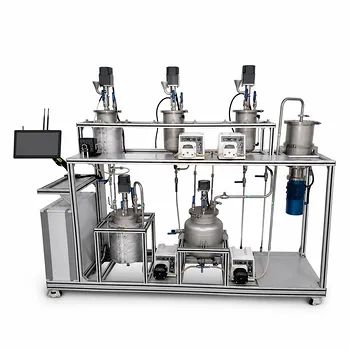
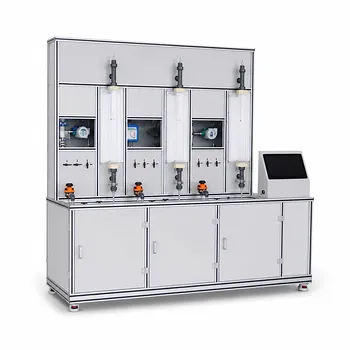
Are transport limitations and poor gas mixing affecting your chemical engineering research? LABPARK helps universities, research institutes, and enterprises bridge the gap between theory and practice. We design and manufacture premium Educational and Vocational Unit Operations Pilot Plants specializing in:
- Chemical Engineering (including fluidized bed and catalytic reactors)
- Bioprocess & Biotech
- Environmental & Water Treatment
Equip your lab with highly visual, industry-grade pilot plants designed to help students and researchers analyze complex fluid dynamics and scale-up parameters with precision.
Contact LABPARK today to find the perfect pilot plant solution for your lab!
Related Products
- Fluidized Bed Gas Solid Catalytic Reaction Educational Pilot Plant
- Two-Dimensional Fluidization Hydrodynamics Educational Pilot Plant for Unit Operations Training
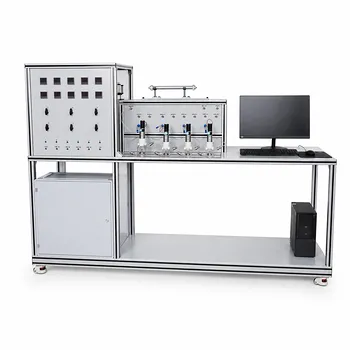
- Multi-Reactor Educational Pilot Plant for Reaction Engineering Unit Operations
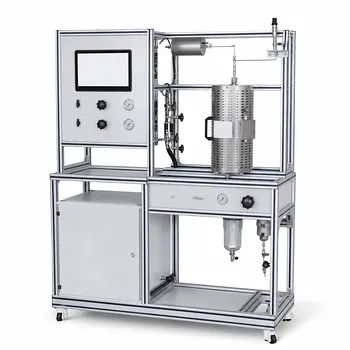
- Multi Functional Catalytic Reaction and Reactor Evaluation Educational Unit Operations Pilot Plant
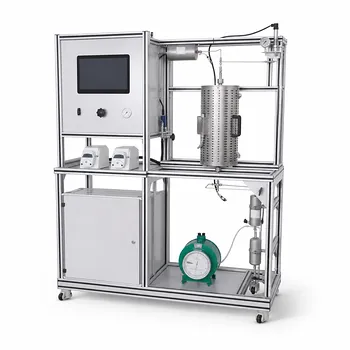
- Fixed Bed Gas Solid Catalytic Reaction Educational Pilot Plant
People Also Ask
- Why is the bed height-to-diameter ratio (L/dt) critical? Fluidized bed pilot plant selection guide.
- How is the minimum fluidization velocity (U_mf) determined and utilized? A Unit Operations Guide
- How does the Mears criterion evaluate transport resistance? Key Guide to Intrinsic Kinetics
- How do reactor pilot plants safely study gas-solid reactions? Master kinetics with thermal & flow control.
- How do pilot plants demonstrate fluidized-bed reactor advantages over fixed-bed? Find Out Now