Composition analyzers challenge feedback control because they measure the process too late. Gas chromatographs and online spectroscopic analyzers require time for sample transport, sample conditioning, chromatographic separation or spectral analysis, and detector signal generation. This creates dead time between a process change and the measurement reaching the controller, so the controller responds to an outdated process state. Under conventional PID tuning, that delay can cause sluggish correction, overshoot, or even instability.
The central problem is not simply measurement accuracy; it is measurement timing. When analyzer dead time is significant relative to the process dynamics, reliable control usually requires dynamic lag compensation, prediction, or a model-based control strategy.
Why Composition Measurements Arrive Late
Sample Transport Adds Dead Time
A composition analyzer usually does not measure directly at the point where the process response occurs. The sample must travel through tubing or a sample line from the vessel, reactor, fermenter, or unit operation to the analyzer.
That transport time varies with line length, flow conditions, pressure, and sample-system design. During this interval, the process composition may already have changed again.
The Analyzer Requires Processing Time
Gas chromatography introduces additional delay while the sample moves through the chromatographic column and its components are separated. The detector then requires time to generate and process a signal representing the measured composition.
Online spectroscopic analyzers may respond differently, but they still require sampling, signal acquisition, interpretation, and communication before a usable value reaches the control system.
The Measurement Represents the Past
The controller compares the desired composition with the measured composition and calculates an error. With analyzer dead time, that error describes a process condition that existed earlier rather than the current condition.
This is analogous to steering a vehicle using a camera that shows the road several seconds behind the vehicle. Increasing steering aggressiveness does not remove the delay; it increases the risk of correcting too strongly or in the wrong direction.
How Dead Time Damages Feedback Control
The Controller Acts on Stale Information
When a disturbance changes composition, the controller may not detect it until the disturbance has propagated through the sample system and analyzer. By then, the process may have moved significantly away from its target.
The controller can therefore continue applying corrective action even after the process has begun responding. When the delayed measurement finally reflects the correction, the controller may reverse direction too late.
Standard PID Tuning Becomes Risky
A PID controller tuned for a fast temperature or pressure measurement may be too aggressive for a delayed composition measurement. The proportional, integral, and derivative actions can amplify the effect of stale information.
Typical results include overshoot, oscillation, slow settling, and possible instability. The problem becomes more severe when the analyzer delay is large compared with the process response time.
Disturbance Rejection Becomes Slower
Feedback control normally counters disturbances such as changes in feed conditions, flowrate, or upstream composition. A delayed analyzer weakens that capability because the corrective action begins only after the disturbance has passed through the measurement path.
This can be especially problematic in pilot plants, where operating conditions may change frequently during experiments and where maintaining stable, reproducible conditions is important.
Why Pilot Plants Expose the Problem
Pilot Plants Have Variable Operating Conditions
Pilot plants are used to evaluate process behavior under realistic conditions, validate operating parameters, and identify risks before scale-up. Their operating points may change often, which makes fixed assumptions about process and analyzer dynamics less reliable.
A sample system that performs adequately at one flowrate, pressure, or composition may introduce a different effective delay under another condition.
Experiments Depend on Reproducible Control
Pilot testing must distinguish genuine process behavior from artifacts caused by poor measurement or control. If the analyzer reports composition late, the control system may create oscillations or transients that obscure the process response being studied.
That can complicate parameter validation and lead engineers to modify equipment or workflows based on a distorted view of process behavior.
Composition Often Has Indirect Process Effects
Composition may be the result of several interacting variables rather than a directly manipulated quantity. For example, the controller may change a feed, utility, flowrate, or reactant condition to influence composition.
This indirect relationship adds process dynamics to the analyzer delay. The control system must account for both the time required to measure composition and the time required for the manipulated variable to affect it.
Understanding the Trade-offs
Faster Response Can Reduce Measurement Quality
Reducing sample transport distance or processing time can improve control responsiveness, but analyzer performance also depends on adequate sample handling and signal quality. A faster measurement is not useful if it is noisy, poorly conditioned, or unrepresentative of the process stream.
The design must balance response time, measurement reliability, and representativeness.
Filtering Can Increase Effective Delay
Signal filtering may be necessary to reduce noise from an analyzer. However, excessive filtering adds further lag and can make the measurement even less useful for a fast feedback loop.
Filtering should therefore be treated as part of the loop dynamics, not as a separate measurement detail.
Conventional PID May Be Insufficient
PID control remains useful for many process variables, particularly when measurements are fast and process dynamics are well characterized. It is less effective when composition measurement dead time dominates the loop.
Simply increasing controller gain or integral action does not solve the fundamental problem. It usually trades sluggishness for oscillation or instability.
Analyzer Availability Matters
Composition analyzers can require sample-system maintenance, calibration, validation, and fault detection. A feedback loop that depends entirely on the analyzer must define what happens when the measurement is unavailable, invalid, or delayed beyond its normal interval.
This operational issue is separate from dead time but directly affects the safety and reliability of the control strategy.
How to Apply This to a Pilot Plant
The appropriate control architecture depends on the relative speed of the analyzer, the process, and the manipulated variable.
- If your primary focus is stable operation: Characterize sample transport and analyzer dynamics, then tune the controller conservatively with the measured dead time included in the loop model.
- If your primary focus is fast disturbance rejection: Use dynamic lag compensation or predictive control so the system can estimate current process behavior before the delayed analyzer value arrives.
- If your primary focus is pilot-data quality: Separate analyzer delay and control-induced transients from genuine process behavior when interpreting experiments.
- If your primary focus is operational resilience: Define fallback behavior, measurement validation, and alarm handling for analyzer failure or excessively delayed results.
Composition analyzers become manageable in feedback loops when their measurement delay is treated as a fundamental process dynamic and incorporated into the control strategy.
Summary Table:
| Key Challenge | Control Impact | Recommended Response |
|---|---|---|
| Sample transport delay | The controller receives outdated composition data | Measure and include transport time in the loop model |
| Analyzer processing time | Corrections begin after the process has already changed | Use conservative tuning or predictive control |
| Indirect process response | Manipulated variables affect composition slowly | Characterize process dynamics and interaction effects |
| Excessive filtering | Noise reduction adds further measurement lag | Balance signal quality with response speed |
| Variable pilot conditions | Analyzer and process dynamics change between experiments | Reassess loop behavior at relevant operating points |
| Analyzer failure or invalid data | Feedback becomes unreliable and may affect safety | Add validation, alarms, and fallback control modes |
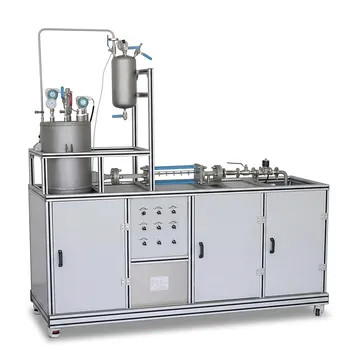
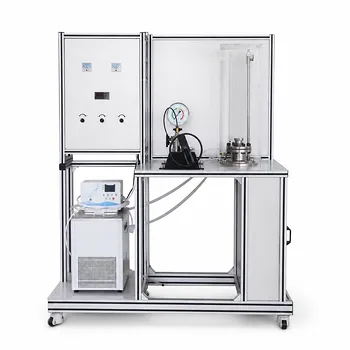
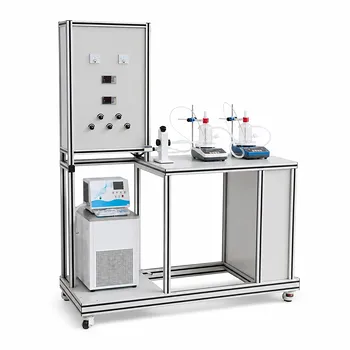
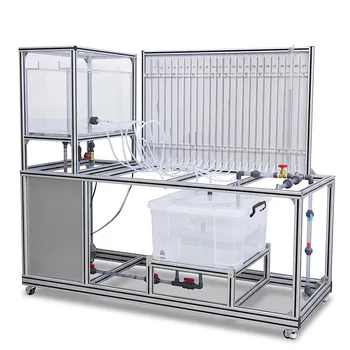
Planning a bioprocess, chemical, or environmental pilot plant? Contact LABPARK to discuss the right Educational and Vocational Unit Operations Pilot Plant for your application. LABPARK supports universities, research institutes, and enterprises with pilot-scale systems for chemical engineering, bioprocess and biotech, and environmental and water treatment applications. Our team can help you evaluate analyzer placement, sample-system dynamics, dead-time compensation, predictive control, measurement validation, and fallback strategies so your pilot plant delivers stable operation, reliable experiments, and higher-quality scale-up data.
Related Products
- Multi Functional Catalytic Reaction and Reactor Evaluation Educational Unit Operations Pilot Plant
- Educational Compression Refrigeration Performance Determination Unit Operations Pilot Plant
- Comprehensive Heat Transfer Coefficient Determination Educational Unit Operations Pilot Plant
- Continuous Batch Extractive Distillation Educational Pilot Plant
- General Purpose Cosmetics Production Unit Operations Training Pilot Plant
People Also Ask
- What reaction engineering principles are shown in a catalytic reactor pilot plant? SO2 Oxidation Guide
- How does feed gas flow rate affect catalytic RFR yields? Optimize Pilot Plant Performance
- Why is FTIR integration in catalytic pilot plants important? Real-Time Student Insights
- How to analyze active metal distribution & identify catalyst poisoning in pilot plants? Expert Diagnostic Guide
- How to study catalyst poisoning & regeneration? Master catalytic reaction life cycles.