The key properties are mechanical strength, compressibility, hydraulic permeability, pore size, and porosity. For packed-bed bioreactors, prioritize rigid, low-compressibility matrices that maintain bed structure and permit uniform flow under pressure. For agitated slurry bioreactors, prioritize high mechanical strength and attrition resistance so the support survives shear and particle collisions without producing fines.
Reactor configuration determines the dominant selection criterion: packed beds require structural rigidity and stable permeability, while agitated slurries require resistance to mechanical damage. In both systems, pore structure must provide high enzyme loading without creating significant internal mass-transfer limitations.
How Reactor Configuration Changes Matrix Requirements
Packed-Bed Bioreactors Require Structural Stability
In a packed bed, liquid flows continuously through a stationary bed of immobilized biocatalyst. The matrix therefore experiences hydraulic pressure and must retain its shape and packing arrangement.
Low compressibility is essential. A deformable or highly swollen gel can compact under pressure, reducing void volume and restricting flow.
Agitated Slurry Bioreactors Require Mechanical Durability
In an agitated slurry reactor, support particles are suspended and repeatedly exposed to impeller-generated shear, turbulence, and collisions with other particles and reactor surfaces.
The matrix must therefore have high mechanical strength and attrition resistance. Fragile carriers can fracture into fines, causing catalyst loss, pump fouling, difficult solid-liquid separation, and less reliable process monitoring.
Properties to Evaluate
Mechanical Strength and Attrition Resistance
Mechanical strength describes the matrix's ability to withstand applied forces without cracking or breaking. Attrition resistance describes its ability to resist gradual wear and the generation of small particles during operation.
These properties are especially important in agitated slurry reactors, where hydrodynamic shear and particle collisions are continuous. Rigid synthetic or inorganic supports are generally better suited to this environment than fragile or friable carriers.
Compressibility and Structural Rigidity
Compressibility determines how much a support deforms under the pressure applied by flowing liquid. Structural rigidity determines whether particles retain their dimensions and packing geometry.
These are dominant considerations in packed-bed reactors. Excessive compression can compact the bed, increase pressure drop, cause uneven flow distribution, and promote channel flow or reduced operating capacity.
Hydraulic Permeability
Hydraulic permeability describes how readily the fluid moves through the packed matrix and the spaces between particles. It depends on particle shape, size distribution, swelling, pore structure, and the stability of the bed.
A support with poor or unstable permeability can require excessive pumping pressure and produce nonuniform substrate exposure. In a packed bed, the matrix must maintain adequate permeability throughout operation rather than gradually collapsing or swelling.
Pore Size Distribution
Pore size controls both the amount of enzyme that can be immobilized and the ease with which substrates and products move through the support.
Pores must be sufficiently large to accommodate the enzyme during immobilization and allow reactants to reach internal active sites. However, pore structure must also support effective retention and distribution of the enzyme rather than simply maximizing empty volume.
Porosity
Porosity is the fraction of the support occupied by void space. Higher useful porosity can increase enzyme loading capacity and provide more internal surface area for immobilization.
Porosity must be evaluated together with pore connectivity and pore size distribution. A highly porous matrix can still perform poorly if its pores are inaccessible or if diffusion through them is too slow.
Internal Mass Transfer
Substrate and product diffusion through the matrix can limit the observed activity of an immobilized enzyme. This occurs when molecules cannot move rapidly enough between the bulk liquid and enzyme located inside the support.
The selected pore structure should provide substrate accessibility and minimize internal mass-transfer resistance in both packed and slurry configurations. This criterion is shared by both reactor types, although the hydrodynamic environment differs.
Matching Properties to Reactor Type
Packed-Bed Selection Priorities
The main evaluation sequence for a packed-bed support is:
- Low compressibility
- High structural rigidity
- Stable hydraulic permeability
- Appropriate pore size and porosity
- Adequate resistance to the expected handling and flow stresses
Rigid natural or synthetic beads with minimal swelling are generally more suitable than soft, highly compressible gels.
Agitated Slurry Selection Priorities
The main evaluation sequence for an agitated slurry support is:
- High mechanical strength
- High attrition resistance
- Stable particle size during agitation
- Appropriate pore size and porosity
- Low internal mass-transfer resistance
The support must remain sufficiently intact for the full reaction cycle and for any downstream recovery or separation step.
Understanding the Trade-offs
Greater Porosity Can Increase Diffusion Resistance
Increasing porosity can improve enzyme loading, but the benefit depends on whether the pore network is accessible to substrates and products. Large internal volumes do not automatically produce high effective activity.
The relevant question is not only how much enzyme the matrix can hold, but how much of that enzyme remains accessible during operation.
Soft Matrices May Offer Loading Advantages
Soft gels can provide favorable immobilization environments and high water content, but their compressibility and mechanical fragility can make them unsuitable for demanding reactor operation.
They are particularly vulnerable in packed beds, where pressure can deform them, and in slurry reactors, where agitation can cause attrition.
Rigid Supports Can Increase Handling Robustness
Rigid synthetic or inorganic carriers generally provide better resistance to compression, shear, and collisions. Their mechanical stability can simplify operation and downstream separation.
However, rigidity alone does not guarantee good performance. The support still requires a pore structure that permits enzyme loading and substrate diffusion.
Particle Breakdown Creates Operational Problems
Attrition produces fines that can leave the reactor with the process stream, accumulate in pumps, and complicate catalyst recovery. In a slurry system, this can directly reduce usable catalyst inventory.
For packed beds, particle deformation or collapse instead primarily threatens pressure drop and flow distribution, even when particle fracture is not the dominant failure mode.
Making the Right Choice for Your Goal
Evaluate the matrix as a reactor component, not only as an enzyme immobilization material.
- If your primary focus is packed-bed operation: Choose a rigid, minimally swelling, low-compressibility support that preserves permeability and uniform flow under hydraulic pressure.
- If your primary focus is agitated slurry operation: Choose a mechanically strong, attrition-resistant support that withstands shear and collisions without generating fines.
- If your primary focus is catalytic productivity: Compare pore size distribution, porosity, and pore accessibility to ensure high enzyme loading without significant internal diffusion limitations.
- If your primary focus is reliable long-term processing: Evaluate mechanical stability, hydraulic behavior, and pore performance after realistic operating exposure rather than only in its unused state.
The best support is the one whose mechanical integrity, hydraulic behavior, and pore accessibility remain compatible with the reactor throughout the complete process.
Summary Table:
| Property | Packed-Bed Priority | Agitated Slurry Priority | Main Purpose |
|---|---|---|---|
| Mechanical strength | High | Very high | Prevent cracking and particle breakdown |
| Compressibility | Very low | Moderate | Maintain bed structure and prevent excessive pressure drop |
| Attrition resistance | Important | Critical | Prevent fines, catalyst loss, and equipment fouling |
| Hydraulic permeability | Critical | Important | Support uniform flow and substrate exposure |
| Pore size distribution | Optimized for accessibility | Optimized for accessibility | Enable enzyme loading and molecular diffusion |
| Porosity and connectivity | High, but stable | High, but accessible | Increase usable loading capacity |
| Internal mass transfer | Low resistance | Low resistance | Preserve effective catalytic activity |
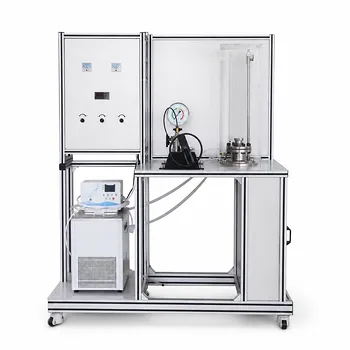
Need reliable equipment for immobilized-enzyme and bioprocess development? Contact LABPARK to discuss your application. LABPARK provides Educational and Vocational Unit Operations Pilot Plants for chemical engineering, bioprocess and biotech, and environmental and water treatment applications. Our systems help universities, research institutes, and enterprises evaluate packed-bed and agitated slurry processes with practical, scalable equipment designed for controlled flow, agitation, separation, and process training.
Related Products
- Multi Functional Catalytic Reaction and Reactor Evaluation Educational Unit Operations Pilot Plant
- Methanol Synthesis and Catalyst Performance Evaluation Educational Unit Operations Pilot Plant
- Photocatalytic Membrane Separation and Degradation Unit Operations Pilot Plant
- Carbon Dioxide Hydrogenation Methanol Synthesis Educational Unit Operations Pilot Plant
- Educational Unit Operations Pilot Plant for Intraparticle Diffusion Effective Factor Measurement
People Also Ask
- How does feed gas flow rate affect catalytic RFR yields? Optimize Pilot Plant Performance
- What reaction engineering principles are shown in a catalytic reactor pilot plant? SO2 Oxidation Guide
- Why is FTIR integration in catalytic pilot plants important? Real-Time Student Insights
- How to analyze active metal distribution & identify catalyst poisoning in pilot plants? Expert Diagnostic Guide
- How to study catalyst poisoning & regeneration? Master catalytic reaction life cycles.