Knowledge Vocational Chemical Engineering Education How to Calculate Film Conversion Coefficient ($M$) & Classify Absorption Regimes: A Practical Guide
Author avatar

Tech Team · LABPARK

Updated 1 month ago

How to Calculate Film Conversion Coefficient ($M$) & Classify Absorption Regimes: A Practical Guide


Here is the definitive calculation. The film conversion coefficient ($M$) is a dimensionless number defined as $M = \frac{D_l k_i^*}{k_l^2}$. Based on this value, you identify the reaction locale: $M \ll 1$ indicates a slow reaction (bulk-dominated), $M \gg 1$ indicates a fast reaction (film-dominated), and $M \to \infty$ indicates an instantaneous reaction at a specific plane.

The Core Takeaway Calculating $M$ isn't a mere academic exercise; it’s a diagnostic tool that dictates which mass transfer model you must use. Before scaling or troubleshooting an absorption column, knowing whether the reaction happens in the bulk liquid or the liquid film prevents catastrophic errors in estimating column height.

Deconstructing the Formula

The equation $M = \frac{D_l k_i^*}{k_l^2}$ compares the reaction rate to the rate of diffusion. By breaking it down, you understand exactly where the resistance to absorption lies.

The Physical Meaning of the Numerator

The numerator, $D_l k_i^$, describes the maximum potential for reaction. It combines how fast molecules diffuse ($D_l$) with how quickly they are consumed ($k_i^$).

$D_l$ is the solute's diffusion coefficient. In a vocational training context, this is often fixed for a given gas-liquid system, but it changes significantly with liquid viscosity and temperature.

$k_i^*$ is the pseudo-first-order reaction rate constant. This critically depends on the reactant concentration in the liquid. In a research lab, ensuring this value is accurate is the primary source of error in your $M$ calculation.

The Physical Meaning of the Denominator

The denominator, $k_l^2$, represents the physical transport barrier. It is the square of the liquid-film mass transfer coefficient.

$k_l$ governs how fast a solute can cross the stagnant liquid film without any reaction. In a pilot-scale column, $k_l$ is dynamic—it shifts with gas and liquid flow rates.

A higher $k_l$ (from turbulence) actually reduces $M$. This means increasing flow rates can paradoxically push a system from a "fast" reaction regime back into a "slow" one, moving the reaction zone out of the film.

Decoding the Absorption Regimes

The value of $M$ fundamentally changes the shape of the concentration profile inside the column’s liquid film, dictating the enhancement factor.

The Slow Reaction Regime ($M \ll 1$)

When diffusion is far quicker than the reaction, the solute saturates the film without reacting. The reaction occurs entirely in the bulk liquid. The liquid film acts purely as a physical barrier with no chemical enhancement.

From a teaching perspective, this is the base case. You can calculate the mass transfer rate independently of the reaction kinetics. The column’s performance depends on the bulk liquid holdup volume, not the interfacial area.

The Fast Reaction Regime ($M \gg 1$)

The reaction is so rapid that the solute is consumed well before it can diffuse across the whole film. The reaction happens exclusively inside the liquid film. The bulk liquid concentration of the solute effectively drops to zero.

For researchers, this regime is desirable for gas scrubbing. The mass transfer rate is greatly enhanced. Your column design here must prioritize maximizing the interfacial surface area, as this is where all the work happens.

The Instantaneous Reaction Regime ($M \to \infty$)

This is the extreme theoretical limit where the reaction rate is infinite. A sharp reaction plane forms within the film where solute and reactant concentrations both drop to zero. The absorption rate is now limited only by how fast the two molecules can diffuse toward this plane.

Understanding the Trade-offs

Misinterpreting $M$ is a common pitfall in laboratory experiments. You must be aware of the hidden assumptions to avoid invalid conclusions.

The Danger of the Pseudo-First-Order Assumption

The formula for $M$ relies on $k_i^*$, a first-order constant. This is often a disguised second-order reaction. If the liquid reactant is depleted near the interface, the true reaction rate slows down, and your calculated $M$ will be an overestimate. In vocational training, this is the critical link between theoretical kinetics and practical modeling.

Ignoring the Gas-Film Resistance

The $M$ coefficient only describes the liquid side. If you have a fast reaction ($M \gg 1$) yet a very dirty gas stream with high gas-film resistance, the overall process might still be gas-film controlled. Calculating $M$ tells you nothing about the gas boundary layer. Students often forget that a "fast" liquid reaction does not automatically mean a fast overall absorption process.

Making the Right Choice for Your Goal

Your application of $M$ should align with your experimental or training objective. Use the following guidelines to determine your focus.

  • If your primary focus is equipment design for gas scrubbing: Aim for an $M$ value greater than 1 by selecting a highly reactive chemical solvent. This shifts the resistance into the liquid film, allowing you to use a much shorter column with high specific surface area packing.
  • If your primary focus is measuring intrinsic kinetics: You must engineer a low $M$ value ($M \ll 1$) by diluting the reactant or increasing the liquid-film mass transfer coefficient ($k_l$) via high liquid rates. This ensures the bulk reaction is the rate-controlling step, isolating the chemistry from the hydrodynamics.
  • If your primary focus is vocational education: Demonstrate the regime shift live. Keep the liquid flow constant to fix $k_l$, and vary the chemical concentration to change $k_i^*$. Plotting the resulting $M$ against a measured enhancement factor makes the dimensionless number a tangible student observation.

In summary, the film conversion coefficient is a critical bridge connecting chemical kinetics to equipment hydraulics, and using it correctly ensures your experimental data accurately scales to real-world operations.

Summary Table:

Absorption Regime Coefficient Range ($M$) Reaction Locale Key Design Focus
Slow Reaction $M \ll 1$ Bulk Liquid Maximize bulk liquid holdup volume
Fast Reaction $M \gg 1$ Liquid Film Maximize interfacial surface area
Instantaneous $M \to \infty$ Specific plane in film Optimize reactant diffusion rates

Elevate Your Chemical Engineering Lab with LABPARK

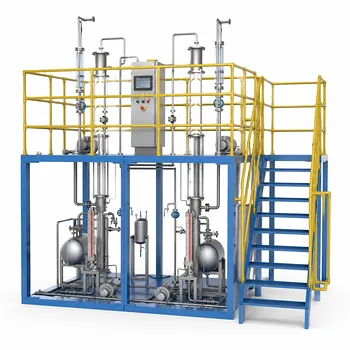
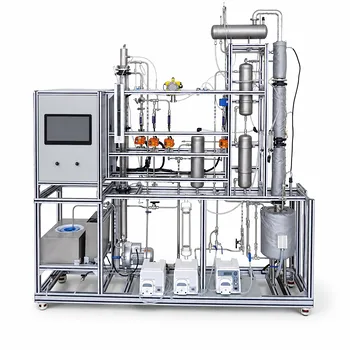
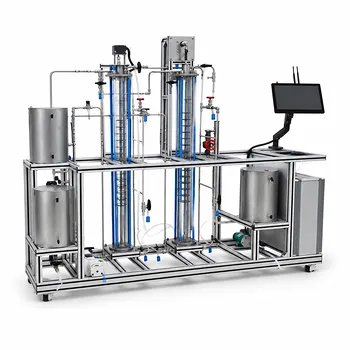
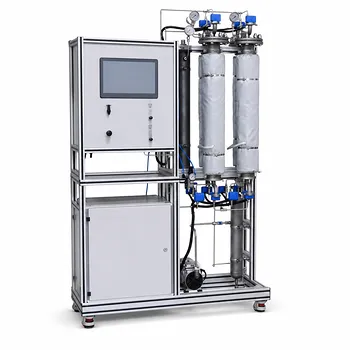
Ready to bridge the gap between chemical theory and hands-on practice? LABPARK provides premium Educational and Vocational Unit Operations Pilot Plants in chemical engineering, bioprocess & biotech, and environmental & water treatment for universities, research institutes, and enterprises.

Our gas absorption pilot columns are designed to help your students and researchers easily visualize absorption regimes, accurately calculate mass transfer coefficients, and master scale-up processes.

Contact LABPARK today to request a quote or customize your laboratory pilot plant!

Related Products

People Also Ask

Related Products

Packed Bed Absorption Educational Unit Operations Pilot Plant

Packed Bed Absorption Educational Unit Operations Pilot Plant

Study gas-liquid absorption, pressure drop, flooding, and mass transfer coefficients with this pilot plant. Transparent packed column, industrial touchscreen, real-time sensor data, automated analysis. Investigate two-phase flow, loading points, column efficiency. Comprehensive data logging and assessment software included.

Absorption and Desorption Educational Unit Operations Pilot Plant

Absorption and Desorption Educational Unit Operations Pilot Plant

Dual packed column absorption and desorption pilot plant for chemical engineering education, offering real-time mass transfer coefficient measurement, durable mobile frame, industrial touch-screen interface, and customizable design for varied laboratory curricula, enabling hands-on study of gas absorption and stripping.

Multimodal Absorption and Desorption Pilot Plant for Unit Operations Training

Multimodal Absorption and Desorption Pilot Plant for Unit Operations Training

Multimodal absorption and desorption pilot plant for higher education labs. Bridges theory and industrial practice with transparent packed columns, three operational modes (real-material, simulated, semi-physical), and SCADA control. Students explore mass transfer, column hydraulics, and process control. Customizable.

Pressure Swing Adsorption Educational Unit Operations Pilot Plant

Pressure Swing Adsorption Educational Unit Operations Pilot Plant

Integrated bench-scale pressure swing adsorption pilot plant for hands-on teaching of gas-solid separation, mass transfer, and process optimization using nitrogen-oxygen model, featuring dual-column design, industrial touchscreen control, digital assessment suite, and customizable hardware and software configurations for educational laboratories.

Bench Scale Dual Column Gas Separation and Capture Educational Pilot Plant

Bench Scale Dual Column Gas Separation and Capture Educational Pilot Plant

This dual-column educational pilot plant provides hands-on teaching of gas adsorption, separation, and capture processes. It features stainless steel columns, regeneration up to 400°C, and a 15.6-inch touchscreen PLC for TSA and PSA studies in chemical engineering curricula, process simulation.

Educational Rotary Disc Liquid-Liquid Extraction Pilot Plant

Educational Rotary Disc Liquid-Liquid Extraction Pilot Plant

A transparent rotary disc column for educational liquid-liquid extraction experiments. This pilot plant enables students to study mass transfer, droplet dynamics, and flooding behavior, bridging theory and practice in chemical engineering unit operations education. Features variable-speed agitation and PLC control.

Dual-Mode Gas Absorption and Desorption Unit Operations Training Pilot Plant

Dual-Mode Gas Absorption and Desorption Unit Operations Training Pilot Plant

Industrial-scale pilot plant for gas absorption and desorption training in chemical engineering. Features dual-mode operation with real and simulated materials, transparent columns for flow visualization, and customizable design. Supports independent or combined loops for hands-on unit operations experiments.

Carbon Dioxide Absorption and Desorption Educational Pilot Plant for Carbon Capture Studies

Carbon Dioxide Absorption and Desorption Educational Pilot Plant for Carbon Capture Studies

Explore carbon dioxide absorption and desorption with this educational pilot plant. Transparent columns visualize mass transfer; electric heating simulates industrial solvent regeneration; touchscreen interface enables data monitoring. Ideal for chemical engineering, bridging theory and practice.

Comprehensive Liquid-Liquid Extraction Pilot Plant for Engineering Education

Comprehensive Liquid-Liquid Extraction Pilot Plant for Engineering Education

Comprehensive liquid-liquid extraction pilot plant for engineering education, integrating rotary and vibratory columns for hands-on observation of phase behavior, flooding limits, and mass transfer efficiency, enabling precise HTU and mass transfer coefficient calculations.

Low Concentration Carbon Dioxide Capture Pressure Swing Adsorption Educational Pilot Plant

Low Concentration Carbon Dioxide Capture Pressure Swing Adsorption Educational Pilot Plant

Low-concentration CO2 capture pilot plant using Pressure Swing Adsorption for engineering education. Students gain practical experience in breakthrough curve measurement, adsorption dynamics, and variable analysis in a hands-on lab setting. Ideal for unit operations, mass transfer, and chemical engineering labs.

Bench Scale Carbon Dioxide Capture Educational Unit Operations Pilot Plant

Bench Scale Carbon Dioxide Capture Educational Unit Operations Pilot Plant

This bench-scale educational pilot plant simulates industrial CO₂ separation using a multi-tower adsorption system for hands-on engineering training. Students achieve ≥90% CO₂ purity while studying pressure swing adsorption, desorption kinetics, and process control in gas purification experiments.

Continuous Batch Extractive Distillation Educational Pilot Plant

Continuous Batch Extractive Distillation Educational Pilot Plant

Versatile pilot plant for continuous, batch, and extractive distillation training. High-borosilicate glass column for visualizing hydraulics, 15.6-inch touchscreen with data logging, precise reflux ratio control 1-99, and durable corrosion-resistant frame. Ideal for chemical engineering education and process research.

Multi-Component Gas Pressure Swing Adsorption Pilot Plant for Unit Operations Education

Multi-Component Gas Pressure Swing Adsorption Pilot Plant for Unit Operations Education

Multi-component gas pressure swing adsorption pilot plant designed for unit operations education. Features four-tower configuration, IoT touchscreen control, dual regeneration, and real-time breakthrough curve analysis for engineering training with safety interlocks and mobile frame simulates industrial PSA processes.

Multi-Modal Distillation Unit Operations Training Pilot Plant

Multi-Modal Distillation Unit Operations Training Pilot Plant

Multi-modal distillation pilot plant for practical unit operations training in chemical engineering education. Features real, analog, and semi-physical simulation modes, industrial construction, customizable for university labs. Hands-on fractionation columns, SCADA control, safety systems. Includes sight glasses, sampling ports, closed-loop recycling.

Multi-Functional Special Distillation Educational Pilot Plant

Multi-Functional Special Distillation Educational Pilot Plant

Versatile multi-functional special distillation pilot plant for chemical engineering education. Supports continuous, vacuum, azeotropic, reactive, extractive distillation. Transparent glass columns enable real-time visual observation of hydrodynamics and separation processes.

Ion Exchange Water Purification Educational Pilot Plant for Engineering Unit Operations

Ion Exchange Water Purification Educational Pilot Plant for Engineering Unit Operations

This bench-scale ion exchange pilot plant trains engineering students in water purification. Dual transparent columns simulate industrial softening and demineralization. Students observe fluid dynamics, perform resin regeneration, and analyze breakthrough curves. The corrosion-resistant frame ensures durability in unit operations experiments.

Plate Column Hydrodynamics Tray Demonstration Educational Pilot Plant

Plate Column Hydrodynamics Tray Demonstration Educational Pilot Plant

Advanced transparent educational pilot plant for chemical engineering labs demonstrates plate column hydrodynamics with industrial sieve bubble cap serrated valve trays for visual observation of gas-liquid contact pressure drop measurement and operational limit analysis including flooding weeping entrainment

Dual-Mode Rectification Pilot Plant for Practical Training Unit Operations

Dual-Mode Rectification Pilot Plant for Practical Training Unit Operations

Industrial-scale dual-mode rectification pilot plant for chemical engineering practical training. Features real-material and simulated-material operation modes, sieve-plate column with sight glasses for visual observation of hydrodynamics, and customizable SCADA control for safe, hands-on learning of unit operations and mass transfer.


Leave Your Message