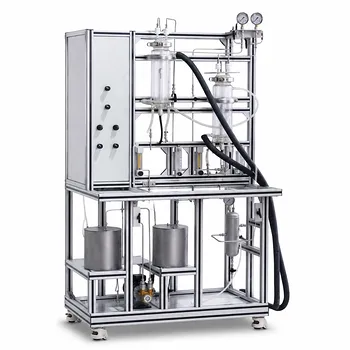
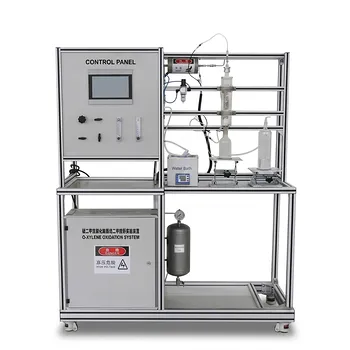
The Thiele modulus is applied in a pilot plant by comparing the timescales of reaction and diffusion inside the catalyst pellet. You calculate the modulus (φ) from measurable physical and kinetic parameters, then use it to predict the internal concentration profile. By varying pellet size or temperature and observing how the measured reaction rate changes, you can experimentally verify whether the process is kinetically controlled (uniform concentration, φ << 1) or diffusion-limited (sharp concentration drop, φ >> 1).
The Thiele modulus translates an abstract pore-diffusion problem into a single, measurable number. In a pilot plant, its real power lies not in the theoretical φ you calculate, but in how you force a change in φ—by altering pellet size or temperature—and watch the reaction shift between kinetic and diffusional control. This diagnostic ability directly guides catalyst pellet design and reactor scale-up.
The Diagnostic Framework: What the Thiele Modulus Tells You
The Physical Meaning of φ
The Thiele modulus (φ) is a dimensionless group that pits the intrinsic reaction rate against the rate of internal pore diffusion.
- It is defined as φ = L * sqrt(k_p / D_e), where L is a characteristic diffusion length (often V_p/S_p, the pellet volume-to-surface-area ratio).
- k_p is the pseudo-first-order rate constant, and D_e is the effective diffusivity of the reactant inside the porous pellet.
- When φ is small, diffusion is fast enough to replenish reactant everywhere; when it is large, the reaction consumes the reactant before it can travel deep into the pellet.
Why This Matters in a Pilot Plant
A pilot plant is essentially a controlled environment where you can isolate and probe the resistive steps.
- Unlike a full-scale reactor, where temperature and concentration gradients can be intertwined, a well-designed pilot unit lets you alter one variable at a time.
- You can hold everything constant and change the pellet radius (L) or the temperature (which expands k_p far more than D_e) and measure the outlet conversion.
- This gives you a direct experimental map of the φ regime, which you then correlate with the theoretical effectiveness factor.
From Theory to Measurement: Practical Steps in a Pilot Plant
The Classic Approach: Vary Pellet Size and Temperature
The simplest diagnostic is a particle-size experiment.
- Prepare catalyst pellets of at least two significantly different sizes (e.g., 2 mm and 6 mm diameters) with identical internal pore structure and loading.
- Run the reactor at identical space velocity and temperature, and record the macro-kinetic reaction rate (r_A).
- If the rate per unit mass of catalyst drops sharply for the larger pellets, internal diffusion resistance is dominant. If the rates are identical, the process is under kinetic control.
The temperature sweep is the second lever.
- At low temperature (low k_p), the reaction is intrinsically slow, and φ will be low—diffusion can keep up.
- As you raise the temperature, k_p grows exponentially, driving φ into the diffusional regime. You will see the apparent activation energy cut in half when you move from kinetic control to strong pore-diffusion limitation.
The Quantitative Method: The Wheeler-Weisz Modulus
Instead of needing the intrinsic rate constant and diffusivity separately, you can compute the Wheeler-Weisz modulus (M_w) from measured pilot-plant data.
- M_w = φ^2 * η = (r_A * L^2) / (c_{A,s} * D_e), where r_A is the observed reaction rate per catalyst volume, c_{A,s} is the surface concentration, and L is the characteristic length.
- This group contains only quantities you can measure or estimate from physical properties.
- If M_w < 0.15: internal diffusion resistance is negligible (η ≈ 1). The reactor is in the kinetic-controlled regime.
- If M_w > 7: the reaction is severely diffusion-limited. The interior of the pellet is starved.
This approach avoids the need to directly measure intrinsic kinetics, because M_w works from the observed, diffusion-disguised rate.
Map the Effectiveness Factor Experimentally
The ultimate validation is to overlay your data on the η vs. φ curve.
- For a spherical pellet and first-order reaction, η = (1/φ) * [(3φ coth 3φ – 1) / (3φ)].
- You can calculate φ from independently measured k_p and D_e, then predict η. Next, you measure the observed rate and compare it with the rate at surface conditions to get an experimental η.
- A close match confirms that internal diffusion alone explains the rate reduction. A mismatch points to other resistances (external film diffusion, heat effects, or poisoning).
Interpreting the Nuances: Thresholds and Regimes
The Kinetic Regime (φ < 0.3, η ≈ 1)
When φ is below about 0.3, the concentration drop inside the pellet is vanishingly small.
- The reactant penetrates fully; every catalytic site sees nearly the same concentration.
- In the pilot plant, this means you are measuring true intrinsic kinetics. Any change in rate with pellet size is experimental noise, not a mass-transfer effect.
The Strong Diffusion-Limited Regime (φ > 10, η ≈ 1/φ)
At φ larger than about 10, the reaction is so fast that the reactant concentration dies out exponentially within a thin outer shell.
- The effectiveness factor becomes close to 1/φ for a sphere. This means doubling the pellet size (thus doubling φ) will roughly halve the catalyst effectiveness.
- In pilot-plant terms, most of the catalyst is decorative weight. You will see a direct inversion: the observed rate becomes inversely proportional to the characteristic diffusion length.
The Transition Zone (0.3 < φ < 10) and Shape Sensitivity
Between these extremes, the system is sensitive to pellet geometry and reaction order.
- For non-spherical shapes, the generalized Thiele modulus using V_p/S_p as the characteristic length normalizes the behavior so that all shapes collapse onto a single η-curve at the two extremes.
- However, in the transition region, the shape does matter. Cylinders or trilobes will have slightly different effectiveness than spheres of equal V_p/S_p.
- When your pilot data falls here, you must use the shape-appropriate effectiveness relation to avoid scaling errors.
Understanding the Trade-offs and Common Pitfalls
When the Thiele Modulus Alone Is Not Enough
The classic Thiele analysis assumes isothermal pellets and a single, irreversible reaction.
- For highly exothermic reactions, intraparticle temperature gradients can appear. If the pellet interior is hotter, the intrinsic rate constant is higher there, partially offsetting the concentration drop. The simple η(φ) relationship breaks, and you might even see η > 1 (internal ignition).
- In a pilot plant, a sign of this is when the observed rate does not drop as expected with larger pellets, or when you see multiple steady states.
The Danger of Neglecting External Film Resistance
The Thiele modulus addresses only internal diffusion. The Sherwood number (Sh) quantifies the external boundary layer resistance.
- If the external mass-transfer coefficient is low, the surface concentration c_{A,s} will be significantly lower than the bulk gas concentration.
- You can use the combined parameter φ_cr ≤ 6 / (1 + 2/Sh)^{0.5} to identify when severe internal gradients cause the concentration to fall to zero inside the pellet. But first, you must verify that the external film accounts for only a minor fraction of the total resistance.
- In a pilot unit, you would vary the gas velocity at constant space time. If the rate changes, external diffusion matters, and your Thiele analysis must account for it.
Selectivity Loss in Complex Reaction Networks
Internal diffusion does not just slow a reaction — it can change the product distribution in parallel or series reactions.
- For two parallel reactions where the desired pathway is intrinsically faster, a diffusion limitation penalizes the faster reaction more. The observed selectivity falls.
- Specifically, the selectivity changes from proportional to the ratio of the rate constants (kinetic control) to proportional to the square root of that ratio (diffusional control). This is a drastic loss you can detect directly in a pilot plant by comparing small and large pellets.
Making the Right Choice for Your Goal
- If your primary focus is kinetic modeling: Operate the pilot plant so that φ < 0.3. Use small pellets and low temperatures. Confirm with a pellet-size variation that the rate is independent of L, ensuring you measure intrinsic kinetics.
- If your primary focus is catalyst pellet optimization: Map the full η vs. φ curve. Run experiments with pellets of 3 – 4 different sizes and find the knee in the curve. Design your commercial pellet to be just below that knee to balance pressure drop and catalyst utilization.
- If your primary focus is identifying mass-transfer bottlenecks: Calculate the Wheeler-Weisz modulus from a single, well-characterized run. M_w < 0.15 dismisses internal diffusion as the culprit; M_w > 7 confirms it and tells you to focus on pore structure or crush strength.
- If your primary focus is scale-up: Do not trust a single-pellet-size experiment. Deliberately operate the pilot plant in both kinetic and diffusional regimes to build a two-zone model. Then predict full-scale performance where heat and mass transfer will likely push you into the diffusion-controlled region.
The Thiele modulus is your compass in a pilot plant — it converts a hidden pore-scale fight into a visible, quantifiable map that tells you where the reaction truly lives.
Summary Table:
| Regime | Thiele Modulus (\phi) | Wheeler-Weisz Modulus (M_w) | Physical Meaning & Action |
|---|---|---|---|
| Kinetic Control | \phi < 0.3 | M_w < 0.15 | Reaction is uniform; measures true intrinsic kinetics. |
| Transition Zone | 0.3 \le \phi \le 10 | 0.15 \le M_w \le 7 | Both reaction & diffusion limit rates; shape-sensitive region. |
| Strong Diffusion Limit | \phi > 10 | M_w > 7 | Severe resistance; reaction is restricted to a thin outer shell. |
Optimize Your Reaction Engineering Research with LABPARK
Accurately mapping kinetic regimes and mass-transfer limitations requires precise, reliable equipment. LABPARK designs and supplies premium Educational and Vocational Unit Operations Pilot Plants in chemical engineering, bioprocess & biotech, and environmental & water treatment.
Whether you are a university teaching reactor design, a research institute studying heterogeneous catalysis, or an enterprise scaling up chemical processes, our pilot plants deliver the controllable testing environments you need to succeed.
Contact LABPARK today to discuss your laboratory or training requirements!
Related Products
- Fixed Bed Gas Solid Catalytic Reaction Educational Pilot Plant
- Fluidized Bed Gas Solid Catalytic Reaction Educational Pilot Plant
- Micro-Scale Gas-Solid Catalytic Reaction Educational Pilot Plant
- Internal Circulation Gradient Free Catalytic Reaction Educational Pilot Plant
- Multi Functional Catalytic Reaction and Reactor Evaluation Educational Unit Operations Pilot Plant
People Also Ask
- How do reactor pilot plants safely study gas-solid reactions? Master kinetics with thermal & flow control.
- How does the Mears criterion evaluate transport resistance? Key Guide to Intrinsic Kinetics
- Fluidized vs. Fixed Bed Reactors: Comparing Heat & Complexity in Pilot Plants
- Why is a multibed configuration necessary for exothermic reactions? Optimize your pilot plant trajectory.
- How is the friction factor determined for fixed-bed pilot plants? Select the best pressure drop correlation.