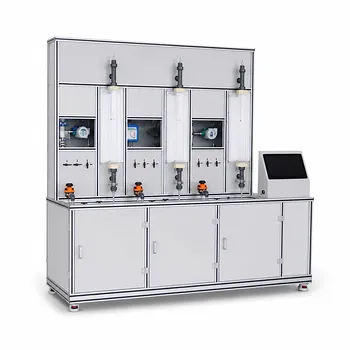
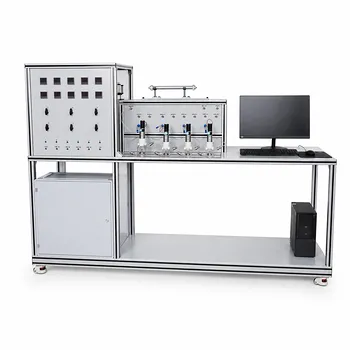
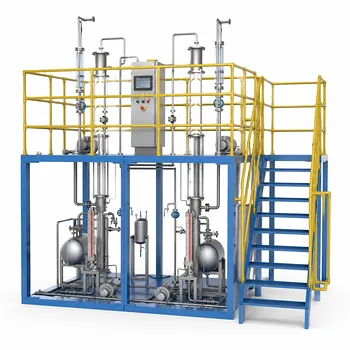
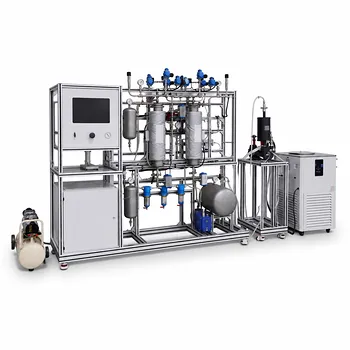
The heart of a gas-liquid SO₃ sulfonation pilot plant is a high-efficiency heat and mass transfer reactor—invariably a falling film unit—backed by precision gas-dilution control and an integrated tail-gas scrubbing system.
Without these, the reaction’s violent exotherm and instantaneous kinetics will create hot spots, degrade the product, and pose a serious safety hazard. Your pilot plant must treat SO₃ dosing, cooling, and effluent neutralization as one inseparable design problem, not three separate add-ons.
A falling film reactor delivers the simultaneous heat removal and interfacial area that a nearly instantaneous, diffusion-limited reaction demands. Pairing it with accurate carrier-gas dilution and a downstream scrubber turns an otherwise uncontrollable chemistry into a safe, predictable, and educationally rich unit operation.
Why the Reactor Type Is Non-Negotiable
The Thermodynamic and Kinetic Reality of SO₃ Sulfonation
The reaction between gaseous SO₃ and an organic substrate is extremely fast and fiercely exothermic.
Conversion is quantitative within milliseconds—meaning the chemical step is never the bottleneck.
What limits the process is mass transfer of SO₃ into the liquid film and heat transfer away from the reaction zone.
If either lags, the liquid temperature spikes locally. The result: charring, polysulfonation, and runaway viscosity.
The Falling Film Reactor as the Default Solution
A falling film reactor spreads the organic feed into a thin, uniform film that flows by gravity down the inside of a cooled tube.
The SO₃/air mixture passes co-currently or counter-currently over that film.
This geometry gives you three critical things at once:
- Large interfacial area – The thin film maximizes gas–liquid contact, which is essential because the Hatta number for this reaction is well above 3; the chemistry finishes inside the liquid film, so mass transfer rules the overall rate.
- Short diffusion paths – Reactant must only penetrate a thin layer, preventing concentration gradients that would otherwise generate hot cores.
- Close-coupled cooling – The jacket around each tube pulls heat out through the metal wall within seconds, right where it is generated.
Alternatives like stirred tanks or bubble columns cannot remove heat quickly enough for a pure SO₃ feed. They work for slow sulfations with sulfuric acid—not for this instantaneous gas–liquid regime.
Materials and Mechanical Integrity
Because the reaction side runs hot and acidic, the reactor tubes and distributor must handle corrosive, wet SO₃ environments.
Materials of construction typically include 316L stainless steel for process-wetted parts or high-nickel alloys if water is present, along with carefully designed liquid distribution plates to maintain film uniformity across all tubes.
The Non-Negotiable Control Trio: Gas, Temperature, and Effluent
Precise SO₃ Dilution and Mass Flow Control
Feeding neat SO₃ gas into the reactor is a recipe for instant degradation.
You must dilute the SO₃ with an inert carrier gas, most commonly nitrogen or dry air, down to a concentration of 4–8 vol%.
This dilution accomplishes three things:
- Moderates the concentration driving force – Lower partial pressure slows the mass transfer just enough to keep temperature peaks in check.
- Smooths out dosing fluctuations – Even a momentary surge in SO₃ flow can burn the film. A carrier gas buffer makes the system far more forgiving.
- Enables accurate metering – SO₃ is a sticky, highly reactive gas. Mass flow controllers on pre-diluted streams are far more reliable than trying to meter a pure, condensable vapor.
Your pilot plant must have mass flow controllers on both the SO₃ source and the carrier gas, with a static mixer upstream of the reactor to ensure perfect homogeneity before the gas hits the film.
Temperature Control Built Into the Reactor Wall
The falling film reactor’s jacket is not a convenience—it is the primary safety barrier.
Cooling medium temperature, flow rate, and outlet temperature must be monitored and controlled to a tolerance of ±1 °C.
You need three-zone temperature monitoring at a minimum: top (film formation zone), middle (peak reaction zone), and bottom (product outlet).
A sudden hot spot signals film breakage or distribution failure and must trigger an automatic SO₃ shut-off.
For pilot-scale work, a jacketed tube-in-shell design with circulating thermal oil or glycol gives the best balance of responsiveness and safety.
Integrated Gas Scrubbing for Tail Gas
Even with perfect conversion, the exiting carrier gas carries traces of SO₃, SO₂, and organic acid mists.
Releasing these directly is neither safe nor educational: it misses the real-world environmental control step.
Your pilot plant must include an inline gas scrubbing system, typically a packed column using dilute alkali (NaOH solution), followed by a mist eliminator.
This shows students and operators how industrial plants achieve 99.9%+ capture efficiency and teaches the unit operation of absorption simultaneously with the reaction.
The scrubber also doubles as a back-pressure regulator, keeping the reactor slightly above atmospheric pressure to prevent air ingress and maintain stable gas flow through the film.
Understanding the Trade-offs and Common Pitfalls
The Cost of Overlooking the Liquid Film Stability
A falling film reactor looks simple; it is merciless if the film breaks.
Insufficient preheating of the organic feed can cause viscosity variations that lead to dry patches or rivulet formation. Once a dry spot forms, the tube wall sees concentrated SO₃, temperature spikes, and the material can coke within seconds.
Always validate your feed temperature and distributor design at the exact pilot flow rates, not just using water tests.
The Trap of Over-Diluting the SO₃
While dilution is essential, too much carrier gas pushes the gas velocity high and can shear the film, entrain droplets, and flood the scrubber.
You must operate within a narrow window: enough dilution to control the exotherm, but not so much that hydrodynamic stability is lost. A SO₃ concentration of 5–7 vol% is typically the sweet spot for pilot-scale films.
When a Falling Film Is Not Enough
For very high-viscosity products that quickly solidify or reach a paste-like consistency even at elevated temperatures, even a falling film can struggle.
In those rare cases, a stirred thin-film reactor (wiped-film) with mechanical agitation may be necessary. But for the vast majority of sulfonation of linear alkylbenzenes, fatty alcohols, or alpha-olefins, the standard falling film is the proven choice.
Making the Right Choice for Your Pilot Plant Goal
Your configuration decisions should align with what you want the pilot plant to teach or demonstrate.
- If your primary focus is safe student training: Invest heavily in the dilution and temperature control interlocks. A fully automated shutdown sequence on temperature excursion is worth more than any manual procedure demonstration.
- If your primary focus is product quality research: Design the film distributor for easy change-out and test multiple tube diameters. Small tube diameters (6–12 mm) give higher heat transfer coefficients and narrower residence time distributions, leading to lighter-colored, lower-1,4-dioxane products.
- If your primary focus is scale-up validation: Instrument the pilot plant with more temperature probes than an industrial unit would have, and deliberately map the axial temperature profile. This data is invaluable for commissioning a production-scale multi-tube falling film reactor.
A well-designed gas-liquid SO₃ sulfonation pilot plant is both a high-performance reaction engineering tool and a deep lesson in the inseparable nature of mass transfer, heat transfer, and reaction safety.
Summary Table:
| Feature | Essential Requirement | Primary Purpose |
|---|---|---|
| Reactor Type | Falling Film Reactor (316L SS) | Maximizes heat/mass transfer; prevents hotspots and charring. |
| Gas Dosing | Carrier-gas dilution (4–8 vol% SO₃) | Moderates reaction kinetics and ensures precise mass flow control. |
| Temperature Control | Multi-zone jacket monitoring (±1 °C) | Prevents film breakage; triggers automatic safety shutdowns. |
| Effluent Control | Integrated packed-column alkali scrubber | Neutralizes tail gases and controls system back-pressure. |
Scale Up Safely with LABPARK Pilot Plants
Designing complex gas-liquid reactions requires precision engineering and absolute safety. LABPARK provides premium Educational and Vocational Unit Operations Pilot Plants in chemical engineering, bioprocess & biotech, and environmental & water treatment. We help universities, research institutes, and enterprises build highly instrumented, reliable systems for hands-on research and training.
Contact LABPARK today to configure your custom pilot plant solution.
Related Products
- Micro-Scale Gas-Solid Catalytic Reaction Educational Pilot Plant
- Fixed Bed Gas Solid Catalytic Reaction Educational Pilot Plant
- Fixed-Bed Chemical Reaction and Gas Dust Tar Removal Unit Operations Pilot Plant
- Educational Unit Operations Pilot Plant for Intraparticle Diffusion Effective Factor Measurement
- Two Phase Flow Pattern Velocity Resistance Measurement Educational Pilot Plant
People Also Ask
- Why is a multibed configuration necessary for exothermic reactions? Optimize your pilot plant trajectory.
- Fluidized vs. Fixed Bed Reactors: Comparing Heat & Complexity in Pilot Plants
- Why is thermal management a major challenge in methane oxidative coupling? Reactor Solutions for Pilot Plants
- How does the Mears criterion evaluate transport resistance? Key Guide to Intrinsic Kinetics
- How do reactor pilot plants safely study gas-solid reactions? Master kinetics with thermal & flow control.