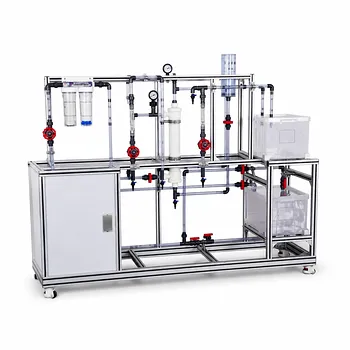
Polymeric and ceramic membranes serve fundamentally different roles in an ultrafiltration pilot plant: the choice is dictated almost entirely by the chemical aggressiveness of your feed and your core research question. Polymeric membranes provide a cost-effective, forgiving platform perfect for teaching classic membrane phenomena—fouling, flux decline, and cleaning protocols—on benign aqueous feeds. Ceramic membranes, though over ten times more expensive, bring the thermal stability, solvent resistance, and ruggedness required to safely process aggressive chemical, refinery, or high-temperature streams where polymers would rapidly degrade.
Polymeric UF membranes excel when your deep need is educational clarity and moderate process conditions; ceramic UF membranes become the non-negotiable tool when the feed itself is the challenge—their durability unlocks research on streams that would destroy softer materials.
Membrane Material Properties at a Glance
Polymeric Membranes: Versatile and Cost-Effective
Polymers such as polysulfone, polyethersulfone, and PVDF dominate pilot‑scale ultrafiltration. They are easy to fabricate, seal, and replace, making them the practical choice for standard training setups.
Their tailored pore size distributions allow students to neatly observe size‑exclusion principles. These membranes are particularly suited for aqueous‑phase separations—concentrating proteins, clarifying fermentation broths, or removing macromolecules—under mild temperature and pH conditions. They also support repeated teaching of fouling behavior and cleaning‑in‑place procedures without excessive cost.
Ceramic Membranes: Built for Tough Environments
Ceramic UF membranes, typically based on alumina, titania, or zirconia, are selected when the process environment is punishing. They deliver outstanding thermal stability, withstanding temperatures that would melt or warp polymers, enabling high‑temperature reaction‑separation coupling.
Their chemical inertness allows them to handle aggressive solvents, strong acids or bases, and corrosive refinery streams. This resistance dramatically reduces material degradation during experiments. Their high mechanical strength also translates to a longer operational lifetime, but they are brittle and require careful mounting and sealing in reactor housings.
Performance and Suitability in Research Settings
Training and Fundamental Studies
When the goal is to teach the fundamentals of ultrafiltration—pore size effects, flux decline models, and cleaning efficiency—polymeric membranes are the superior choice. Their low initial cost and broad availability mean students can run multiple trials, intentionally foul the surface, and test various cleaning chemistries without financial penalty.
In these aqueous, non‑corrosive environments, a polymeric pilot plant provides all the necessary phenomina: concentration polarization, gel layer formation, and the effect of transmembrane pressure on permeate quality. The performance data generated is directly transferable to many food, water, and biotechnology applications.
Simulating Harsh Industrial Processes
If your research involves clarifying refinery effluents, processing hot solvent streams, or validating chemical synthesis separations, ceramic membranes become irreplaceable. Their thermal tolerance allows continuous operation at temperatures where polymeric materials would soften or dissolve.
Chemical stability against organic solvents and extreme pH values ensures that the membrane itself does not become a variable—you are measuring true separation performance, not material breakdown. This fidelity is critical when emulating industrial‑scale aggressive unit operations. Experiments with harsh cleaning agents or sanitization cycles also become feasible, reflecting biopharmaceutical and fine‑chemical manufacturing realities.
Understanding the Trade‑offs
Cost and Accessibility
The upfront cost differential is stark: a ceramic UF module often exceeds ten times the price of an equivalent polymeric module. For teaching labs with limited budgets, this alone makes polymers the default. The lower cost also encourages module replacement for varied studies, whereas ceramic modules represent a significant capital commitment.
Mechanical Fragility and System Integration
Ceramic membranes, despite their chemical strength, are highly brittle and prone to fracture from thermal shock or improper clamping. Sealing them reliably within a pilot‑plant housing demands precision engineering, whereas flexible polymeric membranes are far more forgiving and easier to maintain. This means ceramic systems may require additional training and a more robust support infrastructure.
Lifetime and Downtime Considerations
In an aggressive feed environment, the short life of a polymer membrane—measured in hours or days—can lead to constant interruptions and wasted experimental time. Ceramic’s longer service life under attack offsets its cost by minimizing downtime and maintaining steady‑state operation during extended research campaigns. However, in mild applications, this advantage disappears, and the higher investment rarely pays back.
Making the Right Choice for Your Pilot Plant
Decide based on the primary research challenge, not on a generic wish for “ruggedness.”
- If your primary focus is teaching fundamentals with aqueous feeds: Choose polymeric membranes. They deliver all the core ultrafiltration phenomena at a fraction of the cost, allowing broad student access and repeated trials on fouling and cleaning.
- If your primary focus is aggressive chemical or refinery stream research: Invest in ceramic membranes. Their chemical and thermal resilience is non‑negotiable for safe, representative, and uninterrupted pilot‑scale data.
- If you need to span both training and harsh‑process demonstration: Incorporate both module types. This exposes researchers to material‑science trade‑offs firsthand and ensures your pilot plant can pivot from a gentle teaching mode to a realistic industrial‑simulation mode without safety risks.
Align the membrane material with the physical and chemical reality of your feed streams, and your pilot plant will generate both reliable data and long‑term value.
Summary Table:
| Feature | Polymeric Membranes | Ceramic Membranes |
|---|---|---|
| Cost | Low (Cost-effective, easy to replace) | High (Often 10x more expensive) |
| Resilience | Moderate (Aqueous, mild pH & temp) | Excellent (Aggressive solvents, extreme pH & temp) |
| Primary Use | Teaching fundamentals & fouling models | Simulating harsh industrial/refinery processes |
| Key Drawback | Degrades quickly in harsh feeds | Brittle, prone to mechanical/thermal shock |
Empower Your Lab with LABPARK Pilot Plants
Choosing the right membrane is critical to the success of your chemical and environmental engineering research. LABPARK provides premium Educational and Vocational Unit Operations Pilot Plants in chemical engineering, bioprocess & biotech, and environmental & water treatment.
We help universities, research institutes, and enterprises bridge the gap between academic theory and industrial reality with flexible, high-performance systems tailored to your specific application.
Contact us today to discuss your laboratory requirements and get a customized solution!
Related Products
- Ultrafiltration Membrane Separation Educational Pilot Plant
- Multi-Functional Membrane Separation Educational Pilot Plant for Unit Operations Lab
- Hollow Fiber Ultrafiltration Membrane Separation Educational Pilot Plant
- Multifunctional Membrane Separation Educational Pilot Plant with Ultrafiltration, Nanofiltration, Reverse Osmosis
- Multi-Modal Distillation Unit Operations Training Pilot Plant
People Also Ask
- How do PEI, PVDF, and PSU membranes compare in pilot plants? Find the best fit.
- Pervaporation vs. Vapor Permeation: Handling Suspended Solids in Membrane Pilot Plants
- Isotropic vs. Anisotropic Membranes: How to Choose the Best Pilot Plant Modules
- Why Use a Membrane Separation Pilot Plant vs. Lab Testing? Avoid Costly Scale-Up Failures
- How do membrane pilot plants demonstrate synthetic vs biological membrane advantages?