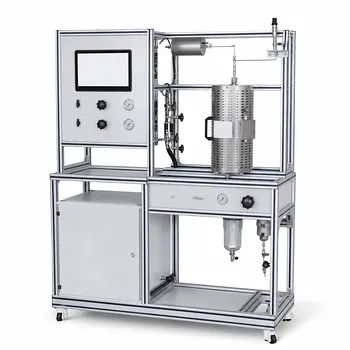
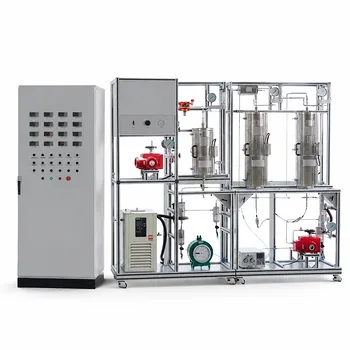
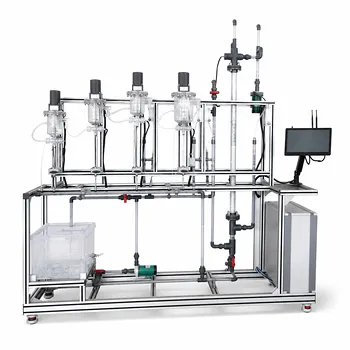
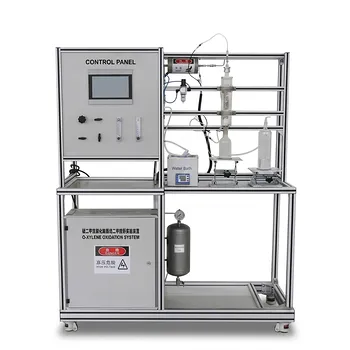
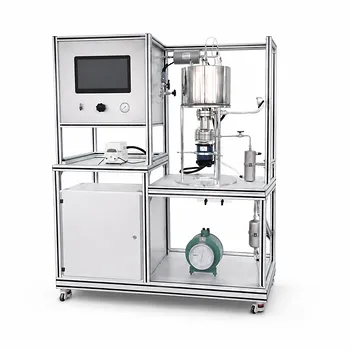
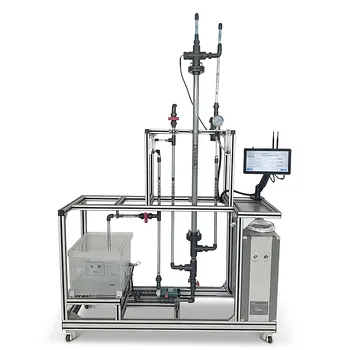
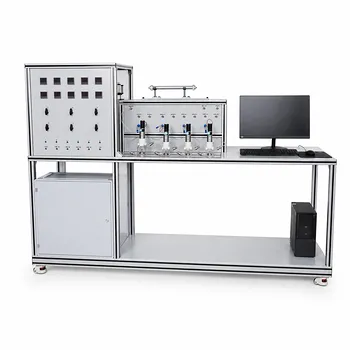
In a polymerization pilot plant, the fundamental choice between a tubular and a stirred-tank reactor is a calculated trade-off: heat transfer versus mixing homogeneity.
A tubular reactor (PFR) provides a high surface-to-volume ratio, making it exceptionally efficient at removing the high heat of polymerization, but it lacks active axial mixing—creating concentration and temperature gradients. A stirred-tank reactor (CSTR) delivers uniform composition and temperature through intense mechanical mixing, yet its low surface-to-volume ratio and, at high pressures, thick containment walls severely restrict heat removal, often forcing you to limit conversion or operate nearly adiabatically. The “better” reactor depends entirely on whether your pilot process is governed by heat removal limits or by the need for perfect compositional uniformity.
The reactor you choose maps directly to your limiting constraint. If your polymerization releases extreme heat and you can tolerate a gradient in polymer properties, a tubular reactor is likely the safer, higher-conversion platform. If your product demands tight molecular-weight or compositional uniformity and you can manage heat load through limited conversion or solvent dilution, a CSTR provides the requisite mixing environment to achieve that.
Dissecting the Heat Transfer Dilemma
The Furnace Within: Polymerization’s Thermal Load
Polymerization reactions release significant energy. In a pilot plant, failing to remove this heat can trigger localized hot spots, runaway kinetics, and unsafe operation.
The reactor’s heat-transfer capacity directly caps your achievable conversion rate and determines operational stability.
Tubular Reactors: Geometry as a Cooling Solution
A tubular reactor’s long, narrow shape gives it a high surface‑to‑volume ratio. This geometry naturally excels at transferring heat to an external jacket.
In high‑pressure processes like LDPE, the tubular reactor acts as a double‑pipe heat exchanger, efficiently managing the intense exotherm.
Operators often use pressure cycling—periodically dropping pressure to increase velocity—to scrub the wall, sustain heat‑transfer coefficients, and push conversion as high as 35%, nearly double that of a stirred autoclave at the same conditions.
Stirred‑Tank Reactors: The Insulated Cauldron
A CSTR’s bulky volume gives it a low surface‑to‑volume ratio, inherently limiting heat removal. The problem is amplified in high‑pressure polymerizations where containment walls are extremely thick (typical 0.1 m at 2100 bar).
These thick walls act as a thermal barrier, causing the reactor to operate almost adiabatically. To prevent dangerous temperature rise, conversion must be restricted—often to around 20%.
Even in lower‑pressure systems, heat is frequently managed only by precooling the feed stream, because the tank’s geometry remains a fundamental bottleneck.
The Mixing Paradox: Uniformity versus Controlled Gradients
Why Mixing Defines Polymer Quality
Mixing quality directly shapes the molecular weight distribution, copolymer composition, and presence of gel spots. An ideal mixing environment ensures every growing polymer chain sees identical local conditions.
Stirred‑Tank Reactors: The Homogeneity Benchmark
A CSTR’s defining component is its mechanical impeller, designed to erase spatial differences. In the ideal case, temperature and reagent concentration are uniform everywhere.
For viscous media, impeller design becomes critical; you must select high‑torque agitators to prevent dead zones. In a pilot‑plant CSTR, mastering impeller geometry and power input is a central skill, because fluid motion depends entirely on that one component.
Yet even a well‑designed CSTR can suffer from non‑ideal mixing at extreme viscosities, creating stagnant pockets that foster localized overheating.
Tubular Reactors: The Discipline of the Profile
An empty tubular reactor follows the plug‑flow model: no mixing in the axial direction, but efficient mixing radially. This creates a deliberate, engineered gradient along the tube.
Reactant concentration falls and temperature rises predictably down the axis. That profile can be exploited by injecting additional initiator at multiple points to flatten the temperature rise and raise overall conversion.
The risk is fluid segregation. If radial mixing collapses due to high viscosity, fluid layers can slide at different velocities, broadening residence‑time distribution and causing product inhomogeneity.
Understanding the Trade‑offs and Pitfills
The Viscosity Threat That Attacks Both Designs
As polymer chains lengthen, viscosity skyrockets and flow often becomes non‑Newtonian. In a CSTR, this demands excessive agitator power and can destroy mixing uniformity. In a tubular reactor, it suppresses radial mixing, increases pumping cost, and may force you to use extruder‑like conveying equipment.
The Scale‑Up Disconnect
Lab‑scale data do not translate linearly. In a CSTR, the surface‑to‑volume ratio worsens as volume increases, while in a tubular reactor, maintaining similar shear history and heat transfer coefficients becomes challenging. These scale‑up effects are precisely why pilot plants exist.
The Solvent Variable: Bulk versus Solution Polymerization
Your process method reshapes the reactor choice. Bulk polymerization yields pure polymer but brings extreme viscosity and the gel effect, frequently favoring the tubular reactor’s superior heat transfer.
Solution polymerization uses a solvent to cut viscosity, making CSTR temperature control far easier, but it adds downstream solvent‑recovery unit operations that you must integrate into the pilot‑plant flow sheet.
Making the Right Choice for Your Pilot Plant
Align your reactor selection with the true controlling factor in your system.
- If your primary focus is managing extreme heat release (e.g., high‑pressure LDPE): A tubular reactor, with its high surface area and ability to use multiple initiator injections, gives you the safest platform and the highest usable conversion.
- If your primary focus is a narrow molecular weight distribution or uniform copolymer composition: A well‑agitated CSTR provides the homogeneous environment essential for consistent product, even if you must cap conversion or use a solvent to manage heat.
- If your polymerization involves highly viscous bulk media without solvent: Invest in a reactor with specialized high‑torque mixing (often a modified CSTR) or accept the gradient discipline of a tubular design with enhanced cooling and wall‑slip strategies.
- If you are scaling up a solution polymerization and prioritize operational simplicity: A CSTR remains the robust workhorse, with the solvent relaxing the most severe heat and mixing penalties.
Your pilot plant is the proving ground; the best reactor is the one whose heat and mixing failure modes you understand deeply enough to control.
Summary Table:
| Feature | Tubular Reactor (PFR) | Stirred-Tank Reactor (CSTR) |
|---|---|---|
| Heat Transfer Area | High (High surface-to-volume ratio) | Low (Low surface-to-volume ratio) |
| Mixing Homogeneity | Low axial mixing (Creates gradients) | High (Mechanical impeller uniformity) |
| Conversion Limits | High (Up to 35% via cooling/multistage) | Restricted (~20% due to adiabatic limits) |
| Viscosity Handling | Prone to radial segregation | Requires high-torque agitators |
| Ideal Application | Highly exothermic bulk polymerization | Narrow molecular-weight distribution |
Optimize Your Unit Operations with LABPARK
Choosing the right reactor configuration is critical to bridging the gap between lab-scale chemistry and industrial production. LABPARK provides state-of-the-art Educational and Vocational Unit Operations Pilot Plants in chemical engineering, bioprocess & biotech, and environmental & water treatment.
We empower universities, research institutes, and enterprises with customizable, high-performance systems designed to master heat transfer, mixing kinetics, and scale-up challenges.
Ready to elevate your research or training facilities? Contact LABPARK today to discuss your pilot plant requirements!
Related Products
- Polymerization Granulation and Pellet Processing Educational Unit Operations Pilot Plant
- Photocatalytic Membrane Separation and Degradation Unit Operations Pilot Plant
- Methanol Synthesis and Catalyst Performance Evaluation Educational Unit Operations Pilot Plant
- Methane Cracking Educational Unit Operations Pilot Plant
- Multi-Stage Stirred Tanks in Series Residence Time Distribution and Mixing Performance Determination Educational Pilot Plant
People Also Ask
- How do educational unit operations pilot plants bridge theory and design? Bridge the Engineering Gap
- How do educational unit operations pilot plants address safety and waste management when scaling up?
- Why Compare Predicted and Experimental Excess Enthalpy? Key to Accurate Pilot Plant Scale-up
- When to transition from PID to adaptive control in pilot plants? Key process indicators.
- Why is the chemical plant startup schedule crucial? De-risk scale-up with pilot plants.