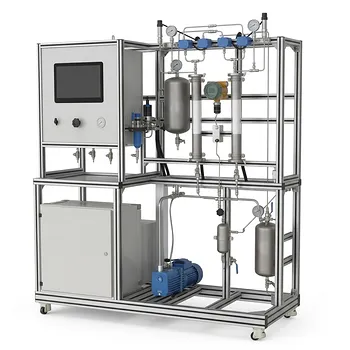
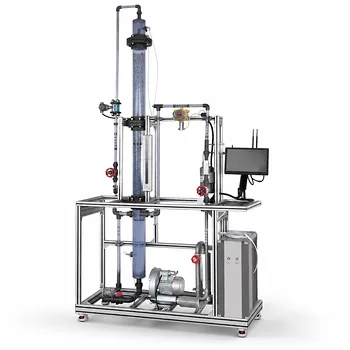
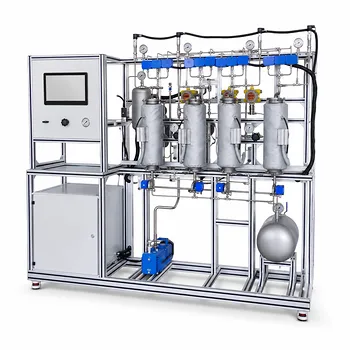
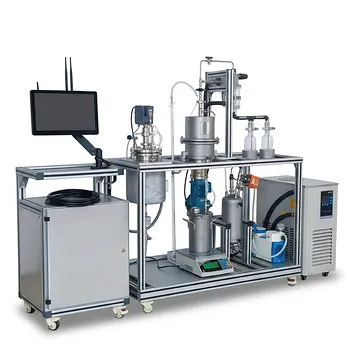
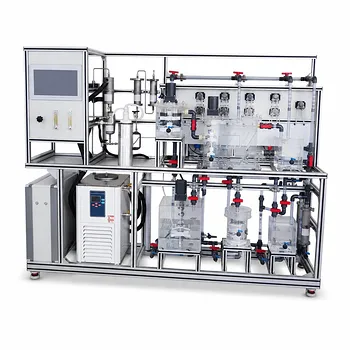
The core of the problem is a physical impossibility. When you're studying the absorption of supercritical gases like methane or nitrogen in a pilot plant, you are operating at a temperature above the gas's critical point. Extrapolating a pure-liquid fugacity for this component is not just an approximation—it is a calculation based on a hypothetical state of matter that does not exist under your process conditions. The scientifically sound, and therefore preferred, procedure is to abandon the pure-liquid standard state entirely and use Henry's law constant as the fundamental reference for the dissolved gas.
The failure of pure-liquid fugacity extrapolation is a thermodynamic reality that directly corrupts pilot plant data analysis. The solution is a standard-state paradigm shift: use experimentally accessible Henry's constants with unsymmetric activity coefficients to achieve thermodynamic consistency and accurate mass transfer calculations.
The Thermodynamic Collapse of the Pure-Liquid Standard State
The standard approach for vapor-liquid equilibrium (VLE) uses a symmetric convention, where both the vapor and liquid phases reference the pure component's fugacity. This method is the bedrock of distillation and condensation design. It catastrophically fails for a supercritical gas dissolved in a liquid solvent.
The "Hypothetical Liquid" Trap
For a component above its critical temperature, a pure liquid cannot exist at any pressure. Extrapolating the liquid fugacity curve beyond the critical point creates a fictitious property. You are essentially inventing a vapor pressure for a liquid that isn't there.
This imaginary value is highly sensitive to the extrapolation method and lacks any experimental basis. It introduces a fundamental, non-correctable error into your pilot plant's VLE model. Your mass transfer calculations will reflect a physical reality that your absorption column has never seen.
Why This Corrupts Pilot Plant Data
The goal of a pilot plant is to generate reliable data for scaling up gas-liquid contactors. Using a hypothetical standard state directly undermines this goal.
- Distorted Driving Forces: The mass transfer driving force is the difference between the bulk concentration and the equilibrium concentration. An incorrect equilibrium constant, derived from a fictitious liquid fugacity, falsifies this driving force. Your calculated column height or stage count becomes untrustworthy.
- Invalid Solubility Predictions: A supercritical gas's solubility in a solvent is a function of non-ideal interactions. Pure-component fugacity models fail to capture the solute-solvent physics, leading to solubility predictions that can be orders of magnitude off from actual pilot plant measurements.
The Correct Paradigm: Henry's Law as the Anchor
The correct thermodynamic framework for supercritical gases in a liquid solution is the unsymmetric convention. This approach acknowledges the fundamental asymmetry of the system: the solvent is a condensable liquid, but the solute is a permanent gas.
Defining the New Standard State
Instead of the pure component, the standard state for the supercritical gas becomes its hypothetical behavior in an infinitely dilute solution. This standard-state fugacity is the Henry's law constant.
This constant is not a fundamental physical property of the pure gas; it is a property of the gas dissolved in a specific solvent. It captures the real interactions between the solute and solvent molecules. Critically, Henry's constants are experimentally accessible and can be correlated from direct solubility measurements.
Implementing the Unsymmetric Activity Coefficient
This new standard state requires a new measure of non-ideality. You must switch to an unsymmetric activity coefficient. This coefficient is normalized such that its value approaches 1.0 as the solute’s mole fraction approaches zero (infinite dilution).
This model accurately describes the behavior of a gas molecule in a sea of solvent molecules. As the solution becomes more concentrated with gas, the activity coefficient captures the solute-solute interactions that deviate from Henry's law. This framework is easily integrated into equations of state, allowing you to calculate the Henry's constant from the equation of state parameters at the infinite dilution limit.
Understanding the Trade-offs and Practicalities
While thermodynamically correct, this method is not without its experimental and modeling demands. You must be aware of these to avoid sending your research down another blind alley.
The Experimental Burden
The accuracy of this method is directly tied to the quality of the Henry's constant data. For a new solvent or a novel gas mixture, you must measure it. Generic correlations or predictions from a simple equation of state may carry significant uncertainty.
This often requires dedicated high-pressure solubility experiments, which can be as complex as the pilot plant run itself. The effort is justified, however, as a single accurate Henry's constant is infinitely more valuable than a thousand data points generated from a fictitious pure-liquid fugacity.
The Minimum Liquid-to-Gas Ratio Reality
The choice of your liquid-to-gas ratio in the pilot plant is a direct consequence of this thermodynamic framework. The equilibrium curve is now defined by Henry's law, not Raoult's law.
- Zero Driving Force: The minimum liquid-to-gas ratio occurs where the operating line for your absorber intersects the Henry's law equilibrium line. At this pinch point, the mass transfer driving force is zero. This represents a thermodynamic limit requiring an infinitely tall column—an impossibility in any pilot plant.
- Practical Operation: To achieve your separation target in a finite column, you must operate at a multiple of this minimum ratio. A typical factor in pilot plants is 1.1 to 2.0 times the minimum liquid rate. This ensures a tangible driving force throughout the column, allowing you to study kinetics and hydraulics with a realistic apparatus height.
Making the Right Choice for Your Pilot Plant Goal
Your path forward depends on the primary objective of your research. The thermodynamic framework is non-negotiable, but your focus within it can shift.
- If your primary focus is high-fidelity design data for scale-up: Prioritize the experimental determination of Henry's constants for your specific solute-solvent system. Validate the predictive power of a chosen activity coefficient model against these measurements before running lengthy pilot plant campaigns.
- If your primary focus is educational demonstration or fundamental kinetic study: Use well-established systems (e.g., CO2-water, O2-water) with robust, published Henry's constant correlations. This allows you to teach the thermodynamic principles correctly and focus the pilot plant work on hydrodynamics, gas-liquid interfacial area measurement, or other transport phenomena, without being mired in VLE model debugging.
The transition from a pure-component to a solution-based standard state marks the line between a grossly flawed simulation and a physically meaningful chemical engineering pilot plant experiment.
Summary Table:
| Feature | Pure-Liquid Extrapolation (Symmetric) | Henry's Law Standard State (Unsymmetric) |
|---|---|---|
| Physical Reality | Fictitious "hypothetical liquid" above critical temp | Real solute-solvent interactions at infinite dilution |
| VLE Model Accuracy | Highly inaccurate, distorts mass transfer driving forces | Accurate; captures true non-ideal gas-liquid behavior |
| Data Basis | Fictitious extrapolated vapor pressure curves | Experimentally accessible Henry's law constants |
| Application | Leads to incorrect pilot plant scale-up sizing | Reliable scale-up design for gas-liquid contactors |
Scale Up Your Chemical Engineering Research with Confidence
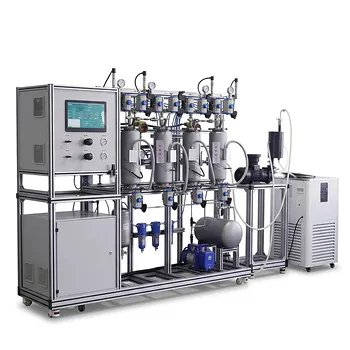
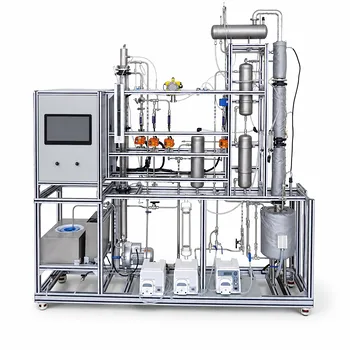
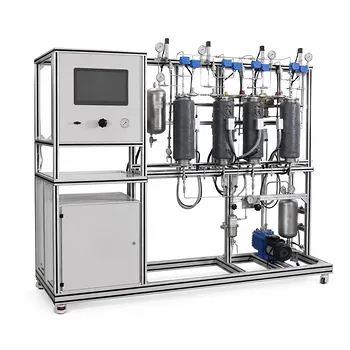
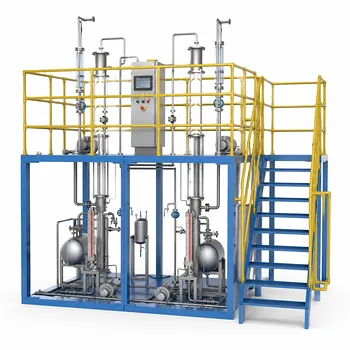
Accurate thermodynamic modeling is only half the battle; you need reliable physical systems to validate your data. LABPARK designs and manufactures premium Educational and Vocational Unit Operations Pilot Plants in chemical engineering, bioprocess & biotech, and environmental & water treatment.
Whether you are a university teaching fundamental mass transfer principles or a research institute/enterprise developing novel gas separation processes, our pilot plants provide the precision and reliability you need. Contact us today to discuss how our customizable pilot plant solutions can accelerate your research and engineering curriculum.
Related Products
- Multi-Component Gas Pressure Swing Adsorption Pilot Plant for Unit Operations Education
- Carbon Dioxide Absorption and Desorption Educational Pilot Plant for Carbon Capture Studies
- Absorption and Desorption Educational Unit Operations Pilot Plant
- Bench Scale Carbon Dioxide Capture Educational Unit Operations Pilot Plant
- Dual-Mode Gas Absorption and Desorption Unit Operations Training Pilot Plant
People Also Ask
- How does Pressure Swing Adsorption (PSA) technology operate? Optimize gas separation with pilot plants.
- How is the direction and driving force of mass transfer determined in a gas absorption unit operations pilot plant?
- How do two-film & penetration theories apply to gas absorption pilot plant teaching? Key pedagogical insights.
- How does partial pressure behavior influence gas absorption pilot plants? Master Mass Transfer
- What are the limitations of Henry's Law in gas absorption pilot plants? Avoid critical lab errors.