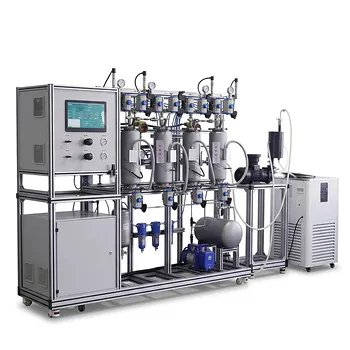
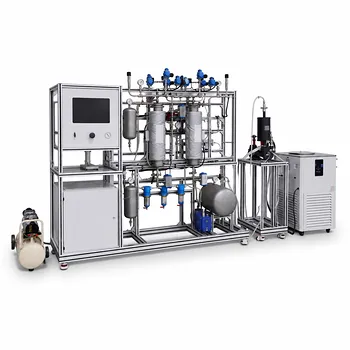
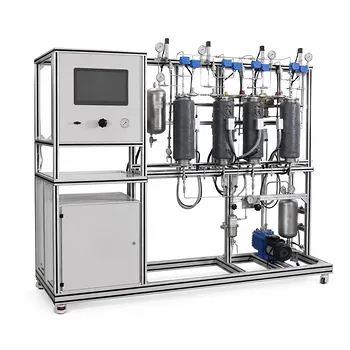
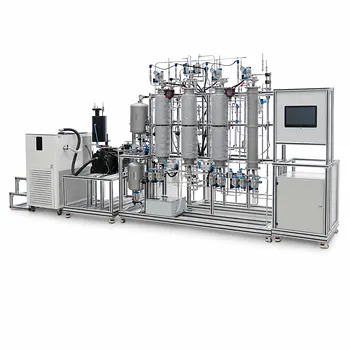
The ideal gas law is the starting point for nearly every gas-phase calculation in a chemical engineering pilot plant.
It is used to estimate gas volume, pressure, and molar flow rates when designing and operating reactors, absorption columns, and storage systems. To apply it correctly, you must use a consistent unit system: temperature in Kelvin ($K = t(^{\circ}\text{C}) + 273.15$), volume in cubic decimeters ($\text{dm}^3$) or cubic meters ($\text{m}^3$), amount in moles ($\text{mol}$), and pressure in Pascals ($\text{Pa}$) or Kilopascals ($\text{kPa}$). The gas constant $R$ must match these units, and the most practical choice for pilot plants is $8.31\ \text{kPa}\cdot\text{dm}^3\cdot\text{mol}^{-1}\cdot\text{K}^{-1}$ (which is numerically equal to $8.31\ \text{J}\cdot\text{mol}^{-1}\cdot\text{K}^{-1}$).
The ideal gas law ($pV=nRT$) gives you a fast, reliable way to convert between pressure, temperature, and molar flow in gas-phase pilot plants—provided you keep all units in a strict SI-derived system and stay aware of its breakdown at high pressures or when gases deviate from ideality.
Building a Solid Foundation with the Ideal Gas Law
The ideal gas law isn’t just a classroom abstraction—it directly translates into sizing equipment, calibrating instruments, and ensuring safe operation in a pilot plant. You can rearrange it to solve for any unknown, but its real power lies in linking measurable quantities to the molar scale that drives mass balances.
Calculating Molar Flow Rates and Vessel Sizing
In gas-phase catalytic reaction or gas absorption pilots, you often know the vessel volume and operating temperature, and you measure the pressure. Using $n = \frac{pV}{RT}$, you instantly get the total moles of gas present.
For example, when a storage cylinder of known volume drops from an initial pressure to a lower value, the mole difference tells you exactly how much reactant has been consumed. Multiply $n$ by the gas’s molar mass ($m = n \times M$) to calculate remaining mass, verify feed rates, and confirm that mass flow controller calibrations are correct.
The same equation lets you size new vessels: for a desired molar holdup at a given pressure and temperature, you solve for $V$. This keeps vessel pressure ratings aligned with safety thresholds during dynamic pilot runs.
The Mandatory Unit System
Consistency is the single non‑negotiable rule. The pilot plant community standard combines:
- Temperature $T$ in Kelvin (convert any Celsius reading by adding 273.15)
- Volume $V$ in cubic decimeters ($\text{dm}^3$, equivalent to liters) or cubic meters ($\text{m}^3$)
- Pressure $p$ in kilopascals ($\text{kPa}$) or pascals ($\text{Pa}$)
- Amount $n$ in moles ($\text{mol}$)
- Gas constant $R = 8.31\ \text{kPa}\cdot\text{dm}^3\cdot\text{mol}^{-1}\cdot\text{K}^{-1}$ (or $8.31\ \text{J}\cdot\text{mol}^{-1}\cdot\text{K}^{-1}$ when working in energy terms)
Mixing units—such as pressure in bar and volume in milliliters without adjusting $R$—is the fastest way to introduce order‑of‑magnitude errors. For pilot plant work, choose the $R$ that matches $\text{kPa}\cdot\text{dm}^3$ and stick with it; this seamlessly connects thermodynamic calculations with the flow and volume scales you actually observe on your rotameters, mass flow controllers, and data acquisition screens.
Beyond the Basics: Real Gas Behavior in High‑Pressure Operations
Pilot plants often push gases into high‑pressure regions where ideal behavior breaks down. Ignoring this can lead to dangerously inaccurate mass balances and undersized safety devices.
When Ideality Fails
The ideal gas law assumes molecules have no volume and no mutual attraction. Under high pressure, those assumptions collapse. For carbon dioxide, using $pV=nRT$ at elevated pressure can introduce calculation errors exceeding 20% to 27%.
To fix this, you can introduce the compressibility factor $Z$ ($pV = ZnRT$) or switch to a real gas equation of state, such as the van der Waals equation, which corrects for intermolecular attraction (parameter $a$) and molecular volume (parameter $b$). These models typically reduce pressure errors to 1%–5%, giving you the accuracy required for reactor sizing, compressor work calculations, and safety margins.
A pilot plant is the perfect place to collect real pressure‑volume‑temperature (PVT) data directly from your reactors or separation columns. That data lets you calculate $Z$ experimentally and validate which equation of state best describes your specific gas mixture before scaling up.
Accounting for Gas Mixtures with Dalton’s Law
In absorption, stripping, or any process with a gas mixture, Dalton’s Law of Partial Pressures is your essential companion to the ideal gas law. The total pressure of a mixture is the sum of the partial pressures of its components.
This matters because mass transfer depends on individual component partial pressures, not the total. For an absorption column, the driving force that pushes a solute gas into the liquid is the difference between its partial pressure in the bulk gas and the equilibrium partial pressure above the liquid. A pilot plant equipped with thermal controls and pressure regulation valves lets you shift these partial pressures, directly observing how increased operating pressure or lower temperature boosts solubility and promotes absorption, while the opposite drives desorption.
Measurement techniques can exploit partial pressure principles. For instance, a semi‑permeable material like a palladium tube selectively passes hydrogen, allowing you to measure its partial pressure dynamically against an inert like argon. This reinforces accurate mass balances and validates kinetic models.
Understanding the Trade‑offs: Speed vs. Precision
The ideal gas law gives you speed and simplicity; real gas models give you precision. You must decide when each is appropriate.
- Ideal gas approach: Fast, transparent, and perfectly adequate when operating well below the critical pressure of your gas and when quick estimates are required. It’s the right tool for standard low‑pressure catalytic reactions and for educational pilots where the goal is to teach core relationships.
- Real gas approach: Necessary when you are pushing into high‑pressure regimes (e.g., supercritical conditions or dense‑phase transport), when your mass balance closure depends on sub‑5% accuracy, or when designing pressure‑bearing equipment to code. The added effort of implementing a van der Waals or Virial equation pays back in safety and reliable scale‑up data.
A common pitfall is neglecting the vapor pressure of a displacement liquid when measuring gas volumes with a gas burette. If you read the total pressure but forget to subtract the water vapor pressure, your calculated “dry gas” moles will be wrong. Similarly, failing to equalize liquid levels in the measuring and reference tubes means the gas pressure no longer equals atmospheric pressure, throwing off the $p$ in your $pV=nRT$ calculation. These practical details separate a reliable pilot plant mass balance from a rough approximation.
Practical Measurement Techniques That Rely on the Gas Laws
The ideal gas law underpins many direct gas‑measurement setups. In pilot plants that track gas production or consumption via liquid displacement devices (gas burettes, leveling vessels), three rules keep your data valid:
- Choose a non‑reactive displacement liquid. The liquid must not dissolve or chemically interact with the gas—for chlorine, for example, use saturated brine, not pure water.
- Equalize pressure before reading. Align the liquid level in the measuring tube with the reference tube so that the gas pressure inside exactly balances the external atmospheric pressure.
- Achieve thermal equilibrium and correct for vapor pressure. Let the system stabilize at ambient temperature, then subtract the vapor pressure of the displacement liquid from the total pressure before applying the ideal gas law to calculate dry gas volume.
These steps ensure that the $p$, $V$, and $T$ you plug into $pV=nRT$ represent the true thermodynamic state of your target gas, not a mixture with unknown water vapor content.
The same logic extends to membrane separation pilots, where Graham’s Law of Diffusion (rate inversely proportional to the square root of molar mass) governs how fast different gases pass through a barrier. Even though Graham’s law is kinetic, your ability to calculate molar flow and partial pressures using the ideal gas law and Dalton’s law is what lets you quantify separation efficiency across multi‑stage diffusion columns.
Making the Right Choice for Your Process
Your decision path depends on the goal you are prioritizing in the pilot plant.
- If your primary focus is rapid, routine mass balances at low to moderate pressures: Use the ideal gas law with $R = 8.31\ \text{kPa}\cdot\text{dm}^3\cdot\text{mol}^{-1}\cdot\text{K}^{-1}$ and strictly convert all temperatures to Kelvin. It will serve you well for most catalytic reactors and atmospheric absorption columns.
- If your primary focus is high‑pressure operation with critical safety margins: Switch to a real gas model—start with the compressibility factor $Z$ from a cubic equation of state like van der Waals—and validate it against PVT data collected directly from your pilot rig.
- If your primary focus is accurate gas mixture analysis or absorption design: Always combine the ideal gas (or real gas) equation with Dalton’s law and correct for vapor pressure when using liquid displacement measurement devices.
- If your primary focus is seamless data integration with your control system: Use the $\text{kPa}\cdot\text{dm}^3$ unit set throughout; it aligns naturally with the standard SI units used in pressure transducers and flow meters, reducing conversion errors and troubleshooting time.
When you respect its limits, the ideal gas law becomes much more than an equation—it becomes a trusted, fast‑acting diagnostic tool that keeps your pilot plant safe, efficient, and ready for scale‑up.
Summary Table:
| Parameter | Symbol | Recommended Unit | Notes |
|---|---|---|---|
| Pressure | p | kPa or Pa | Standard SI-derived unit |
| Volume | V | dm³ (Liters) or m³ | Standard volumetric unit |
| Temperature | T | Kelvin (K) | T(K) = t(°C) + 273.15 |
| Gas Constant | R | 8.31 kPa·dm³/(mol·K) | Matches kPa and dm³ perfectly |
Elevate Your Chemical Engineering Lab with LABPARK
Ready to optimize your process calculations and scale up with precision? LABPARK provides state-of-the-art Educational and Vocational Unit Operations Pilot Plants in chemical engineering, bioprocess & biotech, and environmental & water treatment. Designed specifically for universities, research institutes, and enterprises, our pilot systems bridge the gap between theory and real-world industrial operations.
Contact LABPARK today to find the perfect pilot plant solution for your institution!
Related Products
- Dual-Mode Gas Absorption and Desorption Unit Operations Training Pilot Plant
- Carbon Dioxide Absorption and Desorption Educational Pilot Plant for Carbon Capture Studies
- Carbon Dioxide Adsorption and Capture Educational Unit Operations Pilot Plant
- Absorption and Desorption Educational Unit Operations Pilot Plant
- Packed Bed Absorption Educational Unit Operations Pilot Plant
People Also Ask
- How do two-film & penetration theories apply to gas absorption pilot plant teaching? Key pedagogical insights.
- How is the direction and driving force of mass transfer determined in a gas absorption unit operations pilot plant?
- How does partial pressure behavior influence gas absorption pilot plants? Master Mass Transfer
- How to model chemical absorption as physical absorption? The pilot plant simplification criterion.
- Why does increasing flow fail to enhance absorption in fast chemical reactions? Pilot Plant Insights