The surprising bottleneck in membrane gas separation is often the operating pressure ratio, not the membrane itself. When you run a pilot plant with an extremely selective membrane, you can hit a point where the product purity simply stops rising. This happens because the enrichment becomes pressure-ratio-limited—the degree of separation is no longer controlled by the membrane’s intrinsic selectivity but by the ratio of feed pressure to permeate pressure. At a typical pilot‑scale pressure ratio of 10, for example, pushing selectivity beyond about 40 adds almost nothing to your gas enrichment. Instead, you may just be sacrificing permeability and driving up costs.
Core Takeaway: A membrane’s selectivity only improves enrichment up to a certain threshold. Once selectivity significantly exceeds the pressure ratio, the system enters a pressure-ratio-limited regime where further gains in selectivity yield negligible improvement. In a pilot plant, this means that chasing ever‑higher selectivity can be a wasted effort—and sometimes even counterproductive—unless you also increase the pressure ratio or manage the trade‑offs with permeability.
The Two Regimes That Govern Membrane Enrichment
Understanding why excessive selectivity fails requires looking at the two fundamental limitations of any membrane separation process.
The Selectivity-Controlled Region
At low selectivity, the membrane’s ability to discriminate between molecules directly governs product purity. Increasing selectivity here gives a nearly proportional increase in enrichment. This is the regime where material science shines, and where students in a pilot plant can clearly see the theoretical separation factor (alpha) at work.
The Pressure-Ratio-Limited Region
Everything changes once the membrane’s selectivity grows large relative to the pressure ratio (feed pressure ÷ permeate pressure). In this regime, the maximum achievable permeate concentration is dictated by the pressure ratio itself—not the membrane. No matter how much higher you push the selectivity, the enrichment plateaus. At a pressure ratio of 10, a membrane with a selectivity of 40 delivers virtually the same permeate purity as one with a selectivity of 200. The extra discrimination power has nowhere to go; the driving force is capped.
Why This Happens in Your Pilot Plant
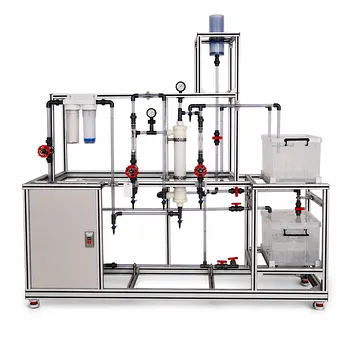
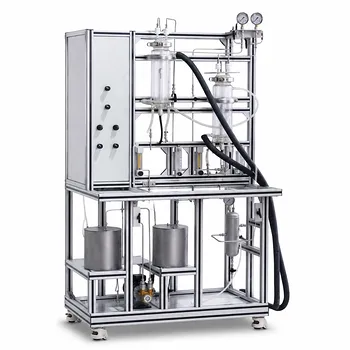
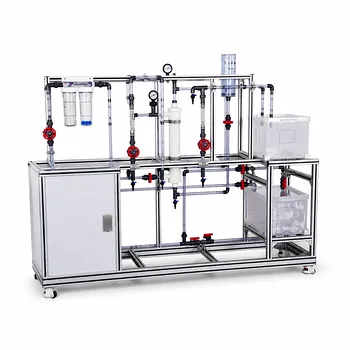
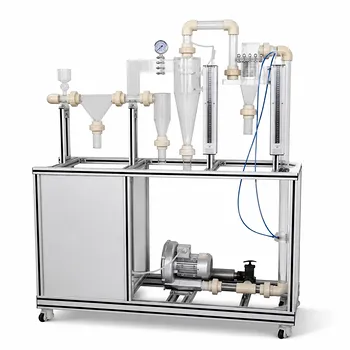
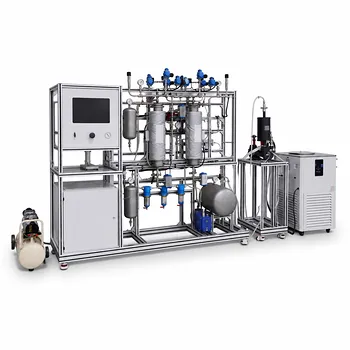
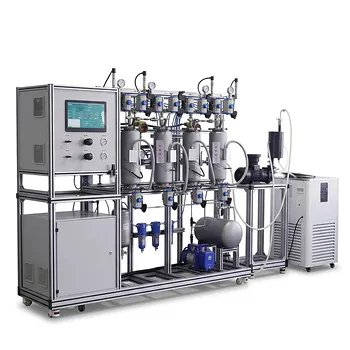
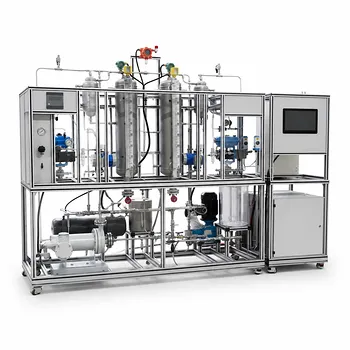
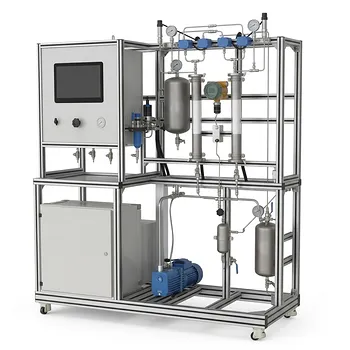
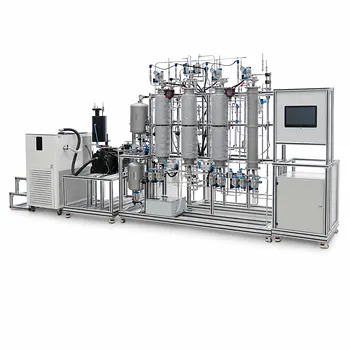
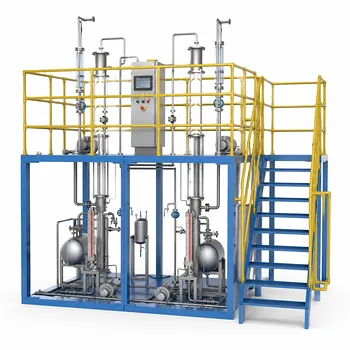
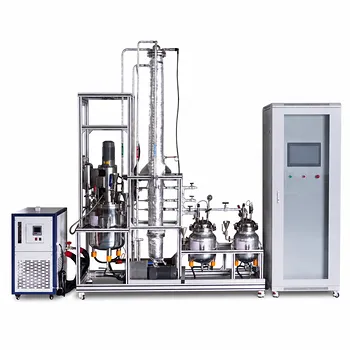
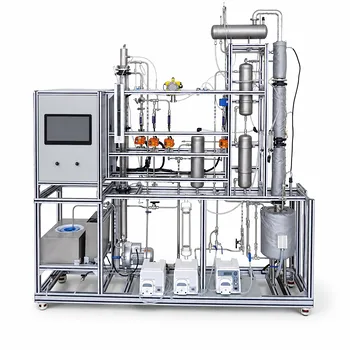
A gas separation unit operations pilot plant makes this phenomenon tangible. You can adjust feed pressure, permeate backpressure, and flow rates, then watch the purity curve flatten out.
The Mathematics Behind the Limit
The separation factor α is defined as (y_A/y_B) / (x_A/x_B). In an ideal system, α tells you the intrinsic separation power. But the actual enrichment is constrained by mass balances and pressure limits. When the pressure ratio is low, the permeate side composition becomes heavily influenced by the bulk flow and the pressure boundary condition, to the point that α simply can’t express itself fully. The faster permeating component gets diluted because the pressure difference cannot sustain a higher concentration gradient.
Experimental Proof on the Lab Bench
In an educational pilot plant, you can demonstrate this by holding the pressure ratio fixed at, say, 8, and testing membranes with selectivities of 20, 50, and 100. You will measure nearly identical permeate concentrations for the 50 and 100 membranes. Plotting the data against the theoretical enrichment limit for that pressure ratio will show you’ve hit the ceiling. This is a powerful lesson: operating conditions can easily override the membrane’s inherent capability.
The Hidden Trade-Off: Selectivity vs. Permeability
The problem isn’t just that high selectivity stops helping; it can actively hurt your process if it comes at the expense of permeability.
The Flux Penalty
In polymer materials, gain in selectivity often requires tighter chains and lower free volume, which reduces gas flux. A membrane with an extremely high α but low permeance will need far more membrane area to process the same volume of gas. In a pilot plant, this means a larger module, higher capital cost, and potentially unrealistic scale‑up paths. Some industrial data show that increasing selectivity just a few points can multiply the required membrane surface area tenfold, wiping out any energy savings.
The Energy Dynamics
Selectivity also affects the energy demand, but not always in the way you might hope. For a given product purity, a higher‑selectivity membrane can reduce compressor power because you need less recycle or less pressure. However, in the pressure‑ratio‑limited region, those energy savings disappear too, because you aren’t getting higher purity anyway. You are simply paying for a more expensive, lower‑flux membrane without reaping any enrichment benefit.
Real-World Pilot Plant Complications
Beyond the pressure‑ratio limit, pilot plant operation reveals other reasons why “super‑selective” membranes can underperform.
The Myth of Universal Scalability
Membrane systems lack traditional economies of scale—the scale‑up factor is close to 1. A highly selective but low‑flux membrane will force you to stack many modules in parallel. In a pilot plant designed to teach scalability, this shows students that selectivity alone does not make a process economically viable; flux and pressure ratio management are just as crucial.
Chemical and Physical Aging
Many extremely selective membranes, such as carrier‑facilitated transport membranes, are fragile. Exposure to real gas streams containing heavy hydrocarbons, water vapor, or aromatics can degrade their performance in weeks. In a research pilot plant, you might see a sharp drop in selectivity within a month, meaning the initial ultra‑high selectivity was a short‑lived illusion. Even industrial workhorses like cellulose acetate show predictable, but modest, selectivity that holds up over time, whereas some advanced materials fail catastrophically.
The Robeson Upper Bound Lesson
By testing membranes of different generations, a pilot plant can illustrate Robeson’s upper bound. This empirical limit ties selectivity and permeability together: beyond a certain line, you cannot increase one without sacrificing the other. A membrane with extremely high selectivity but extremely low permeability pushes against that limit. Your pilot plant data will show that operating near the bound often yields a better overall balance than fixating on selectivity alone.
Making Informed Choices in Your Membrane Pilot Plant
So, when you plan your next experimental campaign or teach students about separation fundamentals, keep these guidelines in mind.
- If your primary goal is to demonstrate the pressure‑ratio limitation: Operate several membranes with increasing selectivity under a fixed, moderate pressure ratio. Show the exact point where enrichment plateaus, and then demonstrate how raising the pressure ratio shifts that plateau upward. This makes the physics tangible.
- If your primary goal is to study the selectivity‑permeability trade‑off: Compare an older, lower‑selectivity/high‑flux membrane with a newer, high‑selectivity/low‑flux material. Measure the required membrane area and the compression energy needed to reach a target purity. The data will reveal the true cost of “better” selectivity.
- If your primary goal is to simulate real‑world durability: Expose an advanced, high‑selectivity membrane to a simulated raw gas mixture containing moisture and hydrocarbons. Track its performance over days and weeks. Use the decline curve to teach about plasticization, fouling, and the importance of long‑term stability over initial selectivity numbers.
- If your primary goal is to train operators for industrial scale‑up: Focus on modules that balance moderate selectivity with high permeability. Show that stacking multiple high‑flux modules in parallel often beats a single extremely selective module, both economically and operationally.
Ultimately, a membrane is only as effective as the system it sits in. By recognizing the pressure‑ratio limit and the selectivity‑permeability trade‑off, you can turn a seemingly puzzling pilot plant result—where a “super” membrane falls flat—into one of the most valuable lessons in process design.
Summary Table:
| Regime / Factor | Key Limiting Driver | Impact on Pilot Plant Purity & Operation |
|---|---|---|
| Selectivity-Controlled | Membrane Selectivity ($\alpha$) | Purity increases proportionally with higher selectivity. |
| Pressure-Ratio-Limited | Feed-to-Permeate Pressure Ratio | Purity plateaus; higher selectivity yields no further benefit. |
| Permeability Trade-off | Flux Penalty & Membrane Area | Low permeability increases required module size and capital cost. |
Optimize Your Gas Separation Studies with LABPARK
Are you looking to demonstrate complex separation phenomena like the pressure-ratio limit to your students or research team? LABPARK provides state-of-the-art Educational and Vocational Unit Operations Pilot Plants in chemical engineering, bioprocess & biotech, and environmental & water treatment.
Designed specifically for universities, research institutes, and enterprises, our robust pilot plants enable hands-on learning, precise process scale-up, and reliable experimental data.
Contact our engineering experts today to find the perfect pilot plant solution for your laboratory!
Related Products
- Multifunctional Membrane Separation Educational Pilot Plant with Ultrafiltration, Nanofiltration, Reverse Osmosis
- Ultrafiltration Membrane Separation Educational Pilot Plant
- Multi-Functional Membrane Separation Educational Pilot Plant for Unit Operations Lab
- Photocatalytic Membrane Separation and Degradation Unit Operations Pilot Plant
- Hollow Fiber Ultrafiltration Membrane Separation Educational Pilot Plant
People Also Ask
- Pervaporation vs. Vapor Permeation: Handling Suspended Solids in Membrane Pilot Plants
- How do PEI, PVDF, and PSU membranes compare in pilot plants? Find the best fit.
- What are the trade-offs of polymer vs inorganic membranes in teaching pilot plants? Key laboratory comparison.
- How can operators optimize operating conditions and cleaning protocols in membrane separation pilot plants to mitigate fouling?
- What are the advantages of membrane separation in pilot plants? Efficient Organic Vapor Recovery