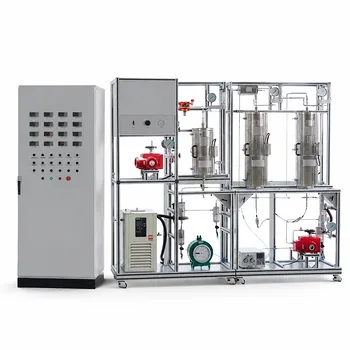
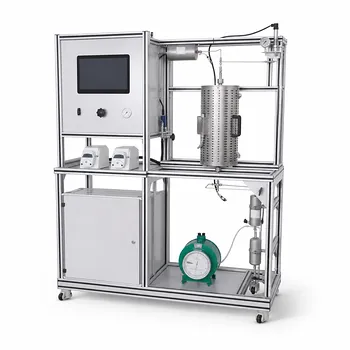
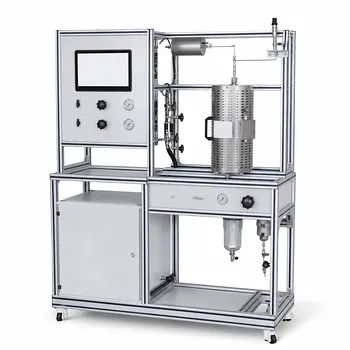
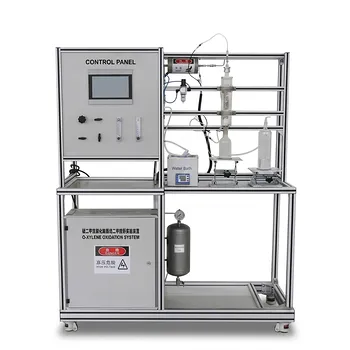
High-pressure catalytic reactor pilot plants are finely tuned to uncover the interplay between reaction kinetics and transport phenomena. The direct answer to your question lies in how catalyst particle size and space velocity jointly govern two things: the intrinsic reaction rate (how fast chemistry happens on the active surface) and the observed conversion efficiency (how much reactant gets turned into product in a given pass). In a pilot‑scale packed bed, smaller catalyst particles reduce internal diffusion resistance, making more of the catalyst’s active sites accessible—this raises the catalyst effectiveness factor and the volumetric reaction rate. Space velocity controls gas residence time: raising it increases the amount of feed processed per hour but slashes contact time, lowering conversion. The net conversion efficiency depends on how these two compete. Small particles can cushion the conversion loss at high space velocity by supercharging catalyst utilization, but they simultaneously drive up pressure drop, which imposes a practical ceiling.
The core interaction is a classic mass‑transfer‑versus‑productivity trade‑off. Smaller catalyst particles unlock a higher intrinsic reaction rate by minimizing internal diffusion limitations, helping maintain conversion even when space velocity is high. However, this benefit is counterbalanced by a steep rise in bed pressure drop. In a pilot plant, therefore, particle size and space velocity must be adjusted together to strike a deliberate balance between throughput, energy cost, and experimental fidelity.
Understanding Catalyst Particle Size in Pilot Plants
Internal Diffusion and the Effectiveness Factor
In a porous catalyst pellet, reactants must diffuse through the pore network to reach the active sites. When the true chemical reaction rate is fast (especially above roughly 380 °C), diffusion can become the bottleneck—only the outermost shell of the particle is used.
Smaller particles shorten the diffusion path length, so a greater fraction of the internal surface participates in the reaction. The catalyst effectiveness factor (η)—the ratio of the observed rate to the rate if all active sites were equally accessible—approaches 1.0 for sufficiently small pellets. This means the volumetric reaction rate (per unit reactor volume) climbs as particle size shrinks, giving you more conversion per gram of catalyst at the same nominal space velocity.
The Pressure‑Drop Penalty
However, packing a bed with smaller particles drastically increases the resistance to gas flow. The resulting pressure drop (ΔP) across the bed rises non‑linearly with decreasing particle diameter. In a high‑pressure pilot plant, a high ΔP not only demands more compression work but can also mechanically crush the catalyst or limit the maximum feasible flow rate. This is the fundamental physical constraint that prevents you from simply grinding the catalyst to dust.
Decoding Space Velocity
Residence Time and Conversion
Space velocity—often expressed as Weight Hourly Space Velocity (WHSV) or Gas Hourly Space Velocity—is the inverse of average residence time. Doubling the space velocity approximately halves the time that reactants spend in contact with the catalyst bed.
The immediate result: the reaction has less opportunity to proceed, so conversion drops. For example, in a pilot reactor oxidizing CO, raising the space velocity from 10 hr⁻¹ to 60 hr⁻¹ can cause conversion to plummet from over 80 % to below 40 %. This is a direct consequence of reduced contact time, not a change in the catalyst’s intrinsic activity.
Throughput Versus Yield
Higher space velocity means you process more raw feed per hour, which can raise the absolute production rate of the target molecule—provided the conversion doesn’t drop too steeply. The pilot plant’s job is to find the “sweet spot” where total product output is maximized, even if per‑pass conversion is lower.
The Interaction: How Particle Size and Space Velocity Work Together
Mitigating Diffusion to Preserve Conversion at High Throughput
Here’s the coupling that pilot‑plant operators must master. When you crank up space velocity to increase throughput, conversion falls because of the shorter residence time. If you simultaneously reduce catalyst particle size, you raise the effectiveness factor. More active sites immediately accessible means the observed reaction rate per volume increases, partially compensating for the lost contact time.
In other words, smaller particles can make the catalyst “work harder” in the reduced time window, keeping conversion higher than it would be with large, diffusion‑limited pellets. This interaction is particularly pronounced at temperatures where the intrinsic kinetics are fast and diffusion is the restricting step.
The Pressure Drop Bottleneck
The compensation strategy has a hard limit. High space velocity already pushes more gas through the bed, raising the pressure drop. Making the particles smaller increases ΔP even more dramatically. At some combination of high flow rate and fine particles, the energy cost of pumping becomes prohibitive, or the bed may fluidise or suffer channeling. Therefore, you cannot simply use ultra‑fine particles to “buy back” all the conversion lost to high space velocity—the pressure‑drop wall forces a compromise.
Understanding the Trade‑offs
The Pilot Plant’s Core Tension
- Small particles + low space velocity → very high conversion, excellent catalyst utilization, but low throughput and potentially high pressure drop if flow rates are not adjusted.
- Large particles + high space velocity → low ΔP, high throughput, but poor effectiveness factor and low per‑pass conversion.
- The optimal operating point is found by running pilot experiments at varying particle sizes (e.g., 2 mm, 3 mm, 5 mm) and several WHSV values to map the interaction. The data reveal how conversion, pressure drop, and selectivity co‑vary.
An Ammonia Synthesis Example
In ammonia pilot reactors, small particles of 2.2–3.3 mm are often used despite the added ΔP, because the synthesis reaction is fast and severely diffusion‑limited above 380 °C. The small particles boost the effectiveness factor, which is essential for demonstrating high conversion in a compact bed. Industrial reactors, however, operate with 6–13 mm particles to keep the pressure drop manageable across a tall bed, accepting a lower effectiveness factor.
Shaped Catalysts as a Middle Ground
One way to soften the trade‑off is to use shaped catalyst particles—trilobes, rings, or wagon‑wheels—that increase the geometric surface‑to‑volume ratio while maintaining a larger equivalent diameter. This reduces pressure drop compared to a bed of small spheres with the same surface area, giving you a better balance between diffusion access and flow resistance.
Making the Right Choice for Your Pilot‑Plant Study
The optimal combination of particle size and space velocity depends entirely on your primary experimental goal.
- If your primary focus is studying intrinsic kinetics and reaction mechanisms: Use the smallest practical particles (e.g., crushed and sieved to a narrow cut) to push the effectiveness factor close to 1.0 and eliminate diffusion disguise. Run at moderate space velocities to get measurable conversion without excessive ΔP.
- If your primary focus is mimicking industrial‑scale behavior: Select particle sizes comparable to those used in production reactors (often larger, extruded or shaped forms) and operate over a wider range of space velocities to observe how diffusion limitations and pressure drop scale.
- If your primary focus is maximizing throughput while maintaining acceptable conversion: Start with a moderately high space velocity and then test progressively smaller particle sizes or shaped catalysts to find the point just before pressure drop becomes uneconomical. Monitor bed integrity and energy costs continuously.
Mastering the interactive dance between catalyst particle size and space velocity is what transforms a pilot plant from a simple demonstration tool into a true predictive engine for reactor design and scale‑up.
Summary Table:
| Factor | High Value Impact | Low Value Impact | Key Trade-off |
|---|---|---|---|
| Catalyst Particle Size | Lower pressure drop, higher diffusion resistance | Higher effectiveness factor, steep pressure drop | Catalyst utilization vs. pressure drop |
| Space Velocity (WHSV) | Higher throughput, lower per-pass conversion | Higher conversion, lower volumetric throughput | Production capacity vs. reaction conversion |
Optimize Your Pilot Operations with LABPARK
Achieving the perfect balance between kinetics and mass transfer requires precise, reliable equipment. LABPARK provides premium Educational and Vocational Unit Operations Pilot Plants across chemical engineering, bioprocess & biotech, and environmental & water treatment.
Whether you are a university training future engineers, a research institute mapping reaction kinetics, or an enterprise scaling up production, our pilot plants deliver the experimental fidelity and control you need.
Contact our technical experts today to find the ideal pilot plant solution for your lab!
Related Products
- Methanol Synthesis and Catalyst Performance Evaluation Educational Unit Operations Pilot Plant
- Carbon Dioxide Hydrogen Methanol Synthesis Educational Unit Operations Pilot Plant
- Multi Functional Catalytic Reaction and Reactor Evaluation Educational Unit Operations Pilot Plant
- Fixed Bed Gas Solid Catalytic Reaction Educational Pilot Plant
- Fixed-Bed Chemical Reaction and Gas Dust Tar Removal Unit Operations Pilot Plant
People Also Ask
- Why is a purge system necessary when operating a gas recirculation loop in a methanol synthesis pilot plant? (Guide)
- How do temp & pressure affect methanol synthesis pilot plants? Optimize equilibrium and catalyst performance.
- Why do modern methanol pilot plants operate at lower pressures? Catalyst & Feed Requirements Explained
- What are the operational requirements for catalyst activation? Safe Methanol Pilot Plant Operation
- Why Compare Predicted and Experimental Excess Enthalpy? Key to Accurate Pilot Plant Scale-up