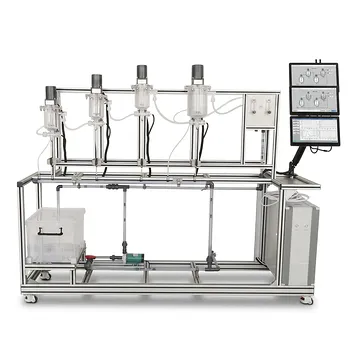
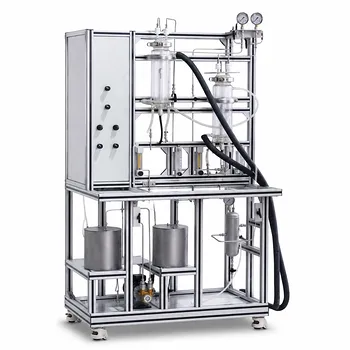
Reactor yield, reactor selectivity, and overall system yield are fundamentally different lenses for viewing process efficiency. In a pilot plant with a recycle loop, reactor yield measures the single-pass conversion of raw materials to product in the reactor. Overall system yield accounts for all losses across the entire unit operation, including downstream separation. However, with a recycle stream, the typical system yield target is effectively transformed into a reactor selectivity target—shifting your focus from maximizing single-pass conversion to maximizing the efficiency of converting expensive reactants to the desired product while minimizing by-products.
A recycle loop changes the optimization game. Instead of chasing a high single-pass reactor yield, your process target pivots to maximizing reactor selectivity. The system’s overall yield is then protected by recovering and recycling unreacted materials, making selectivity the primary economic driver.
Defining the Three Critical Metrics
Before setting targets, you must clearly separate the definitions. Each metric tells you something different about where value is being created or lost in your pilot plant.
What Reactor Yield Actually Measures
Reactor yield, often called single-pass yield, is the narrowest view. It’s the ratio of the desired product formed in the reactor to the amount that would have formed if the limiting reactant had completely converted with no side reactions.
It is mathematically defined by the relationship Yield = Conversion × Selectivity. This metric only captures what happens inside the reactor vessel during a single pass. It ignores any losses that occur later in distillation columns, evaporators, or during product isolation.
How Reactor Selectivity Defines Product Purity
Reactor selectivity measures the proportion of reacted raw materials that converted into your desired target product rather than byproducts. It answers a simple question: of all the reactant that just reacted, how much of it made the right molecule?
High selectivity represents high raw material efficiency. When you recycle unreacted materials, this metric becomes paramount because every molecule that reacts wastefully to form a byproduct is a molecule of raw material permanently lost and a source of downstream purification cost.
Where Overall System Yield Captures Total Losses
Overall system yield is the ultimate bottom line for the processing train. It is the ratio of the final, purified product generated to the stoichiometrically expected product, factoring in every loss mechanism in the plant.
This metric accounts for both chemical losses (poor reactor selectivity) and physical losses. Physical losses include evaporation, leaks, material left in separation unit heels, and mechanical holdup. In a system without a recycle loop, the overall system yield can never exceed the reactor yield. But a functional recycle loop breaks this rule.
How the Recycle Loop Transforms Process Targets
A recycle stream fundamentally changes the purpose and optimization strategy of your reactor. The pilot plant's design intent shifts from “convert everything in one pass” to “react selectively, and keep recycling.”
The Economic Shift from Conversion to Selectivity
With a recycle loop, unreacted, often expensive, raw materials are not lost. They are recovered downstream and fed back to the reactor inlet. This means the overall system yield target is effectively converted into a reactor selectivity target.
Your single-pass conversion rate suddenly becomes an economic trade-off, not a purity problem. If your reactor selectivity is 95% but your single-pass conversion is only 20%, you can still achieve a high overall system yield by efficiently separating and recycling the 80% of unreacted material. The true cost then becomes the energy and capital expense of that separation and recycle step.
Calculating a System Yield-Constrained Target
To set a process target, you must back-calculate from an economic constraint. A common starting point is a raw material cost target—often assumed to be a major percentage, around 80%, of total production cost in early estimates.
You then adjust this target for recovery step losses. The method is to divide your target system yield by the recovery efficiency of your downstream separation train. For example, if your economic model demands a 90% system yield, but your distillation column and recycle system only recovers 95% of unreacted material, your reactor selectivity target must be driven even higher to compensate for those physical losses.
Understanding the Trade-offs
Pilot plant research often uncovers a frustrating conflict. Chasing one metric can actively hurt another, and your control strategy must navigate this tension.
The Conversion-Selectivity Conflict
High conversion rates often lead to lower selectivity. When you push a reaction to near-completion, the high concentration of products and low concentration of reactants promote side reactions, generating more by-products.
For series reactions, like $A + B \rightarrow R \rightarrow S$ where $R$ is your desired product, this danger is acute. Minimizing backmixing and strictly controlling residence time becomes critical to prevent $R$ from over-reacting into the waste product $S$. Pilot plant data showing a spike in byproduct $S$ at higher conversions is a classic sign that you must limit single-pass conversion to protect selectivity.
The Hidden Cost of High Recycle Ratios
Running at low conversion and high selectivity is not a free pass to perfect efficiency. A low conversion rate means your downstream separation unit must process a large volume of material to recover and recycle the unreacted reactant.
This inflates capital equipment size and energy consumption. Your pilot plant data on separation efficiency and pressure drop across the recycle loop provides the real-world numbers to calculate this economic crossover point. You are balancing the cost of waste (poor selectivity) against the cost of recovery (low conversion).
Making the Right Choice for Your Goal
Your operating targets in a pilot plant with a recycle loop must be ordered by priority. The final answer depends on your primary process development objective.
- If your primary focus is maximizing raw material efficiency: Prioritize reactor selectivity above all else. Operate at the conversion level that gives the highest selectivity, and design your downstream separation to handle the high recycle volume.
- If your primary focus is minimizing capital equipment size: You must push for a higher single-pass reactor yield. This will reduce the throughput demand on your downstream separators, even if it means accepting a slightly lower selectivity and higher raw material waste.
- If your primary focus is studying reaction kinetics with a recycle stream: Your process target is not yield, but the reactor selectivity at a given conversion. Use the recycle loop to isolate the steady-state concentration of reactants and byproducts, demonstrating how the loop decouples conversion levels from overall material efficiency.
The pilot plant’s true power is revealing this exact, physical relationship between the reactor’s chemical performance and your separation unit’s physical limits, letting you find the real-world optimum that theory alone cannot predict.
Summary Table:
| Metric | Definition | Focus with Recycle Loop | Key Trade-off |
|---|---|---|---|
| Reactor Yield | Ratio of desired product formed in a single pass. | Secondary to selectivity; determines single-pass conversion. | High conversion can reduce selectivity. |
| Reactor Selectivity | Proportion of reacted material converted to target product. | Primary economic driver; minimizes raw material waste. | Higher selectivity often requires lower conversion. |
| Overall System Yield | Ultimate ratio of final purified product to expected product. | Reflects overall efficiency, combining chemical & physical losses. | Constrained by downstream separation efficiency. |
Optimize Your Process Scale-Up with LABPARK
Are you looking to bridge the gap between laboratory research and industrial scale-up? LABPARK provides state-of-the-art Educational and Vocational Unit Operations Pilot Plants in chemical engineering, bioprocess & biotech, and environmental & water treatment. Designed specifically for universities, research institutes, and enterprises, our modular pilot plants enable researchers and students to master complex process dynamics like recycle loop optimization.
Ready to elevate your research and training capabilities? Contact LABPARK today to find the perfect pilot plant solution for your facility!
Related Products
- Residence Time Distribution and Reactor Flow Characteristics Determination Educational Pilot Plant
- 100L Continuous Loop Hydrogenation Educational Unit Operations Pilot Plant
- Internal Circulation Gradient Free Catalytic Reaction Educational Pilot Plant
- Methane Cracking Educational Unit Operations Pilot Plant
- Multi-Stage Stirred Tanks in Series Residence Time Distribution and Mixing Performance Determination Educational Pilot Plant
People Also Ask
- Why is temperature regulation via a cooling jacket a critical feature in CSTR pilot plants used for laboratory training?
- How does steady-state multiplicity affect the operation and safety of exothermic reactions within a CSTR pilot plant? - Guide
- What parameters to monitor transitioning from Batch to CSTR? Master Pilot Plant Setup
- What role do customizable reactor pilot plants play in evaluating heat and catalyst performance? Scale-up Guide
- Importance of heat balance calculations in reactor pilot plants & how they are taught via unit ops equipment.