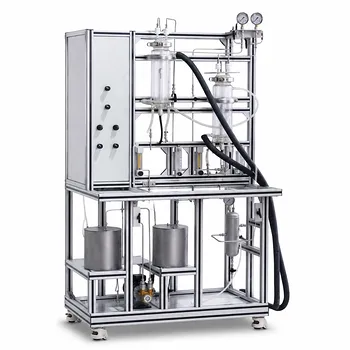
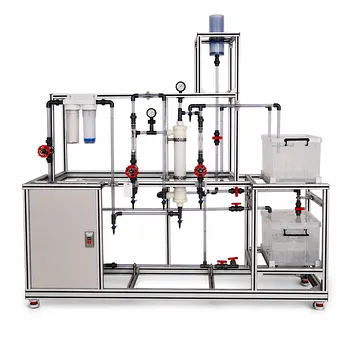
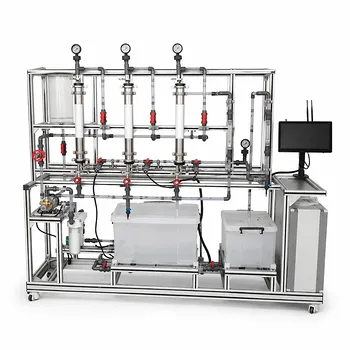
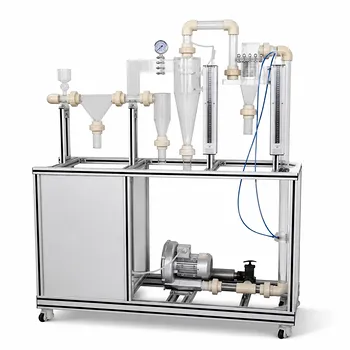
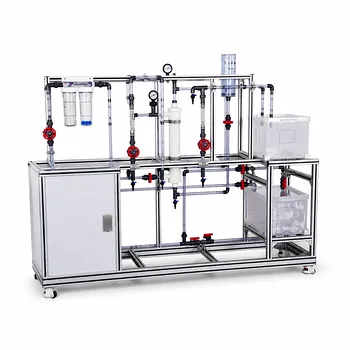
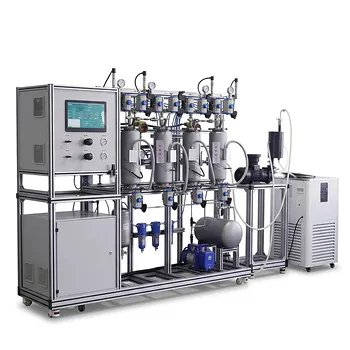
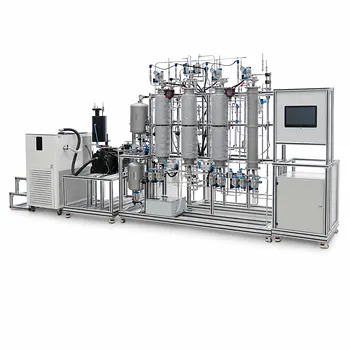
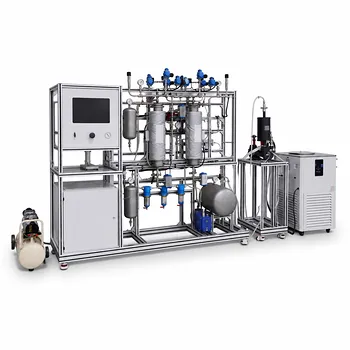
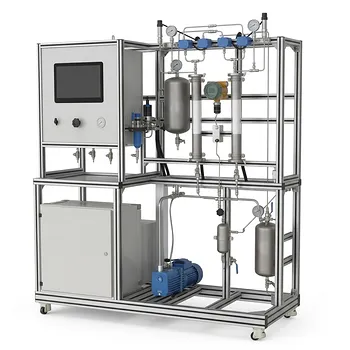
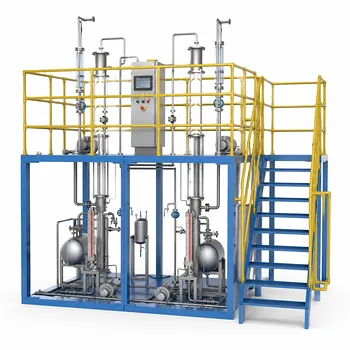
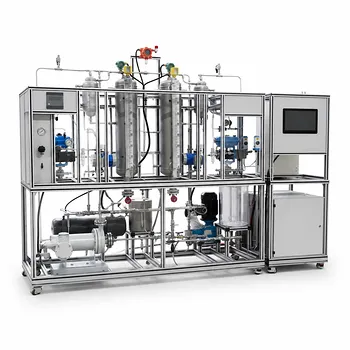
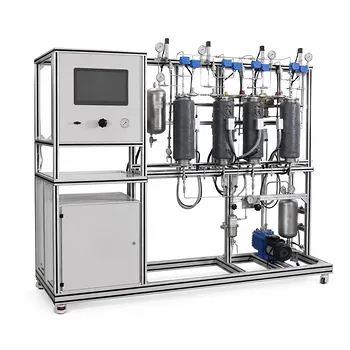
The difference is rooted in a battle between size and solubility. In a membrane gas separation unit operations pilot plant, the solution-diffusion model explains that gas permeability is the product of a molecule’s diffusion coefficient (D) and its solubility in the polymer (S). Glassy polymers, with their rigid backbones, allow smaller molecules to permeate faster because diffusion selectivity (mobility selectivity) dominates. Rubbery polymers, whose flexible chains behave almost like a liquid, allow larger, highly soluble organic vapors to race ahead because solubility selectivity takes over. Configuring a pilot plant with both membrane types lets students directly observe this fundamental trade-off.
The solution-diffusion model reveals that gas separation is never absolute—it is always a balance of
DandS. When configuring an educational pilot plant, the core lesson is that glassy membranes sieve by size, while rubbery membranes sort by solubility, producing radically different separation outcomes for the same gas mixture.
The Solution-Diffusion Model: The Dual-Selectivity Engine
Before students touch a pilot plant valve, they must grasp how dense polymer membranes separate gases without pores. The solution-diffusion model provides that framework.
Three Steps, One Permeability
A gas molecule must dissolve into the membrane’s high-pressure side, diffuse through the material’s free volume, and desorb on the low-pressure side. The rate-limiting factors are solubility (S) and diffusivity (D). Permeability P = D × S captures this. Consequently, membrane selectivity between two gases is the product of mobility selectivity (ratio of diffusion coefficients) and solubility selectivity (ratio of solubilities).
From Theory to the Pilot Plant Measurement
In your unit operations pilot plant, students can measure permeate flux (J) under controlled partial pressure differences (Δp). Using Fick’s law (J = P × Δp / δ), they can back-calculate permeability. This direct measurement anchors the abstract math to real hardware, making the relative importance of D and S tangible.
Glassy Polymers: When Size Rules
Glassy polymers like polysulfone or polyimide possess a stiff, frozen-in backbone. Their structure creates a rigid free-volume distribution that acts as a size-selective molecular sieve.
Mobility Selectivity Dominates
Because the chains are immobile, smaller molecules face much lower resistance to diffusing through the matrix. Hydrogen or helium slip through tiny gaps, while larger hydrocarbons collide with the walls and move sluggishly. In these materials, diffusion selectivity is the heavy-handed ruler. Even if a large hydrocarbon is slightly more soluble, the diffusion penalty is overwhelming; small permanent gases always win the race.
The Pilot Plant Demonstration
Running a mixed H₂/CH₄ feed through a glassy hollow-fiber module will produce a clean, hydrogen-rich permeate. Students see that the membrane rejects methane almost completely, not because methane is less soluble, but because it is physically too large to diffuse quickly. The lesson is etched in the quick pressure rise on the permeate side.
Rubbery Polymers: Solubility Takes the Lead
Think of rubbery polymers—silicone (PDMS) being the classic example—as a high-viscosity liquid. Their flexible chains are in constant thermal motion, which evens out the diffusion rate between small and large molecules.
The Solubility Selectivity Flip
In this liquid-like environment, the obstacle to diffusion melts away. What remains is the gas’s willingness to dissolve, driven by its condensability. Large, easily condensable organic vapors (butane, toluene) have far higher solubility than permanent gases like nitrogen. This solubility selectivity now becomes the dominant separation lever. The surprising result: a bulky butane molecule permeates faster than a tiny oxygen molecule.
Capturing VOCs in the Pilot Plant
A rubbery membrane module fed a nitrogen stream containing a trace of acetone will strip the vapor eagerly, concentrating it on the permeate. Students witness that for vapor recovery applications, a “loose” rubbery material is far more effective than a “tight” glassy sieve—a counterintuitive truth made real. This setup also prevents condensation on the membrane surface because the organics permeate so readily.
Understanding the Trade-offs
No membrane is a universal champion. Configuring a pilot plant without recognizing these limits can turn a clean educational demonstration into a confusing mess.
The Plasticization Pitfall
Glassy polymers are not invulnerable. At high concentrations of highly soluble permeants (like CO₂ or heavy hydrocarbons), these molecules dissolve so aggressively that they pry apart the rigid chains. This plasticization swell increases chain mobility and gradually shifts the membrane from a glassy, diffusion-controlled regime into a rubbery, solubility-controlled one. Permeability spikes, but selectivity collapses. If students operate a glassy module at high partial pressures, their data may no longer illustrate the “sieving” lesson you intended.
When Operating Ranges Mislead
A glassy membrane run at low vapor activity shows size-sieving; the same membrane exposed to a high-boiling solvent may behave entirely differently. In an educational pilot plant, explicitly running a plasticization experiment—gradually increasing a condensable gas’s pressure and tracking the loss of selectivity—teaches students about the practical fragility of membrane performance far better than any textbook graph.
Making the Right Choice for Your Educational Goal
You are the one configuring the experience. Align the membrane and the gas mixture with the principle you want to teach.
- If your primary focus is demonstrating size-sieving separation (e.g., H₂ purification, O₂ enrichment): Select a glassy membrane module and operate at low partial pressures of non-condensable gases to keep diffusion selectivity firmly in control.
- If your primary focus is explaining vapor recovery or solvent dehydration: Use a rubbery membrane module with a mixed feed containing a dilute organic vapor, showing that the larger, condensable component enriches the permeate while permanent gases are rejected.
- If your primary focus is exploring the limits of membrane robustness: Combine both modules and challenge the glassy membrane with increasing concentrations of a plasticizing agent. Contrast its performance collapse with the stable, solubility-driven output of the rubbery module.
The solution-diffusion model does not just live in a derivation; it is a design tool that tells you exactly how to configure your pilot plant to reveal these opposing worlds. Let your students turn the pressure and gas mixture dials until they feel the shift between a sieve and a sponge.
Summary Table:
| Feature / Parameter | Glassy Polymer Membranes | Rubbery Polymer Membranes |
|---|---|---|
| Polymer Structure | Rigid, frozen-in backbone | Flexible, liquid-like chains |
| Dominant Selectivity | Mobility (Diffusion) Selectivity | Solubility Selectivity |
| Separation Principle | Sieves by molecular size | Sorts by condensability/solubility |
| Preferred Permeants | Small molecules (e.g., $H_2$, $He$) | Large, organic vapors (e.g., VOCs, butane) |
| Key Operational Risk | Plasticization at high partial pressures | Membrane swelling (typically stable selectivity) |
Elevate Your Chemical Engineering Lab with LABPARK
Ready to bring hands-on membrane separation concepts to life? LABPARK designs and manufactures high-performance Educational and Vocational Unit Operations Pilot Plants in chemical engineering, bioprocess & biotech, and environmental & water treatment for universities, research institutes, and enterprises.
Our customized pilot plants empower students and researchers to:
- Compare glassy and rubbery membrane separation behaviors in real-time.
- Master gas permeation, diffusion coefficients, and solubility dynamics.
- Test operational boundaries like plasticization using industry-grade control systems.
Contact LABPARK today to discuss your laboratory configuration and request a detailed quote!
Related Products
- Multi-Functional Membrane Separation Educational Pilot Plant for Unit Operations Lab
- Photocatalytic Membrane Separation and Degradation Unit Operations Pilot Plant
- Ultrafiltration Membrane Separation Educational Pilot Plant
- Multifunctional Membrane Separation Educational Pilot Plant with Ultrafiltration, Nanofiltration, Reverse Osmosis
- Gas-Solid Heterogeneous Separation Demonstration Educational Unit Operations Pilot Plant
People Also Ask
- What are the key differences in membrane configurations? Choose the Right Unit Operations Pilot Plant
- How Do Pervaporation, Vapor, and Gas Permeation Differ in Pilot Plants? Key Comparison
- What are the advantages of membrane separation pilot plants? Energy-saving process intensification.
- Pervaporation vs. Vapor Permeation: Handling Suspended Solids in Membrane Pilot Plants
- How do PEI, PVDF, and PSU membranes compare in pilot plants? Find the best fit.