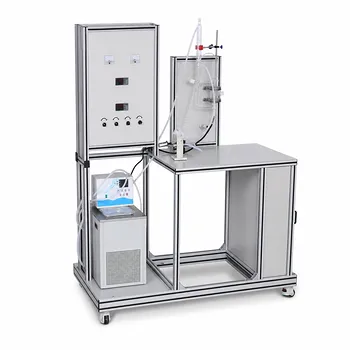
At its core, the division between atmospheric and vacuum distillation is about protecting the hydrocarbons from themselves. In a chemical engineering pilot plant for petroleum refining education, the primary process difference lies in the operating pressure. Atmospheric units run at or near ambient pressure to separate lighter components like gasoline and diesel. Vacuum units, however, drastically reduce pressure to lower the boiling points of heavy residues, preventing them from thermally cracking into unwanted coke and gas. This single operational shift redefines the feed temperature, the product slate, and the very purpose of the column.
The key educational insight is that distillation is not just about adding heat—it’s about manipulating phase equilibrium. Atmospheric distillation teaches the coarse separation of crude oil, while vacuum distillation unlocks the critical lesson of pressure-temperature interdependence, making it possible to recover valuable heavy oils without destroying them.
Operating Pressure: The Defining Difference
How Pressure Defines the Process
Atmospheric distillation operates, as the name suggests, at ambient pressure. The column is essentially open to the atmosphere through its overhead system, giving students a direct feel for how a simple pressure environment governs separation.
Vacuum distillation, in contrast, creates a sub-atmospheric environment (typically below 0.1 bar). This low pressure is the key that allows the separation of high-boiling components at survivable temperatures.
Why Pressure Matters in the Column
The reduced pressure in a vacuum column shifts the entire vapor-liquid equilibrium curve. For a given hydrocarbon, its boiling point drops significantly. Students can physically measure this by tracking the temperature profile at different column stages under vacuum and comparing it to theoretical predictions at 1 atm.
This visible demonstration cements the Clausius-Clapeyron relationship in a way textbooks cannot. A pilot plant lets them turn a vacuum pump knob and watch the boiling point move.
Temperature Limits and Thermal Cracking
The Thermal Ceiling of Atmospheric Units
At atmospheric pressure, crude oil begins to thermally decompose around 630 K (roughly 355–360 °C) . Above this threshold, long hydrocarbon chains start cracking into lighter fragments and, critically, deposit solid carbonaceous coke on hot surfaces.
In a pilot plant, this is a dangerous regime. For education, running an atmospheric column at or above 350 °C risks tarring the internals and providing a false sense of the process, because real refineries never allow this.
How Vacuum Opens the Temperature Window
Vacuum operation completely sidesteps this limit. By pulling the pressure down, heavy vacuum gas oil that might boil at 550 °C at 1 atm can be vaporized at a much cooler 380–400 °C. This stays safely below the cracking threshold.
The pilot plant demonstrates that thermal degradation is not simply about a high number on a thermometer—it is a pressure-dependent phenomenon. Students learn that the same molecule that would crack violently at one pressure can boil placidly at another.
Feedstock and Product Spectrum
The Light Cut in the Atmospheric Column
The atmospheric unit is designed to process the whole crude oil after desalting and preheating (typically 200–240 °C). It neatly fractionates the crude into well-defined cuts like gasoline, kerosene, light diesel, and heavy diesel, each drawn off at different column stages.
This gives students a tangible output. They can collect liquid samples from each tray and run a simple distillation curve, directly linking theoretical plate concepts to real boiling ranges.
The Heavy Heart in the Vacuum Column
The bottom product from the atmospheric column, often called long residue, is a viscous, dark mixture of very high-molecular-weight components. This is the sole feed to the vacuum tower.
In a pilot plant, this feed must be heated to around 380–400 °C under tight vacuum to prevent coking. The vacuum column then splits it into vacuum gas oil (which can be further processed into fuels) and vacuum residue (the base for asphalt or bitumen). For students, this demonstrates that “bottom of the barrel” is a misnomer—it is valuable if you can separate it without destroying it.
Equipment Configuration in a Pilot Plant
Essential Hardware for the Vacuum Switch
To toggle between atmospheric and vacuum operation, the pilot plant must integrate a few specific components. A vacuum pump is the most obvious addition, capable of pulling the system down to the required low absolute pressure.
Equally important are vacuum-rated gaskets, seals, and sight glasses. A standard atmospheric column will simply leak inwards under vacuum, ruining the pressure profile and introducing air that could create flammable mixtures. Pressure sensors and vacuum breakers are mandatory for safe control.
Making the Lesson Visible
The best educational pilot plants include features like a vacuum jacket or heating mantle with precise controls, and multiple thermowells along the column to build a detailed temperature vs. height curve under both modes.
A switching manifold for the feed allows students to run crude through the atmospheric column, collect the residue, and then introduce that residue as feed to the vacuum column—replicating the serial nature of a refinery and solidifying the mass balance concept across two interconnected units.
Understanding the Trade-offs
The Complexity Cost
Running a vacuum distillation unit adds significant operational complexity. Students must learn to manage pump-down times, pressure control valve hysteresis, and the potential for bumping in the reboiler. A simple batch distillation lab becomes a full process control exercise.
This can obscure the core thermodynamic lesson if not carefully guided. A poorly maintained vacuum system will leak, causing inconsistent data and frustration.
Energy and Safety Considerations
Vacuum distillation is often misperceived as “free separation” because boiling points are lower. However, the pilot plant consumes substantial energy to heat the heavy feed to 400 °C, and the vacuum pump itself is an energy consumer.
Safety is also heightened. A vacuum column leak can draw in air, creating an explosive atmosphere inside a hot vessel. Proper interlocks, inert gas purging, and pressure relief systems are non-negotiable, adding layers of cost and training requirements to the pilot plant setup.
How to Configure Your Pilot Plant for Educational Goals
Your choice of operating modes should directly reflect the key principles you want students to master.
- If your primary focus is vapor-liquid equilibrium fundamentals: Start with atmospheric batch distillation of a simple binary mixture. Keep the pressure constant and let students focus solely on temperature-concentration relationships and reflux ratio effects.
- If your primary focus is crude oil fractionation and refinery flow: Invest in a two-column system that physically demonstrates the atmospheric-to-vacuum sequence. Ensure students can analyze each cut’s boiling range and calculate the overall mass balance of the entire charge.
- If your primary focus is advanced process control and safety: Upgrade to a fully automated vacuum column with dynamic pressure control, emergency shutdown logic, and real-time gas chromatography. Use the complexity as a teaching tool for industrial operations.
- If your primary focus is preventing thermal degradation: Run a side-by-side experiment—heat a heavy oil sample in an open beaker at high temperature and compare it to the intact product from the vacuum column. The visual contrast (coke vs. clear oil) makes the lesson permanent.
Every component of the pilot plant, from the vacuum pump to the reflux distributor, should be chosen to illuminate one of these principles clearly. A well-configured unit turns an abstract pressure-temperature chart into a living, breathing process.
Summary Table:
| Feature | Atmospheric Distillation | Vacuum Distillation |
|---|---|---|
| Operating Pressure | Ambient pressure (~1 atm) | Sub-atmospheric (< 0.1 bar) |
| Max Temperature | < 350°C (to prevent thermal cracking) | 380–400°C (lowered boiling points) |
| Primary Feedstock | Whole crude oil (desalted/preheated) | Long residue (atmospheric bottoms) |
| Main Products | Gasoline, kerosene, light/heavy diesel | Vacuum gas oil, vacuum residue (asphalt) |
| Key Equipment | Standard column & open overhead system | Vacuum pump, vacuum-rated seals, heating mantles |
Bring Real-World Refining Processes Into Your Lab
Looking to bridge the gap between thermodynamic theory and industrial practice? LABPARK provides premium Educational and Vocational Unit Operations Pilot Plants in chemical engineering, bioprocess & biotech, and environmental & water treatment. Tailored for universities, research institutes, and enterprises, our pilot plants are engineered to deliver safe, highly visible, and precise hands-on learning experiences.
Whether you need an atmospheric column, a vacuum distillation unit, or a dual-system setup, our experts will help you configure the ideal equipment for your curriculum. Contact LABPARK today to request a customized solution and quote!
Related Products
- Multi-Functional Special Distillation Educational Pilot Plant
- Multi-Modal Distillation Unit Operations Training Pilot Plant
- Continuous Sieve-Plate Distillation Pilot Plant for Unit Operations Laboratory Education
- Green Anhydrous Ethanol Purification Extractive Distillation Unit Operations Training Pilot Plant
- Continuous Batch Extractive Distillation Educational Pilot Plant
People Also Ask
- How does operating pressure influence Methylal/Methanol VLE? Discover its impact on distillation
- Why does simple distillation yield higher efficiency than flash distillation? Key thermodynamic differences.
- Why is thermodynamic consistency testing critical? Validate pilot plant VLE data to avoid costly design errors.
- How Batch vs Continuous Configuration Affects Distillation Pilot Plant Versatility & Footprint
- How does double temperature difference control improve distillation pilot plants? Stabilize purity.