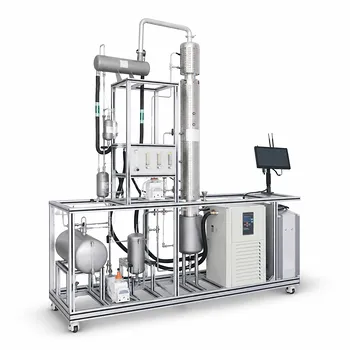
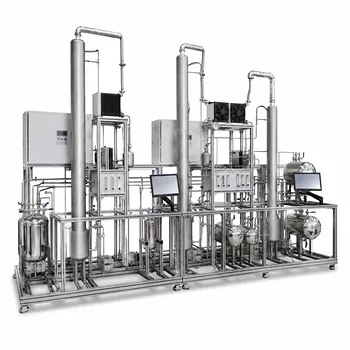
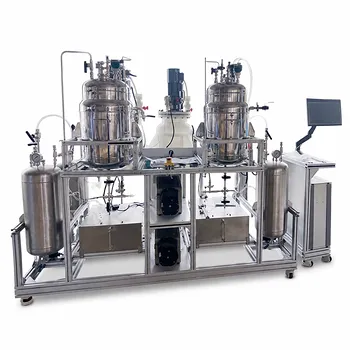
A batch configuration fundamentally increases a distillation pilot plant's versatility while dramatically reducing its physical footprint. Unlike a continuous system that typically requires multiple columns in series to separate a multi-component mixture, a single batch column can process many different components sequentially. This drastically cuts down on the amount of equipment, bench space, and supporting utilities needed in a teaching or research lab.
The core trade-off is adaptability versus process realism. A batch column delivers maximum flexibility and a compact footprint by separating mixtures one fraction at a time, but it operates transiently. A continuous setup models real-world industrial plants but demands more space, especially if multiple product streams are required. The right choice depends on whether your priority is teaching dynamic multi-product behavior or steady-state industrial operations.
How Batch and Continuous Configuration Shapes Versatility
Versatility in a pilot plant means the ability to handle a wide range of feeds, produce multiple high-purity cuts, and teach different chemical engineering concepts in a single system. Batch and continuous configurations approach this in fundamentally different ways.
Multi-Component Separation Capability
A batch distillation column can take a multi-component feed and sequentially separate it into several pure fractions using just one column. The mixture is loaded into the reboiler at the start, and fractions are collected over time in order of increasing boiling point. A continuous system, on the other hand, typically outputs only two product streams (distillate and bottoms) from each column. To achieve three or four high-purity separations, you would need multiple continuous columns in series, which instantly multiplies the equipment count.
Handling Feed Variability and Special Materials
Batch operation shines when you process small, varying quantities or difficult mixtures. You can easily switch from one chemical recipe to another without reconfiguring the plant. Because there is no continuous feed stream, batch stills also handle solids, tars, or polymerizing agents far better—these materials can clog the preheaters, distribution plates, and downcomers of a continuous column. This adaptability makes a batch pilot plant the go-to tool for teaching specialty chemicals, pharmaceuticals, or bioprocess cleaning protocols where feed compositions change frequently.
Operational Flexibility and Teaching Dynamic vs. Steady-State Behavior
A continuous distillation column runs at steady state, with constant compositions at every stage—perfect for teaching material and energy balances and industrial process control. A batch column, by contrast, is inherently dynamic: the reboiler composition depletes over time, and the product purity changes continuously even at a constant reflux ratio. This transient behavior gives students an unmatched view of unsteady-state operations, control strategies, and the principles of fractional collection.
Design advantage: Advanced pilot plants use modular piping and adjustable feed points at multiple column heights. This allows you to switch between full batch mode (heating the mixture directly in the reboiler) and continuous mode (using feed pumps to inject raw material at an intermediate stage), demonstrating both rectifying-only and rectifying-plus-stripping section dynamics in the same physical frame.
Footprint Implications: From a Single Column to a Multi-Column Setup
Footprint is not merely the column’s diameter and height—it encompasses all peripheral equipment, piping, instrumentation, and utilities. The choice of configuration directly dictates how many square meters the pilot plant will demand.
Equipment Count and Space Requirements
A batch system collapses multiple separation stages into one vessel. Because you only need a reboiler, a column with only a rectifying section, a condenser, and a single set of collection vessels, the overall footprint stays minimal. To match that multi-fraction capability, a continuous setup must deploy several full distillation trains (each with its own reboiler, feed system, preheater, and column), which multiplies the required floor space and structural support. For a university lab with limited bench area, this difference can be the deciding factor.
Piping, Instrumentation, and Auxiliaries
Continuous plants demand more complex up-front infrastructure. You need feed pumps, preheaters, level controllers on the reboiler, and often intermediate collection tanks. Batch plants require far less peripheral hardware, making them simpler to install, maintain, and move. Their lower component count also reduces the number of instruments and control loops, cutting both footprint and cost. However, if a pilot plant is designed with quick-connect piping and reconfigurable feed points, you can later add continuous downstream units (like a continuous distillation column) onto an existing batch reactor, achieving high versatility without a dedicated multi-column array from day one.
Understanding the Trade-offs
No configuration is universally superior; each carries distinct limitations that can affect research or teaching outcomes.
- Batch limitations: Because a batch column only has a rectifying section, it cannot perfectly model the stripping section behavior of a full continuous column. This can leave a gap in teaching how the feed plate divides the column. Additionally, the transient nature means students must understand time-varying data, which can be more challenging to interpret than steady-state profiles.
- Continuous limitations: The footprint penalty is real. For a small lab needing to separate four or five components, replicating a full multi-column industrial train is often impractical. Continuous systems are also less forgiving with fouling feeds and require careful cleaning between vastly different mixtures, reducing rapid-turnaround versatility.
- The modular compromise: Many vocational training programs now opt for hybrid designs—a batch reactor feeding a continuous distillation column. This setup trains students on both batch formulation and continuous separation, balancing versatility with industrial relevance without requiring an enormous footprint.
Making the Right Choice for Your Goal
Your decision should be guided by what you need the pilot plant to demonstrate, the range of mixtures you’ll process, and the physical space you can dedicate.
- If your primary focus is teaching multi-component separation and small-batch flexibility: A batch distillation column will give you maximum versatility with the smallest footprint, allowing students to sequentially separate fractions and study dynamic behavior in a single compact unit.
- If your primary focus is demonstrating industrial-scale steady-state operations: A continuous system (even if single-column) provides the authentic experience of constant feed, constant product, and process control loops, but expect a larger footprint and less flexibility for rapid mixture changes.
- If you need to cover both batch formulation and continuous separation: Invest in a pilot plant with modular piping and switchable feed points. This hybrid approach marries the footprint efficiency of batch reactors with the real-world steady-state training of continuous distillation, without duplicating entire column sets.
Ultimately, the configuration you choose will shape not only the lesson plan but also the physical boundaries of your lab. A well-chosen pilot plant turns those constraints into a focused, high-impact learning environment.
Summary Table:
| Feature | Batch Configuration | Continuous Configuration |
|---|---|---|
| Versatility | High; separates multi-components sequentially in one column | Lower; requires multiple columns in series for multi-components |
| Footprint | Compact; minimal equipment, bench space, and auxiliaries | Larger; requires feed pumps, preheaters, and multiple vessels |
| Process Dynamics | Transient/unsteady-state; composition changes over time | Steady-state; constant compositions at every column stage |
| Ideal Application | Teaching dynamic behaviors, specialty chemicals, variable feeds | Modeling industrial process control and steady-state operations |
Optimize Your Engineering Lab with LABPARK
Choosing the right distillation setup is critical to balancing curriculum depth and lab space. LABPARK provides high-quality Educational and Vocational Unit Operations Pilot Plants in chemical engineering, bioprocess & biotech, and environmental & water treatment.
We help universities, research institutes, and enterprises design flexible, space-efficient systems that meet their exact training and research goals.
Ready to configure the ideal pilot plant for your facility? Contact LABPARK today to collaborate with our technical specialists!
Related Products
- Continuous Sieve-Plate Distillation Pilot Plant for Unit Operations Laboratory Education
- Continuous Batch Extractive Distillation Educational Pilot Plant
- Multi-Functional Special Distillation Educational Pilot Plant
- Electrolyte Distillation Purification and Formulation Educational Pilot Plant
- Multi-Modal Distillation Unit Operations Training Pilot Plant
People Also Ask
- Why is vacuum operation capability an essential feature for a distillation unit operations pilot plant? Unlock Efficiency
- How does catalyst water concentration affect distillation pilot plant design? Key separation train choices.
- How to select the right activity coefficient model (Wilson, NRTL, UNIQUAC) for distillation pilot plants?
- What are the primary reflux ratio control strategies? Master Distillation Unit Operations
- How can real-time carbon number prediction improve distillation pilot plants? Optimize control.