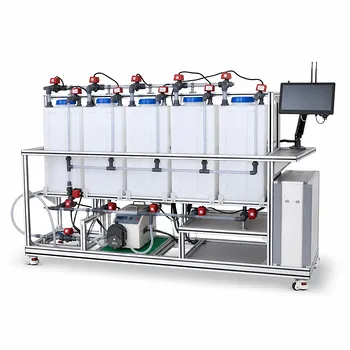
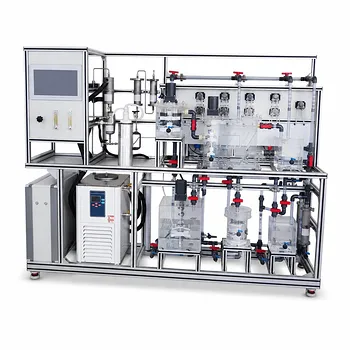
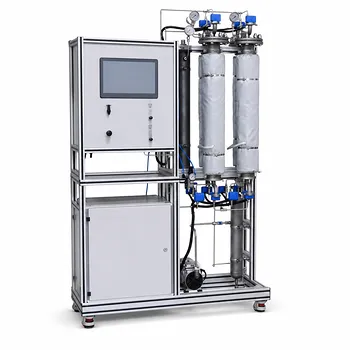
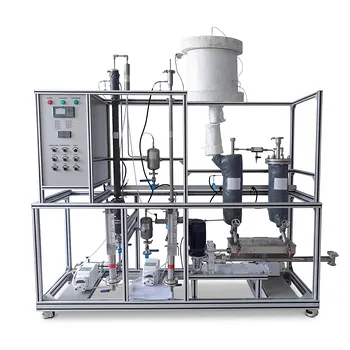
The core of pilot-scale waste sulfuric acid recovery from nitration is a two-step sequence: denitration followed by vacuum concentration. A spent acid stream—containing sulfuric acid, residual nitric acid, water, and organic impurities—is first stripped of volatile nitrogen species, then concentrated under vacuum to bring the sulfuric acid back to a reusable 92.5–95% strength. This mimics the industrial closed-loop approach and lets students directly observe how raw material recycling, waste minimization, and energy management come together in a single teaching unit.
The pilot plant’s real lesson isn’t just the hardware: it’s the choreography of thermal denitration to liberate nitric values and vacuum evaporation to drive water out of the acid without excessive corrosion or decomposition. Together they transform a hazardous waste into a valuable, circular stream.
Why Nitration Creates a Recovery Challenge
The Spent Acid Landscape
After a nitration reaction, the leftover acid phase is a hostile mixture. It holds sulfuric acid (typically 60–75%), 5–10% nitric acid, water, and dissolved or entrained nitro-organics. The sulfuric acid’s strength has dropped because it absorbed reaction water, and the nitric acid must be removed before the acid can be reused in other processes.
The Pilot System’s Role
A pilot-scale teaching plant isn’t just a smaller version of an industrial unit. It’s a controlled environment where each unit operation is exposed, measured, and studied. The plant shows how volatile acids are recovered, how water is driven off without boiling the acid to destructive temperatures, and how these steps collectively reduce waste and chemical purchase costs.
The Two Essential Unit Operations
The pilot-scale recovery train for spent nitration acid relies on denitration and vacuum evaporation as its foundational unit operations. While upstream steps like gravity separation of the crude product may precede acid recovery, the core of acid regeneration rests on this pair.
Denitration: Stripping the Volatile Acid
Denitration removes nitric acid and nitrogen oxides from the spent sulfuric acid. On a pilot scale, this is accomplished by either direct steam stripping or indirect heating in a packed column or a stirred vessel.
In the steam stripping approach, live steam is injected into the hot spent acid. The steam’s heat and stripping action drive off NOₓ gases and decompose residual nitric acid into volatile species. The overhead vapor—a mixture of steam and NOₓ—can be condensed to recover weak nitric acid or routed to an absorption system, closing the nitrogen loop.
In a thermal decomposition arrangement, the acid is simply heated to 110–130°C without steam, allowing nitric acid to decompose according to:
4 HNO₃ → 4 NO₂ + 2 H₂O + O₂
The resulting NO₂ is swept out of the liquid phase.
What makes denitration a distinct unit operation in a pilot plant is the need to balance temperature, residence time, and mass transfer. Too high a temperature can promote the formation of nitrosylsulfuric acid (“chamber crystals”), which fouls equipment. Too low a temperature leaves behind nitric acid that will later concentrate along with the sulfuric acid and create a corrosive, off-spec product.
Vacuum Evaporation: Bringing Concentration Back
After denitration, the sulfuric acid is typically in the 70% range—still too weak for most industrial reuse. Concentration to 92.5–95% is achieved in a vacuum evaporator.
The pilot-scale unit is usually a single-effect, forced-circulation or rising-film vacuum evaporator. By pulling a vacuum (often 50–100 mmHg absolute), the boiling point of the water–sulfuric acid mixture drops dramatically. At 95% strength under atmospheric pressure, the boiling point would exceed 300°C, a regime where hot concentrated acid aggressively attacks most metals and decomposes slightly to SO₃ and water. Under vacuum, evaporation can be driven at a temperature of 150–180°C, keeping corrosion manageable and preserving acid quality.
In the teaching pilot plant, the vacuum evaporator lets students measure heat-transfer coefficients, boil-up rates, and condenser loads. They see firsthand how vacuum management (steam ejectors or liquid ring pumps), vapor-liquid equilibrium, and energy recovery via preheating govern the process economics.
Understanding the Trade-offs and Pitfalls
No unit operation is neutral. On a pilot scale, these trade-offs become learning opportunities.
- Denitration temperature corridors: A narrow window exists between efficient HNO₃ decomposition (>110°C) and unwanted side reactions (>140°C). Pilot-scale operators learn to control the temperature profile to avoid nitrosylsulfuric acid precipitation, which clogs packing and creates a safety risk.
- Vacuum evaporation materials: Even with vacuum, the combination of hot, concentrated sulfuric acid and high velocities demands specialized construction. Pilot plants often use glass-lined steel, tantalum heating elements, or silicon carbide. Any leak of atmospheric air can cause sudden boiling and acid spray.
- Energy footprint: Vacuum evaporation is energy-intensive. Much of the steam’s latent heat is rejected in the condenser. The pilot plant makes this visible through steam consumption meters, pushing students to think about multiple-effect evaporation or mechanical vapor recompression as industrial upgrades.
- Organic carryover: If denitration is incomplete or the upstream product separation was poor, residual organics can concentrate and form tars or carbonaceous residues in the evaporator, degrading heat transfer, and product color.
Making the Right Choice for Your Goal
The sequence of denitration and vacuum evaporation is a proven, teachable approach to recovering nitration spent acid. How you operate and design it depends on what you want to learn or optimize.
- If your primary focus is product-purity education: Emphasize denitration efficiency and off-gas scrubbing. Demonstrate how even traces of residual NOₓ can lower the quality of the recovered sulfuric acid.
- If your primary focus is energy management and sustainability: Use the vacuum evaporator as a platform to test heat integration strategies. Measure the steam-to-evaporation ratio and compare single-effect versus simulated double-effect performance.
- If your primary focus is industrial troubleshooting and safety: Run the plant with deliberate upsets—temperature excursions, air leaks, feed contamination—to show how quickly crystals form or product strength drops.
- If your primary focus is zero-discharge processing: Combine the acid recovery pilot plant with an NOₓ absorption column to recover nitric acid, demonstrating a complete nitrogen-acid loop.
Whether you’re designing a teaching module or an R&D pilot, the denitration–vacuum evaporation pair remains the clearest, most instructive path to turning a corrosive waste into a reusable asset.
Summary Table:
| Unit Operation | Core Purpose | Key Operating Parameter | Primary Pilot Challenge |
|---|---|---|---|
| Denitration | Strips nitric acid & nitrogen oxides from spent acid | Temperature corridor (110–130°C) | Preventing nitrosylsulfuric acid fouling |
| Vacuum Evaporation | Concentrates sulfuric acid to 92.5–95% strength | Vacuum pressure (50–100 mmHg) | Managing corrosion & high energy footprint |
Bring Hands-On Circular Chemistry to Your Lab
Teaching waste minimization and sustainable chemical engineering requires robust, industry-grade equipment. LABPARK provides high-quality Educational and Vocational Unit Operations Pilot Plants in chemical engineering, bioprocess & biotech, and environmental & water treatment.
Designed specifically for universities, research institutes, and enterprises, our pilot systems empower students and researchers to master critical mass-transfer and thermodynamic concepts—like denitration and vacuum evaporation—in a safe, controlled environment.
Ready to elevate your training and research capabilities? Contact LABPARK today to explore our custom pilot-scale solutions!
Related Products
- Solid Waste Pyrolysis and Refining Educational Pilot Plant for Unit Operations
- Multi-Functional Special Distillation Educational Pilot Plant
- Fixed-Bed Chemical Reaction and Gas Dust Tar Removal Unit Operations Pilot Plant
- Methane Cracking Educational Unit Operations Pilot Plant
- Natural Product Extraction Unit Operations Training Pilot Plant
People Also Ask
- How do educational unit operations pilot plants bridge theory and design? Bridge the Engineering Gap
- How do educational unit operations pilot plants address safety and waste management when scaling up?
- When to transition from PID to adaptive control in pilot plants? Key process indicators.
- Why is the chemical plant startup schedule crucial? De-risk scale-up with pilot plants.
- Why Use PTFE & Hastelloy in Chemical Pilot Plants? Prevent Corrosion & Ensure Safety