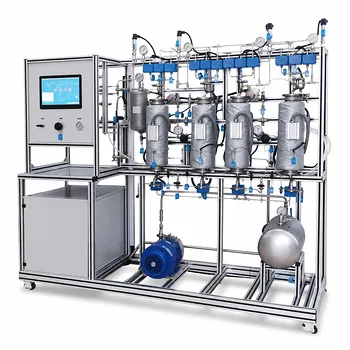
The core of teaching nanoparticle purification lies in contrasting two fundamental separation principles. For a biotechnology or chemical engineering laboratory focused on synthesized magnetic nanoparticles, you should implement magnetic separation and centrifugal separation as your core unit operations. This dual-system approach allows students to directly evaluate efficiency, particle integrity, and process scalability—transforming a simple lab exercise into a deep exploration of downstream processing design.
While many unit operations can isolate solids, the true educational value comes from comparing a particle-specific method (magnetic separation) against a general-purpose force (centrifugation). This direct comparison teaches students to think critically about energy consumption, product loss, and the unique advantages that smart materials bring to industrial separation.
Why Magnetic Separation is the Defining Unit Operation
Harnessing the Particle's Own Property
Magnetic separation is not just a convenience—it is the most logical and illustrative method for these specific materials. By applying an external magnetic field, you can selectively pull the nanoparticle carrier or catalyst out of the reaction mixture without filtering the entire liquid volume.
This technique vividly demonstrates a key concept in green chemical processing: minimizing solvent waste and energy input. It prevents particle aggregation and mechanical damage, offering a gentle, highly selective recovery path that is unique to magnetic materials.
Tight Coupling to Synthesis and Design
Using a magnetic separation unit (such as a simple magnetic rack or a more advanced lab-scale magnetic separator) directly reinforces lessons from the synthesis step. Students immediately see why controlling a particle's magnetic moment and size was critical—a weak magnetic response leads to poor separation.
This creates a powerful feedback loop in the curriculum. The student who synthesizes poorly coated nanoparticles will visibly struggle to isolate them, cementing the importance of reaction control and particle engineering far better than a written exam could.
Centrifugal Separation as the Essential Comparative Benchmark
A Universal Baseline for Solid-Liquid Separation
A high-speed laboratory centrifuge (operating in the 9,000–10,000 r/min range) serves as the necessary point of comparison. It represents the industry-standard, magnetism-agnostic approach. Every bioprocess engineer must understand how centrifugal force alone can harvest cells, precipitates, or any particulate.
By having students centrifuge their magnetic nanoparticles, you force them to confront its universal applicability but also its blindness—it pelletes everything at the bottom, including non-magnetic impurities that a magnetic step would leave behind.
Teaching the Pillars of Downstream Processing
The centrifuge unit becomes a practical tool for teaching core engineering equations, including Stokes' law and the sigma factor. Students can calculate the settling velocity of their synthesized particles and then verify how factors like particle diameter, density difference, and rotational speed physically change the pellet compactness and supernatant clarity.
This hands-on measurement turns the centrifuge from a “black box” into a predictable, optimizable unit operation. It also introduces the concept of scalability—moving from a batch spin to a continuous-flow centrifuge, as seen in pilot plants.
Understanding the Trade-offs
Selectivity vs. Universality
The most critical lesson for students is that a perfect separator does not exist. Magnetic separation offers exquisite selectivity—it targets only the magnetic particle. This yields high purity and low catalyst loss but fails completely if the particles lose their magnetism or are not truly magnetic. The centrifuge works on everything, guaranteeing recovery but sacrificing selectivity unless paired with other purification steps.
Product Quality and Energy Footprint
Your laboratory setup can also expose the hidden costs. Magnetic separation is a low-energy, gentle process that preserves surface coatings and prevents particle aggregation driven by high g-forces. Centrifugation, while fast, can shear sensitive functional groups or compress particles into a hard aggregate that is difficult to resuspend for medical applications. Frame these trade-offs as a laboratory-scale model for the energy and product quality debates that dominate full-scale chemical plant design.
The Educational Trap of "Easy" Solutions
A common pitfall is allowing students to default to the centrifuge because it is familiar. The recommended approach is to design a protocol where magnetic separation is the primary harvest step, and centrifugation is used for polishing the remaining supernatant or processing a control sample of non-magnetic particles. This forces an active comparison, preventing the misconception that separation is a solved problem with a one-size-fits-all tool.
Making the Right Choice for Your Teaching Goal
Selecting the final configuration of unit operations should be driven by the deep educational outcome you want to prioritize. A combined station is always best, but your emphasis can shift.
- If your primary focus is green chemistry and smart materials: Prioritize a high-visibility magnetic separation station. Use a clear vessel where students can watch the black carrier move to the magnet, showcasing minimal energy input and solvent reuse.
- If your primary focus is core bioprocess engineering fundamentals: Make the high-speed centrifuge the central analytical tool. Require detailed calculations of separation efficiency, recovery rates, and scale-up factors for industrial deployment.
- If your primary focus is bridging to industrial pilot-plant training: Integrate these lab units with a discussion of continuous-flow centrifuges and automated magnetic separators. Link the manual batch steps to a larger vision of sensor-monitored, automated downstream processing.
- If your primary focus is comparing downstream options in a design project: Challenge students to justify their sequence of unit operations with data. They must prove, using product yield and purity from both the magnet and centrifuge, why one route is superior for a specific medical or catalytic application.
The right laboratory isn't the one with the most expensive equipment, but the one that turns a seemingly simple separation into a formative lesson in selectivity, scalability, and sustainable process design.
Summary Table:
| Feature | Magnetic Separation | Centrifugal Separation |
|---|---|---|
| Separation Principle | External magnetic field attraction | Rotational force (G-force) / sedimentation |
| Selectivity | High (recovers magnetic particles only) | Low (pellets all dense solids/impurities) |
| Particle Impact | Gentle; prevents aggregation | Harsh; potential shear stress & compaction |
| Key Educational Value | Smart materials & green chemistry concepts | Stokes' law, sigma factor & industrial scale-up |
Enhance Your Engineering Curriculum with LABPARK Pilot Plants
Provide your students with hands-on training in downstream processing. LABPARK designs and supplies premium Educational and Vocational Unit Operations Pilot Plants in chemical engineering, bioprocess & biotech, and environmental & water treatment.
Whether you are upgrading a university laboratory, research institute, or enterprise training center, our pilot-scale equipment bridges the gap between laboratory benchtop chemistry and full-scale industrial operations.
Contact our experts today to build your customized laboratory solution!
Related Products
- Multi-Functional Membrane Separation Educational Pilot Plant for Unit Operations Lab
- Ion Exchange Water Purification Educational Pilot Plant for Engineering Unit Operations
- Hot Filtration Educational Unit Operations Pilot Plant Laboratory System
- Bench Scale Carbon Dioxide Capture Educational Unit Operations Pilot Plant
- Multi Functional Membrane Crystallization Educational Unit Operations Pilot Plant
People Also Ask
- What are the key differences in membrane configurations? Choose the Right Unit Operations Pilot Plant
- How do membrane separation pilot plants teach RO limits? Master osmotic pressure dynamics.
- How Do Pervaporation, Vapor, and Gas Permeation Differ in Pilot Plants? Key Comparison
- How do temperature and pH affect membrane conductivity? Pilot Plant Guide
- How do polymer membranes restrict gas separation? Key pilot plant limits.