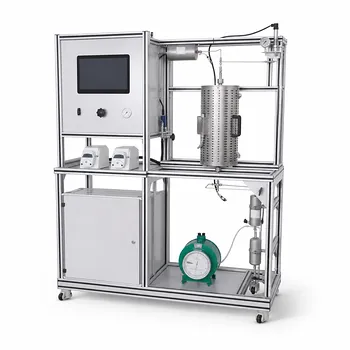
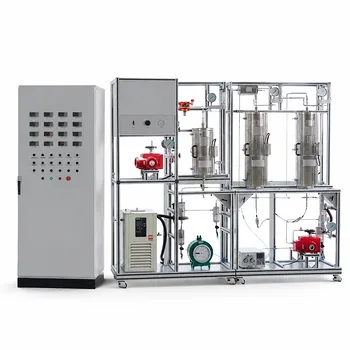
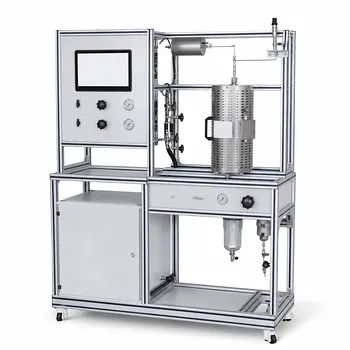
The heart of any biotech unit operations pilot plant is its enzymatic reactor configuration. To effectively demonstrate the principles of biocatalysis, three configurations are non-negotiable: a fixed-bed reactor for immobilized enzymes or cells, a fluidized-bed (or semi-fluidized-bed) reactor for optimal mixing and mass transfer, and a membrane reactor to retain soluble enzymes during continuous operation. These three systems collectively allow students to dissect mass transfer resistance, validate enzyme kinetics, and compare the practical performance of different catalyst immobilization strategies.
Core Takeaway
Equipping a pilot plant with only a stirred tank overlooks the essence of enzyme reaction engineering. A fixed-bed, a fluidized-bed, and a membrane reactor form the essential triad that exposes students to the real-world interplay of diffusion, kinetics, and catalyst retention — the very phenomena that dictate industrial biocatalysis design.
The Three Pillars of Biocatalytic Reactor Design
An educational pilot plant must move beyond simple batch reactions. The following three reactor configurations each illuminate a distinct, critical facet of enzyme-based processing.
Fixed-Bed Reactors: The Workhorse for Immobilized Biocatalysts
Fixed-bed reactors pack immobilized enzymes or whole cells into a column, allowing the substrate solution to flow through. This is the most straightforward way to conduct continuous biocatalysis.
Because the catalyst is held in place, separation is trivial — the product stream exits particle-free. The configuration forces students to encounter mass transfer resistance directly, as substrate must diffuse into the porous carrier to reach the active site, while product must diffuse out. By varying flow rates and catalyst particle size, one can isolate the effect of external and internal mass transfer on the observed reaction rate.
Fluidized-Bed Reactors: Overcoming Pressure Drop and Mass Transfer Limits
A fluidized-bed reactor suspends solid immobilized-enzyme particles by an upward stream of liquid. The particles move freely, behaving like a well-mixed fluid.
This design fundamentally changes the mass transfer landscape compared to a fixed bed. The movement around each particle dramatically reduces the stagnant film layer, enhancing the transport of substrates to the enzyme surface. Critically, fluidization eliminates the high pressure drop and channeling that plague packed columns, making it ideal for feeds with suspended solids or for reactions that require a tighter control of mixing. Students can directly compare the conversion efficiency against a fixed bed under identical catalyst loadings to grasp the concrete trade-off between mixing energy and mass transfer enhancement.
Membrane Reactors: Retaining Soluble Enzymes for Continuous Use
A membrane reactor employs a semi-permeable barrier to physically confine free, soluble enzymes while allowing reactants and products to pass. This configuration achieves two things that immobilized-enzyme reactors cannot: it retains the native catalytic efficiency of soluble enzymes (no immobilization-induced kinetic penalties) and simultaneously simplifies downstream separation.
By continually removing product and adding fresh substrate, the reactor can operate continuously, overcoming product inhibition and shifting equilibrium. This setup is the perfect platform to investigate how enzyme stability in the free form, membrane fouling, and flow dynamics dictate process longevity — a set of challenges central to fine-chemical and pharmaceutical biocatalysis where soluble enzymes are often preferred for their high activity and specificity.
Unlocking Educational Value Through These Configurations
These reactors are not just hardware; they are physical frameworks for teaching the underlying science of bioprocess engineering.
Decoupling Mass Transfer Resistance and Kinetics
When students run the same enzyme on the same carrier in a fixed bed and a fluidized bed, the difference in observed rate is a direct window into mass transfer limitations. They learn that the intrinsic kinetics are only part of the story, and that reactor hydrodynamics can dominate performance. The membrane reactor then provides a baseline of true kinetic control, eliminating all intraparticle diffusion effects, so students can calculate the Thiele modulus and effectiveness factor with genuine experimental data.
Comparing Immobilization Strategies and Operational Modes
The pilot plant becomes a living laboratory to contrast operational philosophies. A fixed bed demonstrates continuous, plug-flow behavior with maximum enzyme density; a fluidized bed shows how continuous-stirred-tank behavior and better heat/mass transfer can be achieved at the cost of some enzyme attrition; and a membrane reactor showcases how the most active enzyme form can be used continuously without being physically altered. Running experiments like starch hydrolysis with amylase (enzyme-catalyzed, mild conditions) against acid-catalyzed hydrolysis quantitatively demonstrates the reduction in activation energy — from 107 kJ/mol down to 36 kJ/mol for sucrose – and why enzymatic processes are inherently energy-efficient.
Integrating Downstream Processing for a Complete Picture
Though not the reactor itself, these configurations naturally integrate with downstream unit operations. A fixed bed requires simple filtration to catch any fines; a membrane reactor is itself a separator; and a fluidized bed often needs a settling or recycle loop. Coupling these reactors with in-line UV-Vis spectrophotometers and pH probes — as in a GOx/CuBDC cascade reaction — lets students observe real-time reaction kinetics, optimize dissolved oxygen and substrate feed rates, and truly understand the dynamics of biocatalytic scale-up beyond a beaker.
Understanding the Trade-offs
No single reactor configuration is universally superior. Trust comes from acknowledging the limitations.
- Fixed-bed reactors suffer from high pressure drops, channeling, and the potential for compression of soft gel carriers. They are poorly suited for gas-evolving reactions or feeds containing particulates.
- Fluidized-bed reactors require precise control of flow velocity to maintain fluidization without washing out the particles. Particle attrition and erosion can degrade the catalyst over time, and back-mixing can reduce overall conversion compared to plug flow.
- Membrane reactors face the inevitable challenge of concentration polarization and fouling, which gradually reduce flux and enzyme retention. Enzyme stability in the free state under continuous operation must be meticulously evaluated, as heat or shear can deactivate the catalyst faster than in an immobilized form.
A pilot plant that only demonstrates the success cases fails to teach. These trade-offs are the real engineering curriculum, forcing optimization between catalyst life, mass transfer, pressure drop, and product purity.
Making the Right Choice for Your Educational Goals
Designing your pilot plant’s reactor suite should map directly to the learning outcomes you value most. Here is how to prioritize:
- If your primary focus is teaching core reaction engineering fundamentals: Begin with a jacketed, instrumented fixed-bed reactor. It is the simplest continuous system and provides the clearest data on internal and external mass transfer effects.
- If your primary focus is hands-on process development for real industrial feeds: Include a fluidized-bed reactor. It prepares students for operations with high-viscosity streams, particulate-laden media, or reactions that demand superior mixing and temperature control.
- If your primary focus is demonstrating integrated, continuous biomanufacturing with soluble enzymes: A membrane reactor is irreplaceable. It teaches the principles of simultaneous reaction and separation, and helps quantify the true economic balance between catalyst replacement costs and operational simplicity.
- If your goal is a comprehensive, R&D-ready unit ops lab: Integrate all three. Their comparative data forms the backbone of an evidence-based mindset, enabling experiments that correlate reactor hydrodynamics with observed kinetics and immobilization efficiency.
When a student can walk from a fixed bed, to a fluidized bed, to a membrane reactor and explain why the rate, selectivity, and stability shift in each, they have not just learned biocatalysis — they have learned how to think like a process engineer.
Summary Table:
| Reactor Type | Key Mechanism | Best Used For | Main Trade-off |
|---|---|---|---|
| Fixed-Bed | Packed column with immobilized catalysts | Analyzing internal/external mass transfer | High pressure drops & channeling |
| Fluidized-Bed | Upward flow suspending catalyst particles | Handling suspended solids & optimizing mixing | Particle attrition & catalyst wash-out |
| Membrane | Semi-permeable barrier retaining soluble enzymes | Continuous operation without immobilization loss | Membrane fouling & polarization |
Build a World-Class Bioprocess Lab with LABPARK
Are you looking to enhance hands-on learning and research? LABPARK designs and manufactures industry-grade Educational and Vocational Unit Operations Pilot Plants in chemical engineering, bioprocess & biotech, and environmental & water treatment for universities, research institutes, and enterprises.
Our custom pilot plants empower your students and researchers to master real-world biocatalysis, mass transfer kinetics, and reactor dynamics. Contact LABPARK today to find the perfect configuration for your lab!
Related Products
- Multi Functional Catalytic Reaction and Reactor Evaluation Educational Unit Operations Pilot Plant
- Methanol Synthesis and Catalyst Performance Evaluation Educational Unit Operations Pilot Plant
- Fixed-Bed Chemical Reaction and Gas Dust Tar Removal Unit Operations Pilot Plant
- 100L Continuous Loop Hydrogenation Educational Unit Operations Pilot Plant
- Micro-Scale Gas-Solid Catalytic Reaction Educational Pilot Plant
People Also Ask
- What reaction engineering principles are shown in a catalytic reactor pilot plant? SO2 Oxidation Guide
- Why is FTIR integration in catalytic pilot plants important? Real-Time Student Insights
- How to analyze active metal distribution & identify catalyst poisoning in pilot plants? Expert Diagnostic Guide
- How do temperature limits and WHSV influence catalytic reactor optimization? Scale-Up Guide
- Why is XPS Critical for Catalytic Reactor Pilot Plants? Optimize Catalyst Performance