A cake crack is a silent process-killer that instantly ruins filtration efficiency, while chemical incompatibility can destroy both the filter media and your vacuum pump. If the filter cake cracks, you must immediately stop the operation and physically compress the solid bed to seal the breach. If your solution is highly acidic or alkaline, you must abandon standard cellulose paper entirely in favor of chemically inert glass fiber or a sintered glass frit, and always install a safety trap to protect your pump.
Cracks are not just a visual defect; they represent a catastrophic loss of differential pressure that channels wash solvents away from impurities. The fix is mechanical intervention, not a change in vacuum. Meanwhile, aggressive chemistry requires a material swap—your standard filter paper is a consumable that will fail, contaminating your product and damaging your equipment.
Resolving the Immediate Mechanical Failure: The Cracked Cake
A crack transforms a precision separation device into a crude bypass channel. The underlying need here isn't just to fix a physical gap, but to restore the hydraulic integrity required for effective purification and drying.
Why a Tiny Crack Destroys the Entire Process
The filter cake itself is the true filtration medium. Once solids accumulate, they create a dense, tortuous path that captures fine particles. A crack creates a low-resistance shortcut. The vacuum pump will preferentially pull air through this path rather than through the tight pore structure of the cake. The pressure differential collapses, and liquid flow through the un-cracked areas essentially stops.
The Immediate Mechanical Fix
You must physically re-compress the solid bed. The primary reference specifies using a clean glass stopper or flat tool. This isn't a delicate tap; you need to press firmly to collapse the channel and blend the surrounding wet cake back together. In larger settings, this "cake-smoothing" action might use an agitator. The goal is to eliminate the void and recreate a uniform, resistive medium.
Crack Prevention Through Observation
In a closed system, you won't always see the crack. Watch for diagnostic indicators. An abnormally fast drop in the liquid meniscus during deliquoring signals a bypass. More critically, if final product purity fails due to washable impurities, it proves that wash solvents took the cracked shortcut and left most of the cake untouched. Address the crack before initiating any wash cycle.
Handling Aggressive Chemistry: Corrosion is Not an Option
The deep need here is material compatibility. A process is only as robust as its weakest component. When dealing with strong acids or alkalis, two critical points of failure emerge: the filter media itself and the vacuum pump downstream.
Protecting the Filter Media from Dissolution
Standard cellulose filter paper is a carbohydrate polymer. Strong acids will hydrolyze it, and strong alkalis will cause it to swell and disintegrate. Glass fiber filters are the standard replacement. They are inherently inert and provide excellent chemical resistance. Sintered glass frits offer an even more robust, reusable solution for aggressive oxidizing agents that might attack organic binders in some glass fiber papers.
The Critical Role of the Safety Trap
Your vacuum pump is a potential victim of both liquid and vapor carryover. Corrosive vapors will attack internal metal components, destroying seals and drastically shortening pump life. A safety trap bottle is non-negotiable. This is placed in-line between the receiving flask and the vacuum source. It acts as a knockout pot, condensing vapors and catching any liquid splashes before they reach the pump.
Understanding the Trade-offs
No solution is without its downsides. Addressing these issues requires accepting certain compromises in process economics or performance.
The Physical Fix’s Limitation
Compressing a cracked cake is a reactive repair, not a guarantee of perfection. Deep, extensive cracking networks can be difficult to fully seal, and aggressive mechanical pressing can sometimes force fine particles into the filter medium’s pores, permanently reducing flow rates.
The Permeability Challenge of Glass Fiber
While chemically inert, glass fiber filters typically have slower flow rates and lower particle retention than a fine-porosity cellulose paper. A sintered glass frit offers excellent retention but can be expensive, fragile, and difficult to clean if particles become trapped deep in the pores. You are often trading chemical robustness for a slight decrease in speed or an increase in maintenance complexity.
Making the Right Choice for Your Process
Your response depends entirely on the root cause you're diagnosing or the chemical nature you're managing.
- If your primary focus is maximizing product purity: Do not ignore rapid deliquoring rates or assume a visual inspection is enough. Physically smooth and seal the cake before introducing any wash solvent.
- If your primary focus is operational safety with strong acids or alkalis: Replace the entire consumable train with a glass frit funnel and a glass fiber filter, and verify that your trap bottle is correctly sealed and contains an inert fluid to neutralize vapors.
- If your primary focus is protecting capital equipment from corrosion: Regularly inspect the trap bottle and replace the vacuum pump oil frequently, as trace acid vapors will inevitably migrate over time and degrade the lubricant.
A robust vacuum filtration process isn't just about applying suction; it's a manual art of maintaining cake integrity and a chemical discipline of selecting inert materials.
Summary Table:
| Issue | Impact on Filtration | Troubleshooting Action |
|---|---|---|
| Filter Cake Cracks | Loss of vacuum pressure & bypass of wash solvents | Compress and smooth the cake using a clean glass stopper |
| Acidic/Alkaline Solutions | Media degradation & vacuum pump corrosion | Switch to glass fiber/sintered frits & install a safety trap |
Optimize Your Unit Operations with LABPARK
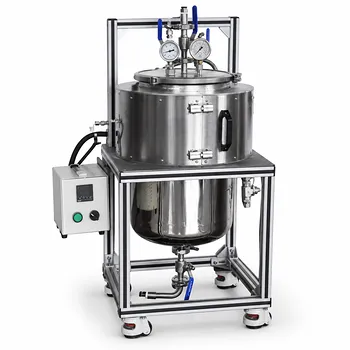
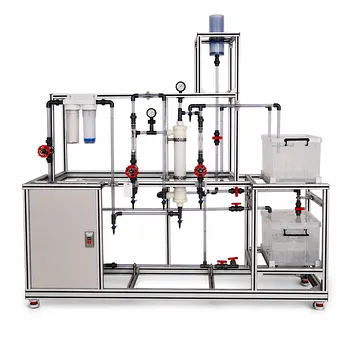
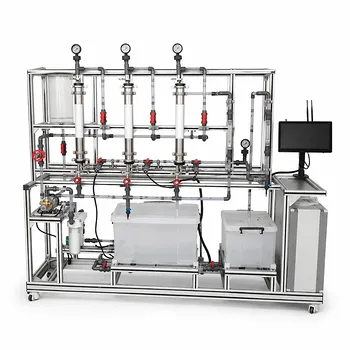
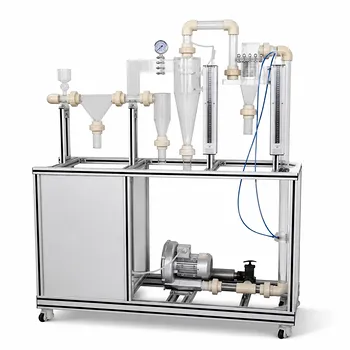
Whether you are training the next generation of engineers or scaling up chemical processes, equipment reliability and safety are paramount. LABPARK provides state-of-the-art Educational and Vocational Unit Operations Pilot Plants in chemical engineering, bioprocess & biotech, and environmental & water treatment for universities, research institutes, and enterprises.
Ensure your laboratory operates with industry-grade precision, safety, and efficiency. Contact LABPARK today to find the perfect pilot plant solution for your facility!
Related Products
- Constant Pressure Filtration Educational Unit Operations Pilot Plant
- Hot Filtration Educational Unit Operations Pilot Plant Laboratory System
- Multi-Functional Special Distillation Educational Pilot Plant
- Ultrafiltration Membrane Separation Educational Pilot Plant
- Multifunctional Membrane Separation Educational Pilot Plant with Ultrafiltration, Nanofiltration, Reverse Osmosis
People Also Ask
- How do educational unit operations pilot plants bridge theory and design? Bridge the Engineering Gap
- How do educational unit operations pilot plants address safety and waste management when scaling up?
- Why splitting a filtration batch doesn't always reduce cycle time? Pilot Plant Insights
- Why Demo Constant-Rate to Constant-Pressure Filtration on a Pilot Plant? Key Practical Insights
- How to select solid-liquid separation equipment for pilot plants? A Step-by-Step Guide